

includes evaporation from the sea, the transportation of water to land, water
recycling through plant evapotranspiration, and the water stock, which is affected
by organic matter and the composition of earth’s crust. For example, the crust of
Africa, South America, and Australia, which is composed of Si rock, is poor in
nutrients and has a quite low water-holding capacity. When we discuss biomass
production on a global scale, water dynamics and geology are the most important
factors, and information on these factors is, unfortunately, very limited.
6.1.2.3 Map of Soil Carbon Distribution
The annual greenhouse gas emissions from fossilized carbon are estimated at 8.9
giga t (tonnes) C (8.9 Â 10
15 g), and the global soil C stock to a soil depth of 2 m is
estimated at 2400 giga t (2400 Â 10
15 g) (Batjes 1996). Comparing the global
anthropogenic C emissions and the total soil organic carbon (SOC) stock (8.9/2400)
results in a value of 0.4% or 4‰ (4 per mille) (Minasny et al. 2017). If the land area
of the world is 149 million km
2 , then it is estimated that on average, there are 161 t of
SOC per hectare. Therefore, a value of 4 per mille equates to an average sequestration rate of 0.6 t of C per hectare per year to offset emissions. This blanket value
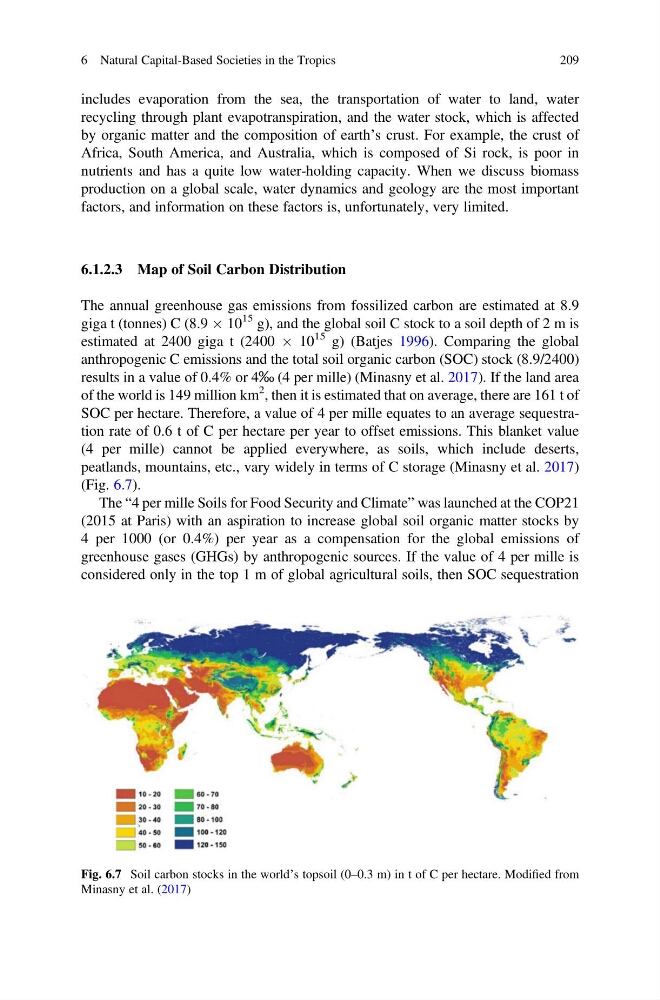
(4 per mille) cannot be applied everywhere, as soils, which include deserts,
peatlands, mountains, etc., vary widely in terms of C storage (Minasny et al. 2017)
(Fig. 6.7).
The “4 per mille Soils for Food Security and Climate” was launched at the COP21
(2015 at Paris) with an aspiration to increase global soil organic matter stocks by
4 per 1000 (or 0.4%) per year as a compensation for the global emissions of
greenhouse gases (GHGs) by anthropogenic sources. If the value of 4 per mille is
considered only in the top 1 m of global agricultural soils, then SOC sequestration
Fig. 6.7 Soil carbon stocks in the world’s topsoil (0–0.3 m) in t of C per hectare. Modified from
Minasny et al. (2017)
6 Natural Capital-Based Societies in the Tropics
209
recycling through plant evapotranspiration, and the water stock, which is affected
by organic matter and the composition of earth’s crust. For example, the crust of
Africa, South America, and Australia, which is composed of Si rock, is poor in
nutrients and has a quite low water-holding capacity. When we discuss biomass
production on a global scale, water dynamics and geology are the most important
factors, and information on these factors is, unfortunately, very limited.
6.1.2.3 Map of Soil Carbon Distribution
The annual greenhouse gas emissions from fossilized carbon are estimated at 8.9
giga t (tonnes) C (8.9 Â 10
15 g), and the global soil C stock to a soil depth of 2 m is
estimated at 2400 giga t (2400 Â 10
15 g) (Batjes 1996). Comparing the global
anthropogenic C emissions and the total soil organic carbon (SOC) stock (8.9/2400)
results in a value of 0.4% or 4‰ (4 per mille) (Minasny et al. 2017). If the land area
of the world is 149 million km
2 , then it is estimated that on average, there are 161 t of
SOC per hectare. Therefore, a value of 4 per mille equates to an average sequestration rate of 0.6 t of C per hectare per year to offset emissions. This blanket value
(4 per mille) cannot be applied everywhere, as soils, which include deserts,
peatlands, mountains, etc., vary widely in terms of C storage (Minasny et al. 2017)
(Fig. 6.7).
The “4 per mille Soils for Food Security and Climate” was launched at the COP21
(2015 at Paris) with an aspiration to increase global soil organic matter stocks by
4 per 1000 (or 0.4%) per year as a compensation for the global emissions of
greenhouse gases (GHGs) by anthropogenic sources. If the value of 4 per mille is
considered only in the top 1 m of global agricultural soils, then SOC sequestration
Fig. 6.7 Soil carbon stocks in the world’s topsoil (0–0.3 m) in t of C per hectare. Modified from
Minasny et al. (2017)
6 Natural Capital-Based Societies in the Tropics
209