

5.9 Innovation in Social Security
The MRV is also important for evaluating the sustainable development goals (SDGs)
in tropical peatland. SDGs are also increasingly used as indices for banks and
investors in determining their investments. For example, these institutions may
stop investing in companies that are neglectful of environment, social, governance
(ESG) and socially responsible investments (SRI) that farm oil palms in tropical
peatlands, decreasing their ABCDEFGs of security in SDGs components as follows
(Fig. 5.20):
– Aquatic/water security: Water reservoir ecosystem
– Biodiversity security: High biodiversity by mixed planting and nature conservation around the peat dome
– Climate change security: Mitigation as carbon emission reduction and adaptation
as high biomass production (sufficient water) against El Niño
– Disaster security: Fire and haze protection
– Energy security: Biomass energy from sago starch and residuals and other
biomass materials in the sago-based ecosystem
– Food/feed security: Sago starch for food and feed (animal husbandry and fish
culture)
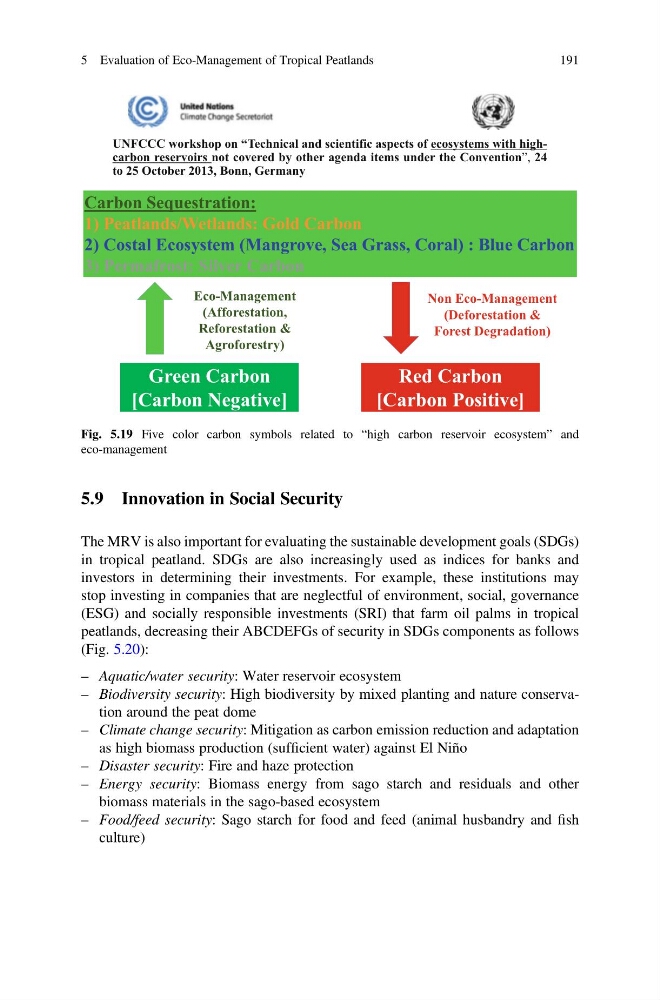
UNFCCC workshop on “Technical and scientific aspects of ecosystems with highcarbon reservoirs not covered by other agenda items under the Convention”, 24
to 25 October 2013, Bonn, Germany
Carbon Sequestration:
1) Peatlands/Wetlands: Gold Carbon
2) Costal Ecosystem (Mangrove, Sea Grass, Coral) : Blue Carbon
3) Permafrost: Silver Carbon
Red Carbon
[Carbon Positive]
Non Eco-Management
(Deforestation &
Forest Degradation)
Eco-Management
(Afforestation,
Reforestation &
Agroforestry)
Green Carbon
[Carbon Negative]
Fig. 5.19 Five color carbon symbols related to “high carbon reservoir ecosystem” and
eco-management
5 Evaluation of Eco-Management of Tropical Peatlands
191
The MRV is also important for evaluating the sustainable development goals (SDGs)
in tropical peatland. SDGs are also increasingly used as indices for banks and
investors in determining their investments. For example, these institutions may
stop investing in companies that are neglectful of environment, social, governance
(ESG) and socially responsible investments (SRI) that farm oil palms in tropical
peatlands, decreasing their ABCDEFGs of security in SDGs components as follows
(Fig. 5.20):
– Aquatic/water security: Water reservoir ecosystem
– Biodiversity security: High biodiversity by mixed planting and nature conservation around the peat dome
– Climate change security: Mitigation as carbon emission reduction and adaptation
as high biomass production (sufficient water) against El Niño
– Disaster security: Fire and haze protection
– Energy security: Biomass energy from sago starch and residuals and other
biomass materials in the sago-based ecosystem
– Food/feed security: Sago starch for food and feed (animal husbandry and fish
culture)
UNFCCC workshop on “Technical and scientific aspects of ecosystems with highcarbon reservoirs not covered by other agenda items under the Convention”, 24
to 25 October 2013, Bonn, Germany
Carbon Sequestration:
1) Peatlands/Wetlands: Gold Carbon
2) Costal Ecosystem (Mangrove, Sea Grass, Coral) : Blue Carbon
3) Permafrost: Silver Carbon
Red Carbon
[Carbon Positive]
Non Eco-Management
(Deforestation &
Forest Degradation)
Eco-Management
(Afforestation,
Reforestation &
Agroforestry)
Green Carbon
[Carbon Negative]
Fig. 5.19 Five color carbon symbols related to “high carbon reservoir ecosystem” and
eco-management
5 Evaluation of Eco-Management of Tropical Peatlands
191