

water management,” (2) evaluating eco-management by (semi-)real-time “Integrated
MRV Systems,” from which all forest values will be enhanced by both biomass
production and utilization (which was wasted by carbon neutral system) [economybased VCs] and natural capital function [ecology-based VCs]. Thus, when economybased VCs and ecology-based VCs are compatible, “carbon negative” status will
eventually be achieved because biomass energy will be provided to local society,
and biochar will contribute to carbon sequestration, improving soil fertility, and
contributing to increased biomass productivity while enhancing natural capital.
Finally, to operate “large-scale eco-management of tropical peatland,” it is
necessary to establish reliable evaluation systems using monitoring on the ground
level, remote sensing from the air (drone and satellite), and modeling based on data
and information obtained through monitoring and sensing activities. As the evaluation system for the “large-scale eco-management of tropical peatland” is currently
under development, however, this topic will be published in the next book entitled
“Tropical Peatland Eco-Evaluation.” Here, basic monitoring and sensing mechanisms are only described.
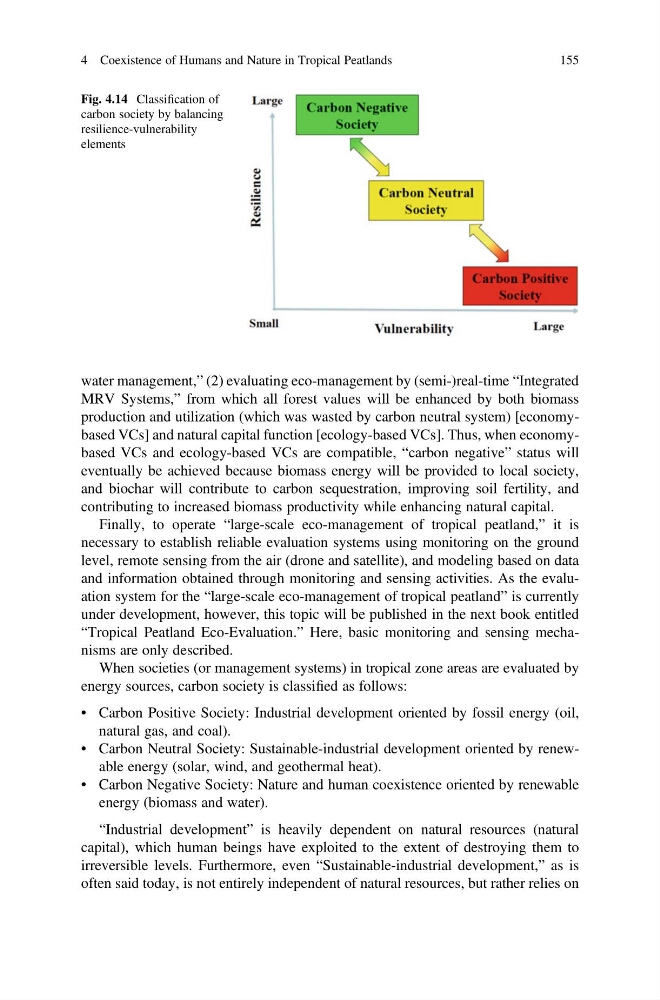
When societies (or management systems) in tropical zone areas are evaluated by
energy sources, carbon society is classified as follows:
• Carbon Positive Society: Industrial development oriented by fossil energy (oil,
natural gas, and coal).
• Carbon Neutral Society: Sustainable-industrial development oriented by renewable energy (solar, wind, and geothermal heat).
• Carbon Negative Society: Nature and human coexistence oriented by renewable
energy (biomass and water).
“Industrial development” is heavily dependent on natural resources (natural
capital), which human beings have exploited to the extent of destroying them to
irreversible levels. Furthermore, even “Sustainable-industrial development,” as is
often said today, is not entirely independent of natural resources, but rather relies on
Fig. 4.14 Classification of
carbon society by balancing
resilience-vulnerability
elements
4 Coexistence of Humans and Nature in Tropical Peatlands
155
MRV Systems,” from which all forest values will be enhanced by both biomass
production and utilization (which was wasted by carbon neutral system) [economybased VCs] and natural capital function [ecology-based VCs]. Thus, when economybased VCs and ecology-based VCs are compatible, “carbon negative” status will
eventually be achieved because biomass energy will be provided to local society,
and biochar will contribute to carbon sequestration, improving soil fertility, and
contributing to increased biomass productivity while enhancing natural capital.
Finally, to operate “large-scale eco-management of tropical peatland,” it is
necessary to establish reliable evaluation systems using monitoring on the ground
level, remote sensing from the air (drone and satellite), and modeling based on data
and information obtained through monitoring and sensing activities. As the evaluation system for the “large-scale eco-management of tropical peatland” is currently
under development, however, this topic will be published in the next book entitled
“Tropical Peatland Eco-Evaluation.” Here, basic monitoring and sensing mechanisms are only described.
When societies (or management systems) in tropical zone areas are evaluated by
energy sources, carbon society is classified as follows:
• Carbon Positive Society: Industrial development oriented by fossil energy (oil,
natural gas, and coal).
• Carbon Neutral Society: Sustainable-industrial development oriented by renewable energy (solar, wind, and geothermal heat).
• Carbon Negative Society: Nature and human coexistence oriented by renewable
energy (biomass and water).
“Industrial development” is heavily dependent on natural resources (natural
capital), which human beings have exploited to the extent of destroying them to
irreversible levels. Furthermore, even “Sustainable-industrial development,” as is
often said today, is not entirely independent of natural resources, but rather relies on
Fig. 4.14 Classification of
carbon society by balancing
resilience-vulnerability
elements
4 Coexistence of Humans and Nature in Tropical Peatlands
155