

term but also in the long term. Furthermore, it will help in restoring the degraded
secondary forest around the village.
4.5 New Concept on Value Chains
Value chains (VCs) are generally understood as a series of business activities
representing a chain of values and mainly focus on the aspects of the economy
and commercial base [economy-based VCs]; however, the new innovated “Value
Chains Concept” should consider involving the “Natural Capital” values, “Biodiversity conservation” values, “Soil conservation” values, and “Carbon sequestration” values to each process in the VCs [ecology-based VCs]. Future consideration
of VCs, in addition to the usual creation of economic added value, should be
responsible for identifying the high importance of the four values listed above and
formulating unique strategies that effectively enhance competitive advantage
through the “ecology-based VCs.” In the integration and utilization of the
ecology-based VCs into the economic-based VCs, it is necessary to examine how
much “added value” is generated in which process from upstream to downstream in
economic activities. Adding features and services from within an ecological-based
VCs to economy-based VCs concepts can produce positive outcomes that no one
expected, rather than incurring unnecessary additional costs.
Another important key is the transparency of ecological-based value addition in
the value chain. Transparency gives only guarantee and mortgage for both the
economy-based VCs and especially the ecology-based VCs, for which the reliable
“Integrated MRV System” described in Chap. 5 is expected to be developed and
introduced at an early stage.
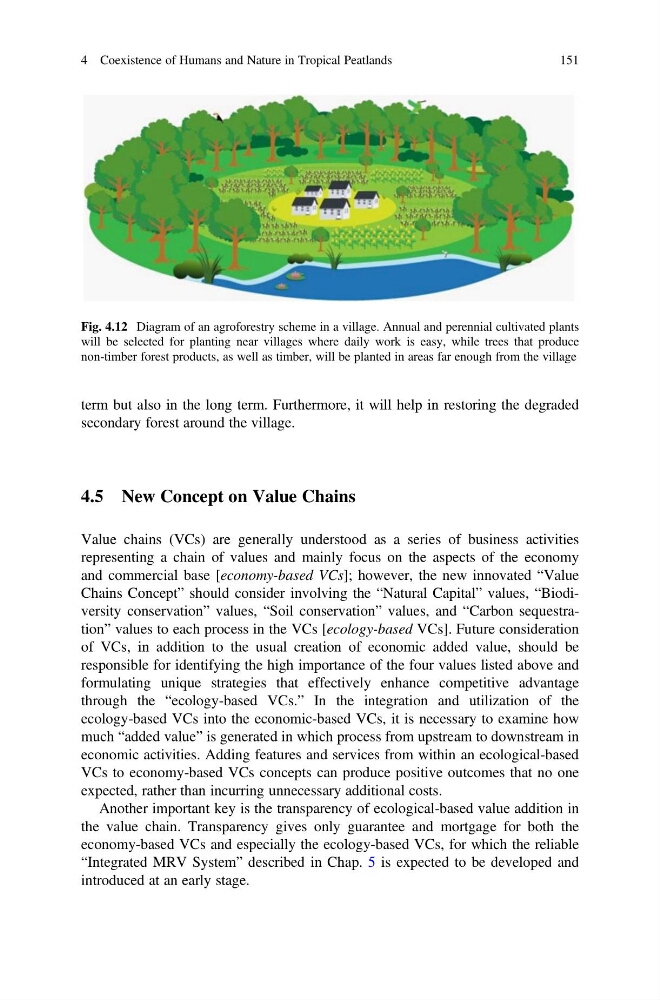
Fig. 4.12 Diagram of an agroforestry scheme in a village. Annual and perennial cultivated plants
will be selected for planting near villages where daily work is easy, while trees that produce
non-timber forest products, as well as timber, will be planted in areas far enough from the village
4 Coexistence of Humans and Nature in Tropical Peatlands
151
secondary forest around the village.
4.5 New Concept on Value Chains
Value chains (VCs) are generally understood as a series of business activities
representing a chain of values and mainly focus on the aspects of the economy
and commercial base [economy-based VCs]; however, the new innovated “Value
Chains Concept” should consider involving the “Natural Capital” values, “Biodiversity conservation” values, “Soil conservation” values, and “Carbon sequestration” values to each process in the VCs [ecology-based VCs]. Future consideration
of VCs, in addition to the usual creation of economic added value, should be
responsible for identifying the high importance of the four values listed above and
formulating unique strategies that effectively enhance competitive advantage
through the “ecology-based VCs.” In the integration and utilization of the
ecology-based VCs into the economic-based VCs, it is necessary to examine how
much “added value” is generated in which process from upstream to downstream in
economic activities. Adding features and services from within an ecological-based
VCs to economy-based VCs concepts can produce positive outcomes that no one
expected, rather than incurring unnecessary additional costs.
Another important key is the transparency of ecological-based value addition in
the value chain. Transparency gives only guarantee and mortgage for both the
economy-based VCs and especially the ecology-based VCs, for which the reliable
“Integrated MRV System” described in Chap. 5 is expected to be developed and
introduced at an early stage.
Fig. 4.12 Diagram of an agroforestry scheme in a village. Annual and perennial cultivated plants
will be selected for planting near villages where daily work is easy, while trees that produce
non-timber forest products, as well as timber, will be planted in areas far enough from the village
4 Coexistence of Humans and Nature in Tropical Peatlands
151