

4.5.1 Economy-Based Value Chains
For the sustainability of business activity, it is critical that a project master plan
achieves cost-effectiveness through the establishment of the right framework to
balance investment and benefit. Under the current economic market, any plan that
cannot achieve sustainability of its business without addressing the cost issue, even if
an apparently good management plan is decided, is not solvent. For example, the
value chain for processed wood products is well-formed from forest to market.
However, the ecological services that forests and trees provide were never valued
in the markets. Consumers are also not reminded of any of the ecosystem services
behind the processed wood products. This well-formed value chain is never easy to
shift, and changing consumer consciousness is extremely difficult.
Efforts have been made to economically evaluate ecosystem services, but the lack
of a market and the absence of a proper evaluation mechanism have prevented them
from being incorporated and considered into this traditional economic value chain.
The reconstruction of value chains is essential and cannot be discounted when
considering the responsible eco-management that contributes to the preservation of
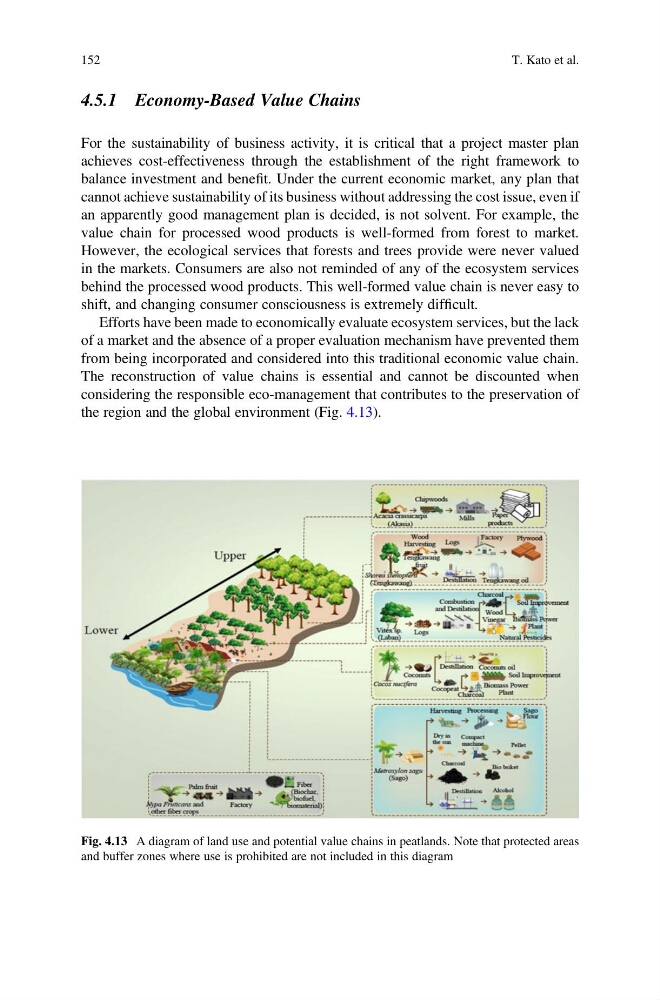
the region and the global environment (Fig. 4.13).
Fig. 4.13 A diagram of land use and potential value chains in peatlands. Note that protected areas
and buffer zones where use is prohibited are not included in this diagram
152
T. Kato et al.
For the sustainability of business activity, it is critical that a project master plan
achieves cost-effectiveness through the establishment of the right framework to
balance investment and benefit. Under the current economic market, any plan that
cannot achieve sustainability of its business without addressing the cost issue, even if
an apparently good management plan is decided, is not solvent. For example, the
value chain for processed wood products is well-formed from forest to market.
However, the ecological services that forests and trees provide were never valued
in the markets. Consumers are also not reminded of any of the ecosystem services
behind the processed wood products. This well-formed value chain is never easy to
shift, and changing consumer consciousness is extremely difficult.
Efforts have been made to economically evaluate ecosystem services, but the lack
of a market and the absence of a proper evaluation mechanism have prevented them
from being incorporated and considered into this traditional economic value chain.
The reconstruction of value chains is essential and cannot be discounted when
considering the responsible eco-management that contributes to the preservation of
the region and the global environment (Fig. 4.13).
Fig. 4.13 A diagram of land use and potential value chains in peatlands. Note that protected areas
and buffer zones where use is prohibited are not included in this diagram
152
T. Kato et al.