

be a carbon sequestration activity in the plantation area. Moreover, the wood
vinegar, a byproduct of charcoal production, has potential as a fungicide and
insecticide for seedling production in the nursery. Alternatively, local people could
sell the charcoal as a high-calorie raw material for biomass power plants. The
advantages of this method are that the laban is native to the area. That means that
local people can earn cash income by producing and selling high value-added
products. In the past, selling charcoal to biomass power plants was never considered,
but with the current debate on coal-free power plants, charcoal, which has a heat
content similar to that of coal, is one of the most promising renewable energy
sources.
Meanwhile, tengkawang (Shorea macrophylla) trees play an important role in the
forest that surrounds the village and the area of mixed planting of the laban and
intensive crops. The tengkawang was also found to be grown by the villagers during
the social and vegetation survey. There were not so many trees, but they were large,
over 50 cm in diameter. The timber from the tengkawang can be used for construction wood or plywood. Conversely, fruit/seeds and bark can also be used as raw
material for food and craft, and its fruits are of a large size compared to other species.
The tengkawang fruit is a valuable raw material for vegetable fat compared to other
vegetable oils, such as coconut oil because it has a high melting point of approximately 37
C (Connell 1974). Because of its characteristics, tengkawang oil is
suitable for making margarine, chocolate, soap, lipstick, medicine, wax, etc. In
international trade, the tengkawang fruit is known as illipe nut, and its fat is
known as Borneo tallow or green butter. Since the tengkawang takes a long time
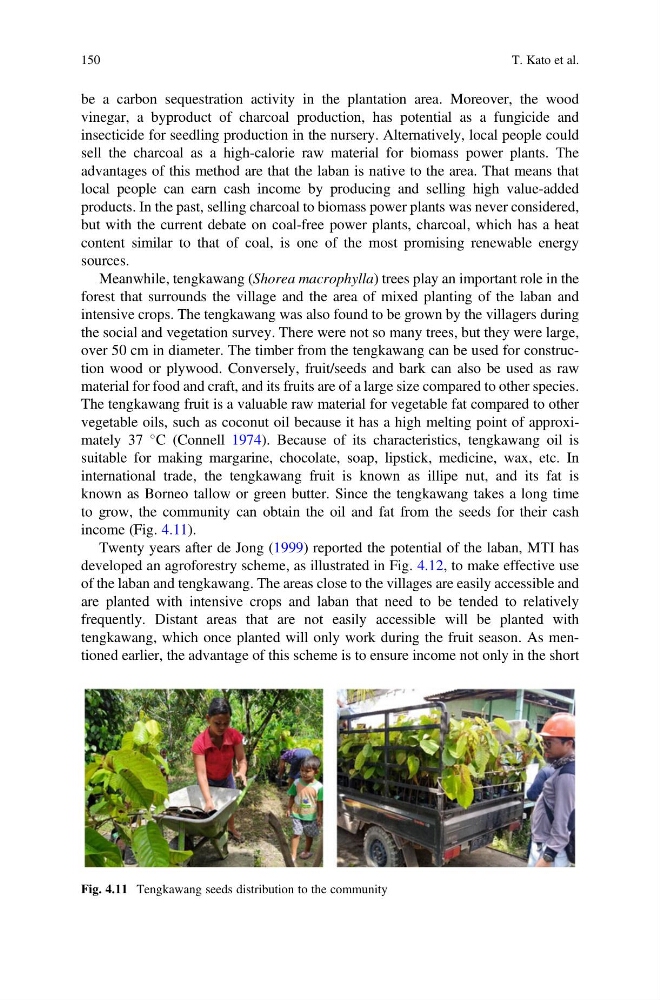
to grow, the community can obtain the oil and fat from the seeds for their cash
income (Fig. 4.11).
Twenty years after de Jong (1999) reported the potential of the laban, MTI has
developed an agroforestry scheme, as illustrated in Fig. 4.12, to make effective use
of the laban and tengkawang. The areas close to the villages are easily accessible and
are planted with intensive crops and laban that need to be tended to relatively
frequently. Distant areas that are not easily accessible will be planted with
tengkawang, which once planted will only work during the fruit season. As mentioned earlier, the advantage of this scheme is to ensure income not only in the short
Fig. 4.11 Tengkawang seeds distribution to the community
150
T. Kato et al.
vinegar, a byproduct of charcoal production, has potential as a fungicide and
insecticide for seedling production in the nursery. Alternatively, local people could
sell the charcoal as a high-calorie raw material for biomass power plants. The
advantages of this method are that the laban is native to the area. That means that
local people can earn cash income by producing and selling high value-added
products. In the past, selling charcoal to biomass power plants was never considered,
but with the current debate on coal-free power plants, charcoal, which has a heat
content similar to that of coal, is one of the most promising renewable energy
sources.
Meanwhile, tengkawang (Shorea macrophylla) trees play an important role in the
forest that surrounds the village and the area of mixed planting of the laban and
intensive crops. The tengkawang was also found to be grown by the villagers during
the social and vegetation survey. There were not so many trees, but they were large,
over 50 cm in diameter. The timber from the tengkawang can be used for construction wood or plywood. Conversely, fruit/seeds and bark can also be used as raw
material for food and craft, and its fruits are of a large size compared to other species.
The tengkawang fruit is a valuable raw material for vegetable fat compared to other
vegetable oils, such as coconut oil because it has a high melting point of approximately 37
C (Connell 1974). Because of its characteristics, tengkawang oil is
suitable for making margarine, chocolate, soap, lipstick, medicine, wax, etc. In
international trade, the tengkawang fruit is known as illipe nut, and its fat is
known as Borneo tallow or green butter. Since the tengkawang takes a long time
to grow, the community can obtain the oil and fat from the seeds for their cash
income (Fig. 4.11).
Twenty years after de Jong (1999) reported the potential of the laban, MTI has
developed an agroforestry scheme, as illustrated in Fig. 4.12, to make effective use
of the laban and tengkawang. The areas close to the villages are easily accessible and
are planted with intensive crops and laban that need to be tended to relatively
frequently. Distant areas that are not easily accessible will be planted with
tengkawang, which once planted will only work during the fruit season. As mentioned earlier, the advantage of this scheme is to ensure income not only in the short
Fig. 4.11 Tengkawang seeds distribution to the community
150
T. Kato et al.