

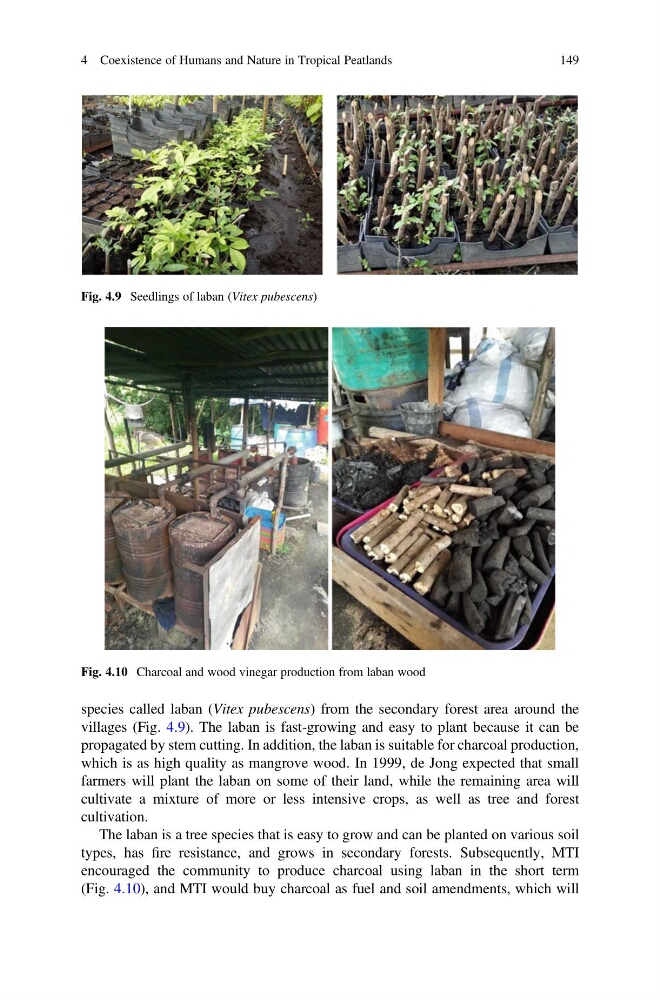
species called laban (Vitex pubescens) from the secondary forest area around the
villages (Fig. 4.9). The laban is fast-growing and easy to plant because it can be
propagated by stem cutting. In addition, the laban is suitable for charcoal production,
which is as high quality as mangrove wood. In 1999, de Jong expected that small
farmers will plant the laban on some of their land, while the remaining area will
cultivate a mixture of more or less intensive crops, as well as tree and forest
cultivation.
The laban is a tree species that is easy to grow and can be planted on various soil
types, has fire resistance, and grows in secondary forests. Subsequently, MTI
encouraged the community to produce charcoal using laban in the short term
(Fig. 4.10), and MTI would buy charcoal as fuel and soil amendments, which will
Fig. 4.9 Seedlings of laban (Vitex pubescens)
Fig. 4.10 Charcoal and wood vinegar production from laban wood
4 Coexistence of Humans and Nature in Tropical Peatlands
149
villages (Fig. 4.9). The laban is fast-growing and easy to plant because it can be
propagated by stem cutting. In addition, the laban is suitable for charcoal production,
which is as high quality as mangrove wood. In 1999, de Jong expected that small
farmers will plant the laban on some of their land, while the remaining area will
cultivate a mixture of more or less intensive crops, as well as tree and forest
cultivation.
The laban is a tree species that is easy to grow and can be planted on various soil
types, has fire resistance, and grows in secondary forests. Subsequently, MTI
encouraged the community to produce charcoal using laban in the short term
(Fig. 4.10), and MTI would buy charcoal as fuel and soil amendments, which will
Fig. 4.9 Seedlings of laban (Vitex pubescens)
Fig. 4.10 Charcoal and wood vinegar production from laban wood
4 Coexistence of Humans and Nature in Tropical Peatlands
149