

the peatland management, WSL selected four observation sites: one location
upstream, two locations in the middle, and one location downstream of the rivers.
Collecting samples from three points (a center and two riversides) at each location,
the total number of sampling points becomes 36 in the rivers.
As a result, WSL has a high diversity of aquatic fauna that consists of 27 species
of fish belonging to 13 families. The number of total individuals was 218. Fish
diversity in WSL is higher than in Batang Kerang, Sarawak, which has only
12 species of fish belonging to 7 families (Rahim et al. 2009). However, it is still
lower than in Sebangau National Park, which has 55 species of fish belonging to
16 families (Thornton et al. 2018). This is because the observation period in
Sebangau National Park of 15 months was more extended than WSL, which includes
the rainy and dry season, whereas it was the rapid survey as only performed during
the rainy season in WSL. WSL will continue the observation throughout the year to
obtain more complete data.
In contrast to the work in Sebangau National Park, WSL conducted a more
extensive survey of not only fish but also aquatic macroinvertebrates, resulting in
identification of 6 species of annelids (6 families), 9 species of mollusks (7 families),
7 species of insects (6 families), and 10 species of crustaceans (9 families). Four
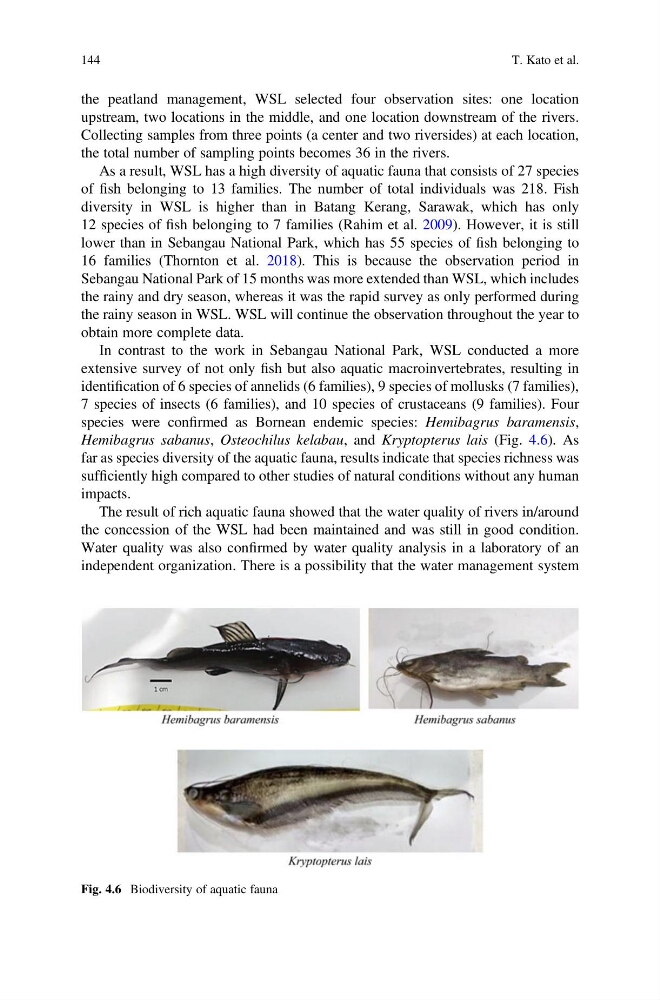
species were confirmed as Bornean endemic species: Hemibagrus baramensis,
Hemibagrus sabanus, Osteochilus kelabau, and Kryptopterus lais (Fig. 4.6). As
far as species diversity of the aquatic fauna, results indicate that species richness was
sufficiently high compared to other studies of natural conditions without any human
impacts.
The result of rich aquatic fauna showed that the water quality of rivers in/around
the concession of the WSL had been maintained and was still in good condition.
Water quality was also confirmed by water quality analysis in a laboratory of an
independent organization. There is a possibility that the water management system
Fig. 4.6 Biodiversity of aquatic fauna
144
T. Kato et al.
upstream, two locations in the middle, and one location downstream of the rivers.
Collecting samples from three points (a center and two riversides) at each location,
the total number of sampling points becomes 36 in the rivers.
As a result, WSL has a high diversity of aquatic fauna that consists of 27 species
of fish belonging to 13 families. The number of total individuals was 218. Fish
diversity in WSL is higher than in Batang Kerang, Sarawak, which has only
12 species of fish belonging to 7 families (Rahim et al. 2009). However, it is still
lower than in Sebangau National Park, which has 55 species of fish belonging to
16 families (Thornton et al. 2018). This is because the observation period in
Sebangau National Park of 15 months was more extended than WSL, which includes
the rainy and dry season, whereas it was the rapid survey as only performed during
the rainy season in WSL. WSL will continue the observation throughout the year to
obtain more complete data.
In contrast to the work in Sebangau National Park, WSL conducted a more
extensive survey of not only fish but also aquatic macroinvertebrates, resulting in
identification of 6 species of annelids (6 families), 9 species of mollusks (7 families),
7 species of insects (6 families), and 10 species of crustaceans (9 families). Four
species were confirmed as Bornean endemic species: Hemibagrus baramensis,
Hemibagrus sabanus, Osteochilus kelabau, and Kryptopterus lais (Fig. 4.6). As
far as species diversity of the aquatic fauna, results indicate that species richness was
sufficiently high compared to other studies of natural conditions without any human
impacts.
The result of rich aquatic fauna showed that the water quality of rivers in/around
the concession of the WSL had been maintained and was still in good condition.
Water quality was also confirmed by water quality analysis in a laboratory of an
independent organization. There is a possibility that the water management system
Fig. 4.6 Biodiversity of aquatic fauna
144
T. Kato et al.