

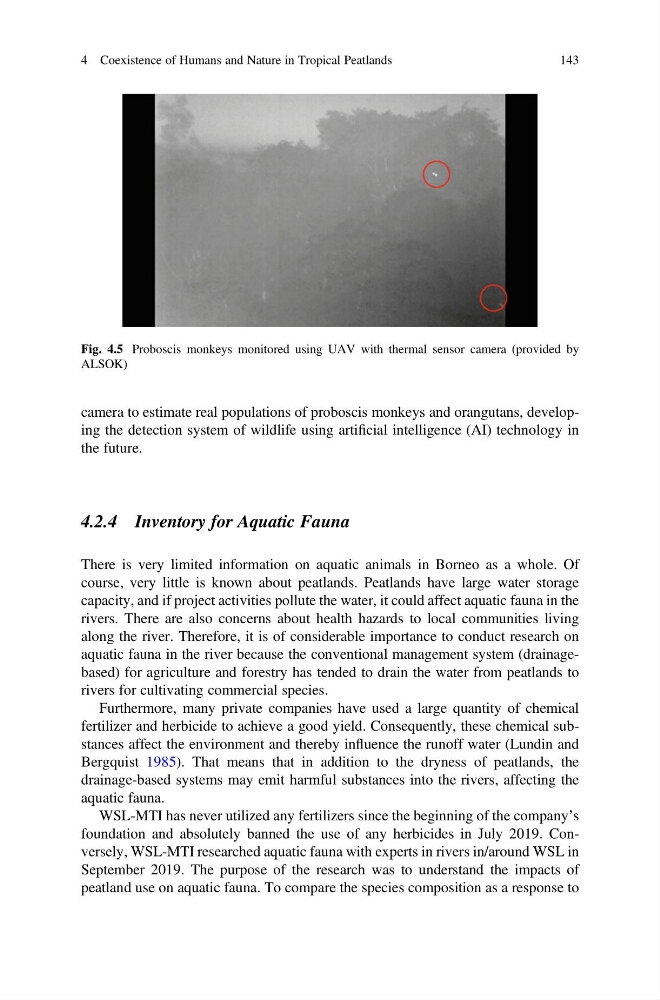
camera to estimate real populations of proboscis monkeys and orangutans, developing the detection system of wildlife using artificial intelligence (AI) technology in
the future.
4.2.4 Inventory for Aquatic Fauna
There is very limited information on aquatic animals in Borneo as a whole. Of
course, very little is known about peatlands. Peatlands have large water storage
capacity, and if project activities pollute the water, it could affect aquatic fauna in the
rivers. There are also concerns about health hazards to local communities living
along the river. Therefore, it is of considerable importance to conduct research on
aquatic fauna in the river because the conventional management system (drainagebased) for agriculture and forestry has tended to drain the water from peatlands to
rivers for cultivating commercial species.
Furthermore, many private companies have used a large quantity of chemical
fertilizer and herbicide to achieve a good yield. Consequently, these chemical substances affect the environment and thereby influence the runoff water (Lundin and
Bergquist 1985). That means that in addition to the dryness of peatlands, the
drainage-based systems may emit harmful substances into the rivers, affecting the
aquatic fauna.
WSL-MTI has never utilized any fertilizers since the beginning of the company’s
foundation and absolutely banned the use of any herbicides in July 2019. Conversely, WSL-MTI researched aquatic fauna with experts in rivers in/around WSL in
September 2019. The purpose of the research was to understand the impacts of
peatland use on aquatic fauna. To compare the species composition as a response to
Fig. 4.5 Proboscis monkeys monitored using UAV with thermal sensor camera (provided by
ALSOK)
4 Coexistence of Humans and Nature in Tropical Peatlands
143
the future.
4.2.4 Inventory for Aquatic Fauna
There is very limited information on aquatic animals in Borneo as a whole. Of
course, very little is known about peatlands. Peatlands have large water storage
capacity, and if project activities pollute the water, it could affect aquatic fauna in the
rivers. There are also concerns about health hazards to local communities living
along the river. Therefore, it is of considerable importance to conduct research on
aquatic fauna in the river because the conventional management system (drainagebased) for agriculture and forestry has tended to drain the water from peatlands to
rivers for cultivating commercial species.
Furthermore, many private companies have used a large quantity of chemical
fertilizer and herbicide to achieve a good yield. Consequently, these chemical substances affect the environment and thereby influence the runoff water (Lundin and
Bergquist 1985). That means that in addition to the dryness of peatlands, the
drainage-based systems may emit harmful substances into the rivers, affecting the
aquatic fauna.
WSL-MTI has never utilized any fertilizers since the beginning of the company’s
foundation and absolutely banned the use of any herbicides in July 2019. Conversely, WSL-MTI researched aquatic fauna with experts in rivers in/around WSL in
September 2019. The purpose of the research was to understand the impacts of
peatland use on aquatic fauna. To compare the species composition as a response to
Fig. 4.5 Proboscis monkeys monitored using UAV with thermal sensor camera (provided by
ALSOK)
4 Coexistence of Humans and Nature in Tropical Peatlands
143