

4.2.3 Wildlife Monitoring by Camera Traps and UAV
WSL-MTI has been conducting studies and monitoring to identify habitats and
populations living in and around the concession areas. In addition to periodic direct
observations made by companies with experts, WSL-MTI also uses camera traps and
UAV technology to collect additional information, which is not easily obtained
through direct observation. Camera traps have been installed since August 2019,
scattered in 20 observation points in the MTI conservation area, which is one of the
core areas in the conservation network (this will be discussed later). Since most wild
animals are active from evening to midnight in areas that are not disturbed by human
activities, the use of camera traps would be beneficial in identifying fauna behavior.
After the installation of camera traps, MTI observed a short video in which a mother
orangutan carried a baby on her back, indicating that the population of orangutans
has increased, as suggested by reports from experts.
In addition to terrestrial monitoring, WSL-MTI also conducts aerial monitoring
for wildlife using UAV technology. The UAV observations were more focused on
proboscis monkeys that live primarily in tree canopies (Fig. 4.5), and orangutans that
make nests in tree canopies. The sensor in the UAV has been using a thermal camera
in addition to an optical system, which helps the observer to detect the position of the
target wild animal and shows a brighter color due to the difference in temperature of
the habitat. Until now, WSL-MTI has been collecting data caught by the thermal
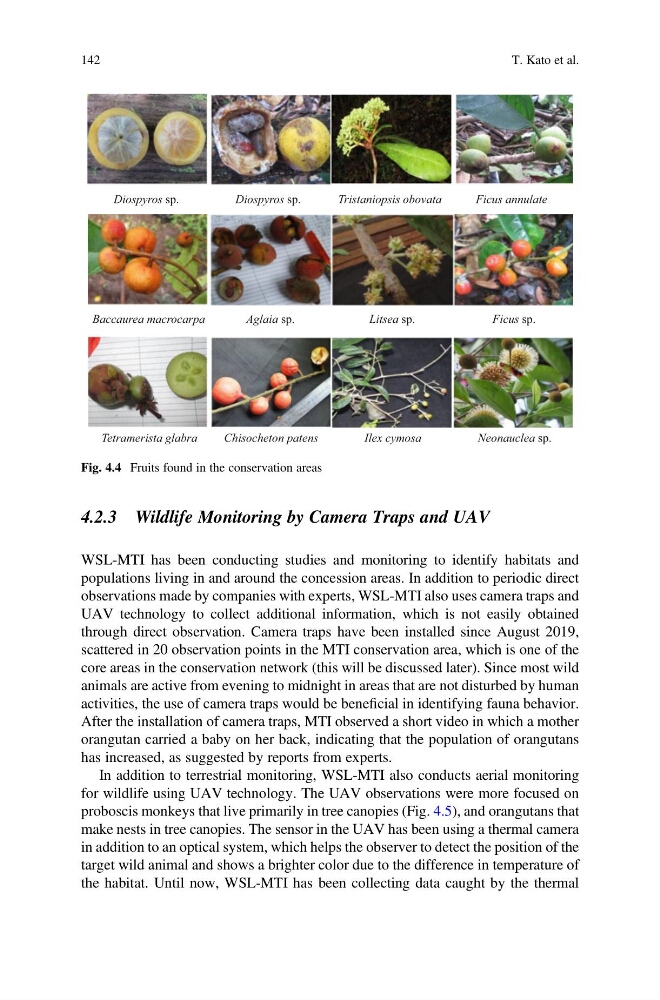
Diospyros sp.
Diospyros sp.
Tristaniopsis obovata
Ficus annulate
Baccaurea macrocarpa
Aglaia sp.
Litsea sp.
Ficus sp.
Tetramerista glabra
Chisocheton patens
Ilex cymosa
Neonauclea sp.
Fig. 4.4 Fruits found in the conservation areas
142
T. Kato et al.
WSL-MTI has been conducting studies and monitoring to identify habitats and
populations living in and around the concession areas. In addition to periodic direct
observations made by companies with experts, WSL-MTI also uses camera traps and
UAV technology to collect additional information, which is not easily obtained
through direct observation. Camera traps have been installed since August 2019,
scattered in 20 observation points in the MTI conservation area, which is one of the
core areas in the conservation network (this will be discussed later). Since most wild
animals are active from evening to midnight in areas that are not disturbed by human
activities, the use of camera traps would be beneficial in identifying fauna behavior.
After the installation of camera traps, MTI observed a short video in which a mother
orangutan carried a baby on her back, indicating that the population of orangutans
has increased, as suggested by reports from experts.
In addition to terrestrial monitoring, WSL-MTI also conducts aerial monitoring
for wildlife using UAV technology. The UAV observations were more focused on
proboscis monkeys that live primarily in tree canopies (Fig. 4.5), and orangutans that
make nests in tree canopies. The sensor in the UAV has been using a thermal camera
in addition to an optical system, which helps the observer to detect the position of the
target wild animal and shows a brighter color due to the difference in temperature of
the habitat. Until now, WSL-MTI has been collecting data caught by the thermal
Diospyros sp.
Diospyros sp.
Tristaniopsis obovata
Ficus annulate
Baccaurea macrocarpa
Aglaia sp.
Litsea sp.
Ficus sp.
Tetramerista glabra
Chisocheton patens
Ilex cymosa
Neonauclea sp.
Fig. 4.4 Fruits found in the conservation areas
142
T. Kato et al.