

without fertilizer or herbicides and the absence of drainage enriches the water quality
of rivers and the aquatic fauna.
4.3 Conservation Network of Landscape
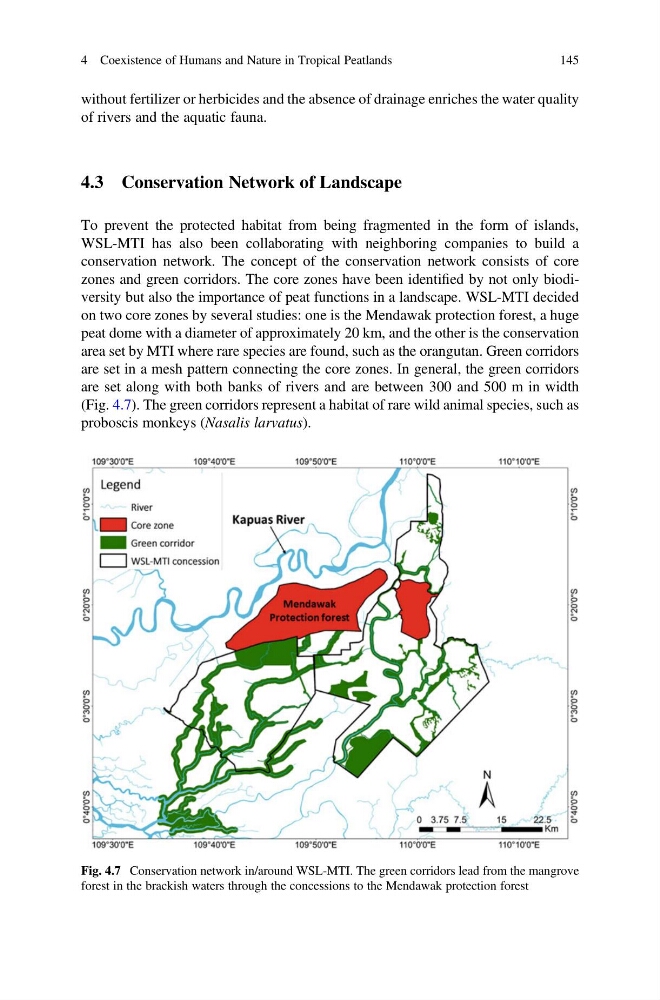
To prevent the protected habitat from being fragmented in the form of islands,
WSL-MTI has also been collaborating with neighboring companies to build a
conservation network. The concept of the conservation network consists of core
zones and green corridors. The core zones have been identified by not only biodiversity but also the importance of peat functions in a landscape. WSL-MTI decided
on two core zones by several studies: one is the Mendawak protection forest, a huge
peat dome with a diameter of approximately 20 km, and the other is the conservation
area set by MTI where rare species are found, such as the orangutan. Green corridors
are set in a mesh pattern connecting the core zones. In general, the green corridors
are set along with both banks of rivers and are between 300 and 500 m in width
(Fig. 4.7). The green corridors represent a habitat of rare wild animal species, such as
proboscis monkeys (Nasalis larvatus).
Fig. 4.7 Conservation network in/around WSL-MTI. The green corridors lead from the mangrove
forest in the brackish waters through the concessions to the Mendawak protection forest
4 Coexistence of Humans and Nature in Tropical Peatlands
145
of rivers and the aquatic fauna.
4.3 Conservation Network of Landscape
To prevent the protected habitat from being fragmented in the form of islands,
WSL-MTI has also been collaborating with neighboring companies to build a
conservation network. The concept of the conservation network consists of core
zones and green corridors. The core zones have been identified by not only biodiversity but also the importance of peat functions in a landscape. WSL-MTI decided
on two core zones by several studies: one is the Mendawak protection forest, a huge
peat dome with a diameter of approximately 20 km, and the other is the conservation
area set by MTI where rare species are found, such as the orangutan. Green corridors
are set in a mesh pattern connecting the core zones. In general, the green corridors
are set along with both banks of rivers and are between 300 and 500 m in width
(Fig. 4.7). The green corridors represent a habitat of rare wild animal species, such as
proboscis monkeys (Nasalis larvatus).
Fig. 4.7 Conservation network in/around WSL-MTI. The green corridors lead from the mangrove
forest in the brackish waters through the concessions to the Mendawak protection forest
4 Coexistence of Humans and Nature in Tropical Peatlands
145