

3.10 Monitoring at Project Sites
The WSL-MTI have also involved a number of monitoring activities in assessing the
impact on the peat ecosystem, resulting in the accumulation of a decade of data over
a large area, which has never occurred previously. The various monitoring events
have been particularly careful to study the impact of the project on protected areas
and rivers, as well as CO 2 emissions, which are considered to have an impact on
global climate change. For flora and fauna, these monitoring events have been
carried out on a regular basis with experts.
3.10.1 Meteorological Observation
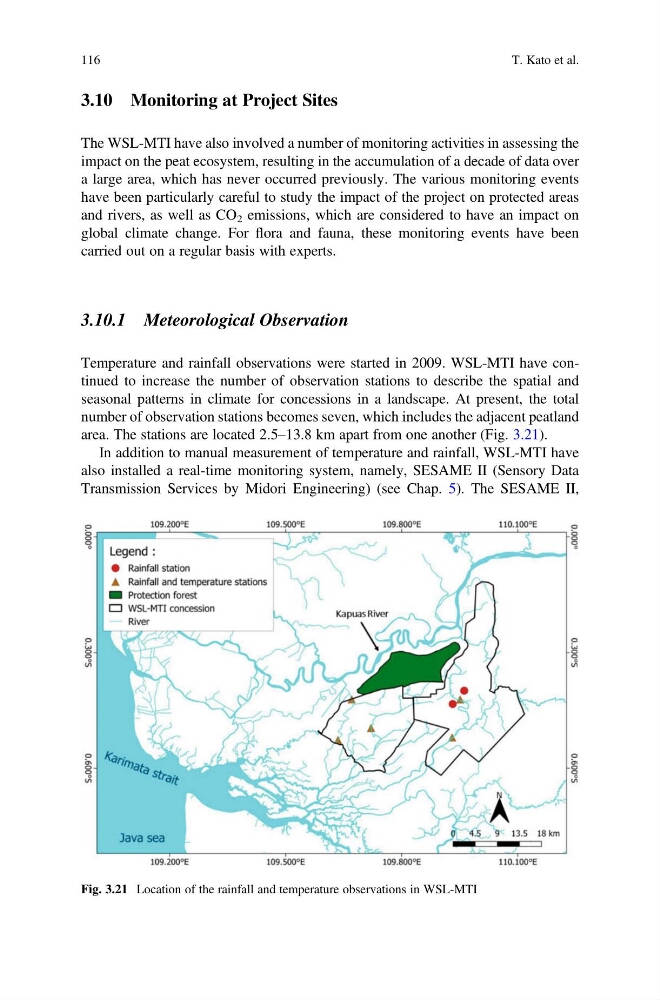
Temperature and rainfall observations were started in 2009. WSL-MTI have continued to increase the number of observation stations to describe the spatial and
seasonal patterns in climate for concessions in a landscape. At present, the total
number of observation stations becomes seven, which includes the adjacent peatland
area. The stations are located 2.5–13.8 km apart from one another (Fig. 3.21).
In addition to manual measurement of temperature and rainfall, WSL-MTI have
also installed a real-time monitoring system, namely, SESAME II (Sensory Data
Transmission Services by Midori Engineering) (see Chap. 5). The SESAME II,
Fig. 3.21 Location of the rainfall and temperature observations in WSL-MTI
116
T. Kato et al.
The WSL-MTI have also involved a number of monitoring activities in assessing the
impact on the peat ecosystem, resulting in the accumulation of a decade of data over
a large area, which has never occurred previously. The various monitoring events
have been particularly careful to study the impact of the project on protected areas
and rivers, as well as CO 2 emissions, which are considered to have an impact on
global climate change. For flora and fauna, these monitoring events have been
carried out on a regular basis with experts.
3.10.1 Meteorological Observation
Temperature and rainfall observations were started in 2009. WSL-MTI have continued to increase the number of observation stations to describe the spatial and
seasonal patterns in climate for concessions in a landscape. At present, the total
number of observation stations becomes seven, which includes the adjacent peatland
area. The stations are located 2.5–13.8 km apart from one another (Fig. 3.21).
In addition to manual measurement of temperature and rainfall, WSL-MTI have
also installed a real-time monitoring system, namely, SESAME II (Sensory Data
Transmission Services by Midori Engineering) (see Chap. 5). The SESAME II,
Fig. 3.21 Location of the rainfall and temperature observations in WSL-MTI
116
T. Kato et al.