

76
G. Altarelli and S. Forte
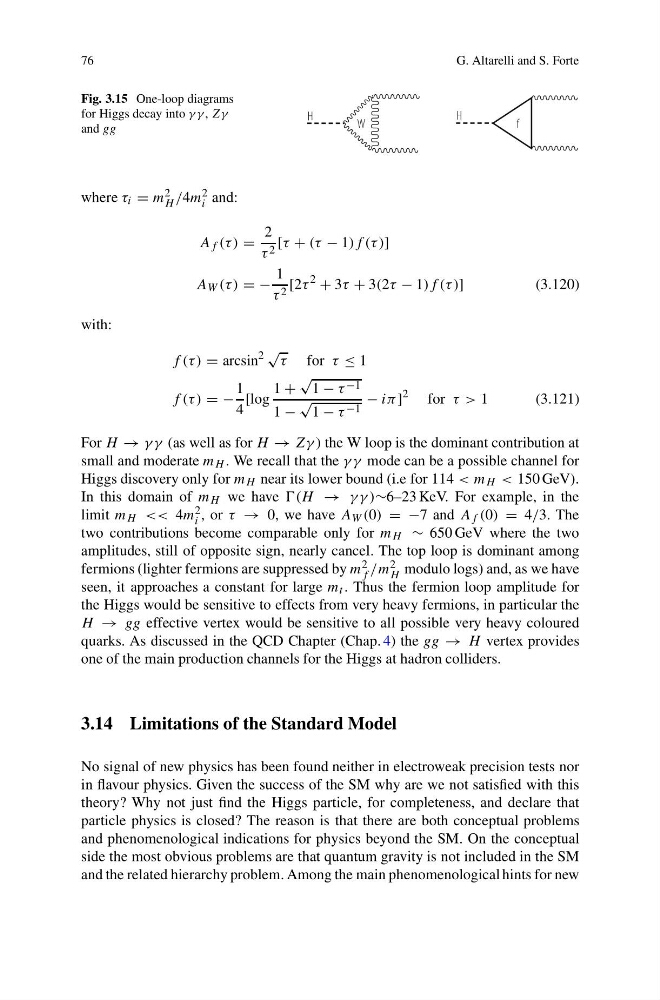
Fig. 3.15 One-loop diagrams
for Higgs decay into γ γ , Zγ
and gg
W
H
H
f
where τ i = m 2
H /4m 2
i and:
A f (τ ) =
2
τ 2 [τ + (τ − 1)f (τ )]
A W (τ ) = −
1
τ 2 [2τ
2
+ 3τ + 3(2τ − 1)f (τ )]
(3.120)
with:
f (τ ) = arcsin
2 √
τ for τ ≤ 1
f (τ ) = −
1
4
[log
1 +
√
1 − τ −1
1 −
√
1 − τ −1
− iπ]
2
for τ > 1
(3.121)
For H → γ γ (as well as for H → Zγ ) the W loop is the dominant contribution at
small and moderate m H . We recall that the γ γ mode can be a possible channel for
Higgs discovery only for m H near its lower bound (i.e for 114 < m H < 150 GeV).
In this domain of m H we have (H → γ γ )∼6–23 KeV. For example, in the
limit m H << 4m 2
i , or τ → 0, we have A W (0) = −7 and A f (0) = 4/3. The
two contributions become comparable only for m H ∼ 650 GeV where the two
amplitudes, still of opposite sign, nearly cancel. The top loop is dominant among
fermions (lighter fermions are suppressed by m 2
f /m 2
H modulo logs) and, as we have
seen, it approaches a constant for large m t . Thus the fermion loop amplitude for
the Higgs would be sensitive to effects from very heavy fermions, in particular the
H → gg effective vertex would be sensitive to all possible very heavy coloured
quarks. As discussed in the QCD Chapter (Chap. 4) the gg → H vertex provides
one of the main production channels for the Higgs at hadron colliders.
3.14 Limitations of the Standard Model
No signal of new physics has been found neither in electroweak precision tests nor
in flavour physics. Given the success of the SM why are we not satisfied with this
theory? Why not just find the Higgs particle, for completeness, and declare that
particle physics is closed? The reason is that there are both conceptual problems
and phenomenological indications for physics beyond the SM. On the conceptual
side the most obvious problems are that quantum gravity is not included in the SM
and the related hierarchy problem. Among the main phenomenological hints for new
G. Altarelli and S. Forte
Fig. 3.15 One-loop diagrams
for Higgs decay into γ γ , Zγ
and gg
W
H
H
f
where τ i = m 2
H /4m 2
i and:
A f (τ ) =
2
τ 2 [τ + (τ − 1)f (τ )]
A W (τ ) = −
1
τ 2 [2τ
2
+ 3τ + 3(2τ − 1)f (τ )]
(3.120)
with:
f (τ ) = arcsin
2 √
τ for τ ≤ 1
f (τ ) = −
1
4
[log
1 +
√
1 − τ −1
1 −
√
1 − τ −1
− iπ]
2
for τ > 1
(3.121)
For H → γ γ (as well as for H → Zγ ) the W loop is the dominant contribution at
small and moderate m H . We recall that the γ γ mode can be a possible channel for
Higgs discovery only for m H near its lower bound (i.e for 114 < m H < 150 GeV).
In this domain of m H we have (H → γ γ )∼6–23 KeV. For example, in the
limit m H << 4m 2
i , or τ → 0, we have A W (0) = −7 and A f (0) = 4/3. The
two contributions become comparable only for m H ∼ 650 GeV where the two
amplitudes, still of opposite sign, nearly cancel. The top loop is dominant among
fermions (lighter fermions are suppressed by m 2
f /m 2
H modulo logs) and, as we have
seen, it approaches a constant for large m t . Thus the fermion loop amplitude for
the Higgs would be sensitive to effects from very heavy fermions, in particular the
H → gg effective vertex would be sensitive to all possible very heavy coloured
quarks. As discussed in the QCD Chapter (Chap. 4) the gg → H vertex provides
one of the main production channels for the Higgs at hadron colliders.
3.14 Limitations of the Standard Model
No signal of new physics has been found neither in electroweak precision tests nor
in flavour physics. Given the success of the SM why are we not satisfied with this
theory? Why not just find the Higgs particle, for completeness, and declare that
particle physics is closed? The reason is that there are both conceptual problems
and phenomenological indications for physics beyond the SM. On the conceptual
side the most obvious problems are that quantum gravity is not included in the SM
and the related hierarchy problem. Among the main phenomenological hints for new