

3 The Standard Model of Electroweak Interactions
77
physics we can list coupling unification, dark matter, neutrino masses (discussed in
Sect. (3.7)), baryogenesis and the cosmological vacuum energy.
The computed evolution with energy of the effective SM gauge couplings clearly
points towards the unification of the electro-weak and strong forces (GUT’s) at
scales of energy M GU T ∼ 10 15 − 10 16 GeV [31] which are close to the scale
of quantum gravity, M P l ∼ 10 19 GeV. One is led to imagine a unified theory
of all interactions also including gravity (at present superstrings provide the best
attempt at such a theory). Thus GUT’s and the realm of quantum gravity set a
very distant energy horizon that modern particle theory cannot ignore. Can the SM
without new physics be valid up to such large energies? One can imagine that some
obvious problems could be postponed to the more fundamental theory at the Planck
mass. For example, the explanation of the three generations of fermions and the
understanding of fermion masses and mixing angles can be postponed. But other
problems must find their solution in the low energy theory. In particular, the structure
of the SM could not naturally explain the relative smallness of the weak scale of
mass, set by the Higgs mechanism at μ ∼ 1/
√
G F ∼ 250 GeV with G F being the
Fermi coupling constant. This so-called hierarchy problem is due to the instability
of the SM with respect to quantum corrections. This is related to the presence of
fundamental scalar fields in the theory with quadratic mass divergences and no
protective extra symmetry at μ = 0. For fermion masses, first, the divergences are
logarithmic and, second, they are forbidden by the SU (2) ⊗ U(1) gauge symmetry
plus the fact that at m = 0 an additional symmetry, i.e. chiral symmetry, is restored.
Here, when talking of divergences, we are not worried of actual infinities. The
theory is renormalizable and finite once the dependence on the cut off is absorbed
in a redefinition of masses and couplings. Rather the hierarchy problem is one of
naturalness. We can look at the cut off as a parameterization of our ignorance on the
new physics that will modify the theory at large energy scales. Then it is relevant to
look at the dependence of physical quantities on the cut off and to demand that no
unexplained enormously accurate cancellations arise.
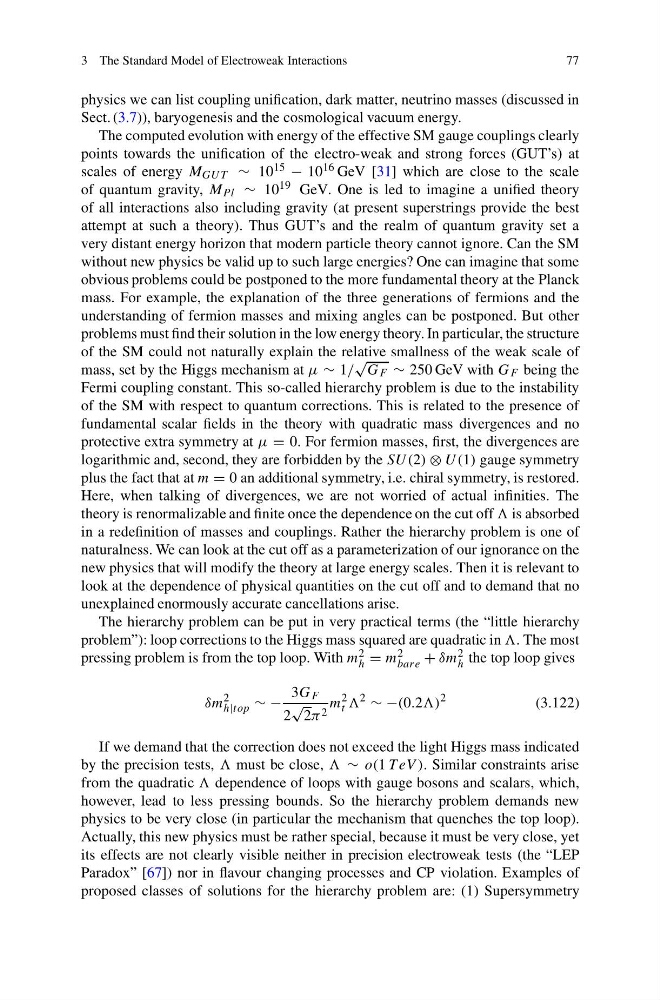
The hierarchy problem can be put in very practical terms (the “little hierarchy
problem”): loop corrections to the Higgs mass squared are quadratic in . The most
pressing problem is from the top loop. With m 2
h = m 2
bare + δm 2
h the top loop gives
δm
2
h|top ∼ −
3G F
2
√
2π 2
m
2
t
2
∼ −(0.2
2
(3.122)
If we demand that the correction does not exceed the light Higgs mass indicated
by the precision tests, must be close, ∼ o(1 T eV ). Similar constraints arise
from the quadratic dependence of loops with gauge bosons and scalars, which,
however, lead to less pressing bounds. So the hierarchy problem demands new
physics to be very close (in particular the mechanism that quenches the top loop).
Actually, this new physics must be rather special, because it must be very close, yet
its effects are not clearly visible neither in precision electroweak tests (the “LEP
Paradox” [67]) nor in flavour changing processes and CP violation. Examples of
proposed classes of solutions for the hierarchy problem are: (1) Supersymmetry
77
physics we can list coupling unification, dark matter, neutrino masses (discussed in
Sect. (3.7)), baryogenesis and the cosmological vacuum energy.
The computed evolution with energy of the effective SM gauge couplings clearly
points towards the unification of the electro-weak and strong forces (GUT’s) at
scales of energy M GU T ∼ 10 15 − 10 16 GeV [31] which are close to the scale
of quantum gravity, M P l ∼ 10 19 GeV. One is led to imagine a unified theory
of all interactions also including gravity (at present superstrings provide the best
attempt at such a theory). Thus GUT’s and the realm of quantum gravity set a
very distant energy horizon that modern particle theory cannot ignore. Can the SM
without new physics be valid up to such large energies? One can imagine that some
obvious problems could be postponed to the more fundamental theory at the Planck
mass. For example, the explanation of the three generations of fermions and the
understanding of fermion masses and mixing angles can be postponed. But other
problems must find their solution in the low energy theory. In particular, the structure
of the SM could not naturally explain the relative smallness of the weak scale of
mass, set by the Higgs mechanism at μ ∼ 1/
√
G F ∼ 250 GeV with G F being the
Fermi coupling constant. This so-called hierarchy problem is due to the instability
of the SM with respect to quantum corrections. This is related to the presence of
fundamental scalar fields in the theory with quadratic mass divergences and no
protective extra symmetry at μ = 0. For fermion masses, first, the divergences are
logarithmic and, second, they are forbidden by the SU (2) ⊗ U(1) gauge symmetry
plus the fact that at m = 0 an additional symmetry, i.e. chiral symmetry, is restored.
Here, when talking of divergences, we are not worried of actual infinities. The
theory is renormalizable and finite once the dependence on the cut off is absorbed
in a redefinition of masses and couplings. Rather the hierarchy problem is one of
naturalness. We can look at the cut off as a parameterization of our ignorance on the
new physics that will modify the theory at large energy scales. Then it is relevant to
look at the dependence of physical quantities on the cut off and to demand that no
unexplained enormously accurate cancellations arise.
The hierarchy problem can be put in very practical terms (the “little hierarchy
problem”): loop corrections to the Higgs mass squared are quadratic in . The most
pressing problem is from the top loop. With m 2
h = m 2
bare + δm 2
h the top loop gives
δm
2
h|top ∼ −
3G F
2
√
2π 2
m
2
t
2
∼ −(0.2
2
(3.122)
If we demand that the correction does not exceed the light Higgs mass indicated
by the precision tests, must be close, ∼ o(1 T eV ). Similar constraints arise
from the quadratic dependence of loops with gauge bosons and scalars, which,
however, lead to less pressing bounds. So the hierarchy problem demands new
physics to be very close (in particular the mechanism that quenches the top loop).
Actually, this new physics must be rather special, because it must be very close, yet
its effects are not clearly visible neither in precision electroweak tests (the “LEP
Paradox” [67]) nor in flavour changing processes and CP violation. Examples of
proposed classes of solutions for the hierarchy problem are: (1) Supersymmetry