

3 The Standard Model of Electroweak Interactions
75
for the width of a particle of mass m H decaying through a diagram with only one
weak vertex.
A glance to the branching ratios shows that the branching ratio into τ pairs is
larger by more than a factor of two with respect to the c ¯
c channel. This is at first
sight surprising because the colour factor N C favours the quark channels and the
masses of τ ’s and of D mesons are quite similar. This is due to the fact that the
QCD corrections replace the charm mass at the scale of charm with the charm
mass at the scale m H , which is lower by about a factor of 2.5. The masses run
logarithmically in QCD, similar to the coupling constant. The corresponding logs
are already present in the 1-loop QCD correction that amounts to the replacement
m 2
q → m 2
q [1 + 2α s /π(log m 2
q /m 2
H + 3/2)] ∼ m 2
q (m 2
H ).
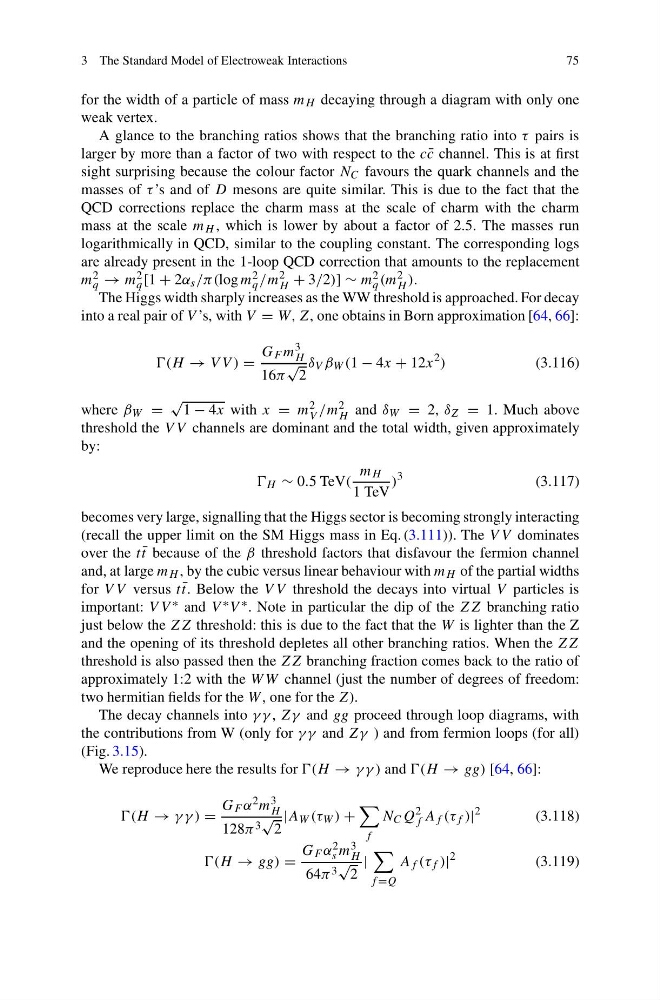
The Higgs width sharply increases as the WW threshold is approached. For decay
into a real pair of V ’s, with V = W, Z, one obtains in Born approximation [64, 66]:
(H → V V ) =
G F m
3
H
16π
√
2
δ V β W (1 − 4x + 12x
2 )
(3.116)
where β W =
√
1 − 4x with x = m 2
V /m 2
H and δ W = 2, δ Z = 1. Much above
threshold the V V channels are dominant and the total width, given approximately
by:
H ∼ 0.5 TeV(
m H
1 TeV
)
3
(3.117)
becomes very large, signalling that the Higgs sector is becoming strongly interacting
(recall the upper limit on the SM Higgs mass in Eq. (3.111)). The V V dominates
over the t ¯
t because of the β threshold factors that disfavour the fermion channel
and, at large m H , by the cubic versus linear behaviour with m H of the partial widths
for V V versus t ¯
t. Below the V V threshold the decays into virtual V particles is
important: V V ∗ and V ∗ V ∗ . Note in particular the dip of the ZZ branching ratio
just below the ZZ threshold: this is due to the fact that the W is lighter than the Z
and the opening of its threshold depletes all other branching ratios. When the ZZ
threshold is also passed then the ZZ branching fraction comes back to the ratio of
approximately 1:2 with the W W channel (just the number of degrees of freedom:
two hermitian fields for the W , one for the Z).
The decay channels into γ γ , Zγ and gg proceed through loop diagrams, with
the contributions from W (only for γ γ and Zγ ) and from fermion loops (for all)
(Fig. 3.15).
We reproduce here the results for (H → γ γ ) and (H → gg) [64, 66]:
(H → γ γ ) =
G F α 2 m 3
H
128π 3
√
2
|A W (τ W ) +
f
N C Q
2
f A f (τ f )|
2
(3.118)
(H → gg) =
G F α 2
s m 3
H
64π 3
√
2
|
f =Q
A f (τ f )|
2
(3.119)
75
for the width of a particle of mass m H decaying through a diagram with only one
weak vertex.
A glance to the branching ratios shows that the branching ratio into τ pairs is
larger by more than a factor of two with respect to the c ¯
c channel. This is at first
sight surprising because the colour factor N C favours the quark channels and the
masses of τ ’s and of D mesons are quite similar. This is due to the fact that the
QCD corrections replace the charm mass at the scale of charm with the charm
mass at the scale m H , which is lower by about a factor of 2.5. The masses run
logarithmically in QCD, similar to the coupling constant. The corresponding logs
are already present in the 1-loop QCD correction that amounts to the replacement
m 2
q → m 2
q [1 + 2α s /π(log m 2
q /m 2
H + 3/2)] ∼ m 2
q (m 2
H ).
The Higgs width sharply increases as the WW threshold is approached. For decay
into a real pair of V ’s, with V = W, Z, one obtains in Born approximation [64, 66]:
(H → V V ) =
G F m
3
H
16π
√
2
δ V β W (1 − 4x + 12x
2 )
(3.116)
where β W =
√
1 − 4x with x = m 2
V /m 2
H and δ W = 2, δ Z = 1. Much above
threshold the V V channels are dominant and the total width, given approximately
by:
H ∼ 0.5 TeV(
m H
1 TeV
)
3
(3.117)
becomes very large, signalling that the Higgs sector is becoming strongly interacting
(recall the upper limit on the SM Higgs mass in Eq. (3.111)). The V V dominates
over the t ¯
t because of the β threshold factors that disfavour the fermion channel
and, at large m H , by the cubic versus linear behaviour with m H of the partial widths
for V V versus t ¯
t. Below the V V threshold the decays into virtual V particles is
important: V V ∗ and V ∗ V ∗ . Note in particular the dip of the ZZ branching ratio
just below the ZZ threshold: this is due to the fact that the W is lighter than the Z
and the opening of its threshold depletes all other branching ratios. When the ZZ
threshold is also passed then the ZZ branching fraction comes back to the ratio of
approximately 1:2 with the W W channel (just the number of degrees of freedom:
two hermitian fields for the W , one for the Z).
The decay channels into γ γ , Zγ and gg proceed through loop diagrams, with
the contributions from W (only for γ γ and Zγ ) and from fermion loops (for all)
(Fig. 3.15).
We reproduce here the results for (H → γ γ ) and (H → gg) [64, 66]:
(H → γ γ ) =
G F α 2 m 3
H
128π 3
√
2
|A W (τ W ) +
f
N C Q
2
f A f (τ f )|
2
(3.118)
(H → gg) =
G F α 2
s m 3
H
64π 3
√
2
|
f =Q
A f (τ f )|
2
(3.119)