

9 Symmetry Violations and Quark Flavour Physics
609
The rotation angles are defined and labeled in a way which relates to the mixing
of two specific generations. In the limit θ 23 = θ 13 = 0 the third generation
decouples, and the situation reduces to the usual Cabibbo mixing of the first two
generations, with θ 12 identified as the Cabibbo angle. The angles θ 12 , θ 23 , θ 13 can
all be chosen to lie in the first quadrant, i.e. s ij , c ij > 0, by appropriate redefinition
of the quark field phases.
From measurements it is known that 1 s 12 s 23 s 13 . It is therefore
common to use a parametrization of the CKM matrix that emphasizes this hierarchy.
In the Wolfenstein parametrization one defines
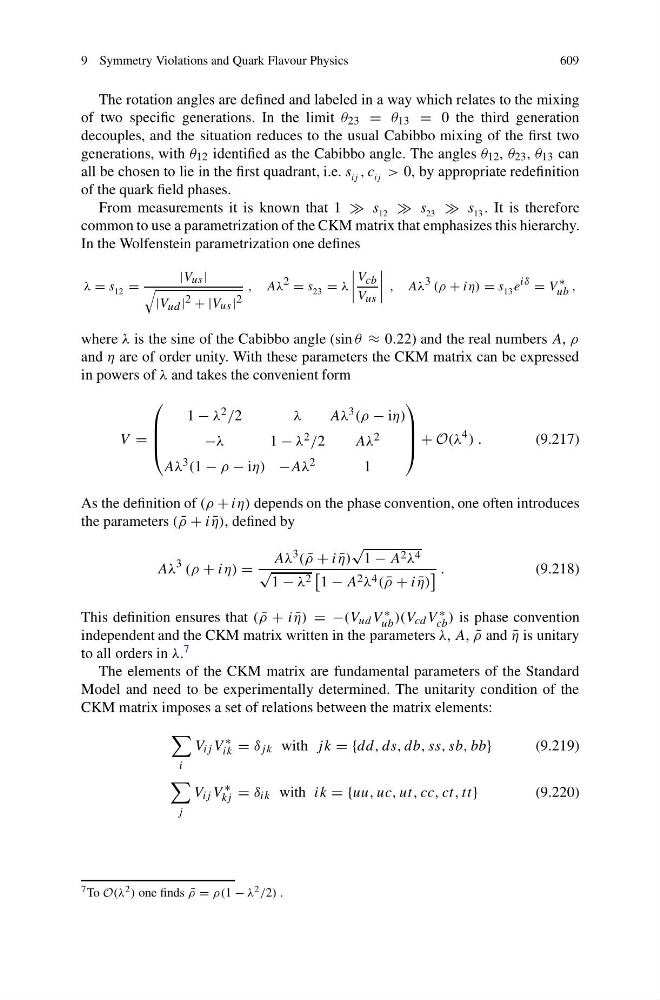
λ = s 12 =
|V us |
|V ud | 2 + |V us | 2
, Aλ 2 = s 23 = λ
V cb
V us
, Aλ 3 (ρ + iη) = s 13 e iδ = V ∗
ub ,
where λ is the sine of the Cabibbo angle (sin θ ≈ 0.22) and the real numbers A, ρ
and η are of order unity. With these parameters the CKM matrix can be expressed
in powers of λ and takes the convenient form
V =
⎛
⎜
⎜
⎝
1 − λ 2 /2
λ
Aλ 3 (ρ − iη)
−λ
1 − λ 2 /2
Aλ 2
Aλ 3 (1 − ρ − iη) −Aλ 2
1
⎞
⎟
⎟
⎠ + O(λ
4 ) .
(9.217)
As the definition of (ρ + iη) depends on the phase convention, one often introduces
the parameters ( ¯
ρ + i ¯
η), defined by
Aλ
3 (ρ + iη) =
Aλ 3 ( ¯
ρ + i ¯
η)
√
1 − A 2 λ 4
√
1 − λ 2
1 − A 2 λ 4 ( ¯
ρ + i ¯
η)
.
(9.218)
This definition ensures that ( ¯
ρ + i ¯
η) = −(V ud V ∗
ub )(V cd V ∗
cb ) is phase convention
independent and the CKM matrix written in the parameters λ, A, ¯
ρ and ¯
η is unitary
to all orders in λ. 7
The elements of the CKM matrix are fundamental parameters of the Standard
Model and need to be experimentally determined. The unitarity condition of the
CKM matrix imposes a set of relations between the matrix elements:
i
V ij V
∗
ik = δ jk with j k = {dd, ds, db, ss, sb, bb}
(9.219)
j
V ij V
∗
kj = δ ik with ik = {uu, uc, ut, cc, ct, tt}
(9.220)
7 To O(λ 2 ) one finds ¯
ρ = ρ(1 − λ 2 /2) .