

608
K. Kleinknecht and U. Uwer
structure imprinted which is described by the Cabibbo Kobayshi Maskawa (CKM)
quark-mixing matrix
V CKM ≡ V L,u V
†
L,d .
The charge current terms expressed in the mass eigenstates have the form
L CC = −
g
√
2
¯ ˜
u L γ
μ W
+
μ V CKM ˜
d L + ¯ ˜
d L γ
μ W
−
μ V CKM
†
˜
u L
.
Here, the matrix element (V CKM ) ij connects a left-handed up-type quark of the
ith generation to a left-handed down-type quark of the j th generation. The matrix
elements are therefore expressed using flavor indices:
V CKM =
⎛
⎜
⎜
⎝
V ud V us V ub
V cd V cs V cb
V td V ts V tb
⎞
⎟
⎟
⎠
For a non-diagonal CKM matrix the charged quark currents are thus inter-generation
flavor changing currents. In analogy to the flavor eigenstates introduced by Cabibbo
it is usual to absorb the CKM matrix by introducing for the down-type quarks the
weak quark eigenstates ˜
d = V CKM ˜
d L .
Since it is the product of unitary matrices the CKM matrix itself is unitary,
i.e. V CKM V CKM
†
= 1, and its elements are in general complex. The number of
parameters of a general unitary 3 × 3 matrix is nine, three rotation angles and six
phases. By rephasing the quark mass eigenstates ˜
q → e iα q ˜
q one can remove five
phases, corresponding to the five independent phase differences between the quarks,
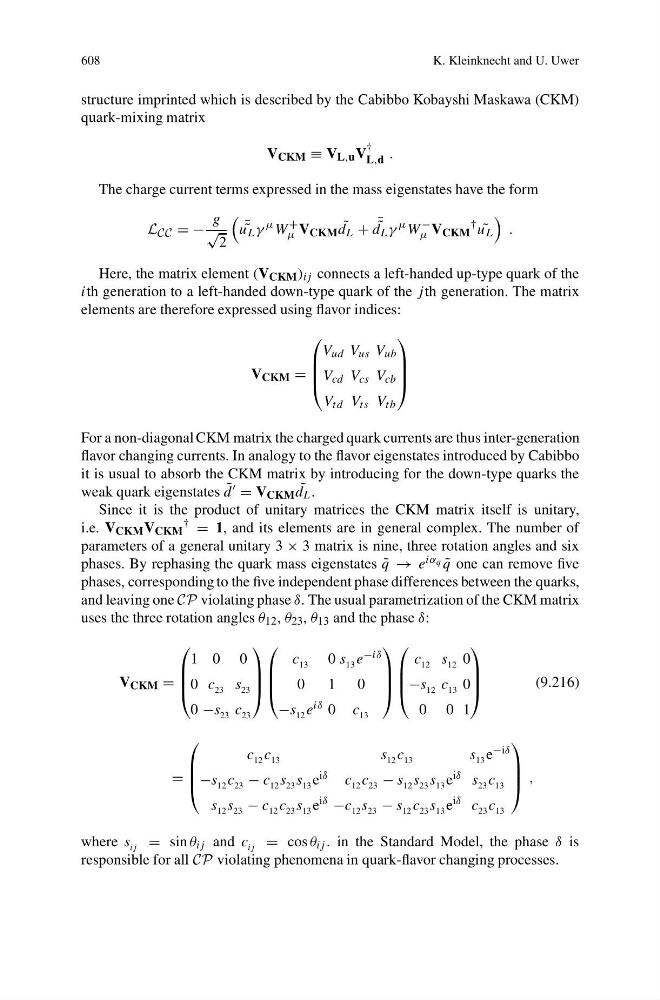
and leaving one CP violating phase δ. The usual parametrization of the CKM matrix
uses the three rotation angles θ 12 , θ 23 , θ 13 and the phase δ:
V CKM =
⎛
⎜
⎜
⎝
1 0 0
0 c 23 s 23
0 −s 23 c 23
⎞
⎟
⎟
⎠
⎛
⎜
⎜
⎝
c 13 0 s 13 e −iδ
0
1 0
−s 12 e iδ 0 c 13
⎞
⎟
⎟
⎠
⎛
⎜
⎜
⎝
c 12 s 12 0
−s 12 c 13 0
0 0 1
⎞
⎟
⎟
⎠
(9.216)
=
⎛
⎜
⎜
⎝
c 12 c 13
s 12 c 13
s 13 e −iδ
−s 12 c 23 − c 12 s 23 s 13 e iδ c 12 c 23 − s 12 s 23 s 13 e iδ s 23 c 13
s 12 s 23 − c 12 c 23 s 13 e iδ −c 12 s 23 − s 12 c 23 s 13 e iδ c 23 c 13
⎞
⎟
⎟
⎠ ,
where s ij = sin θ ij and c ij = cos θ ij . in the Standard Model, the phase δ is
responsible for all CP violating phenomena in quark-flavor changing processes.