

610
K. Kleinknecht and U. Uwer
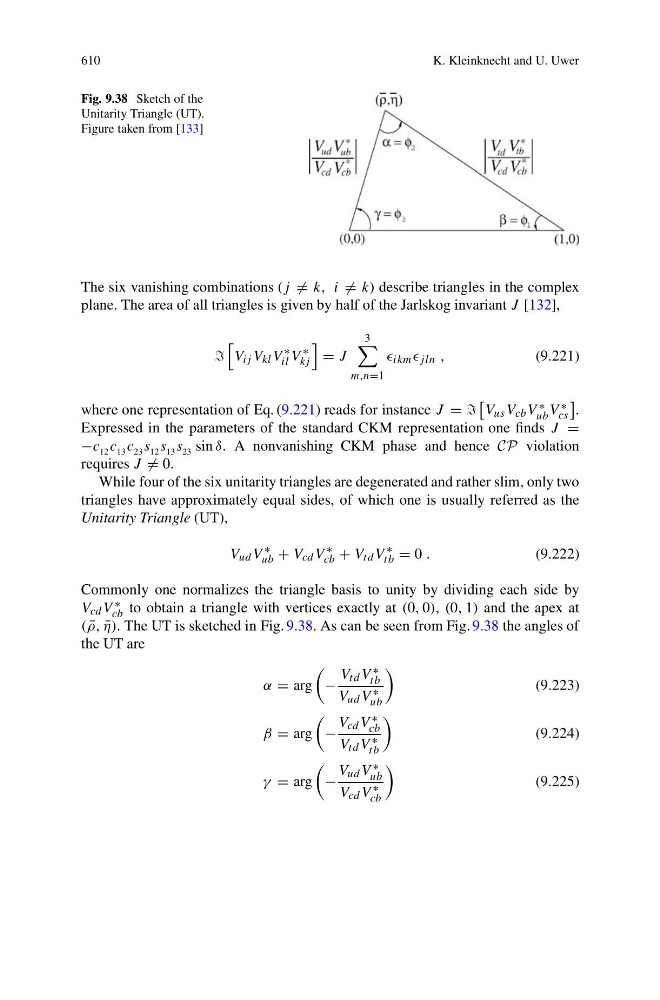
Fig. 9.38 Sketch of the
Unitarity Triangle (UT).
Figure taken from [133]
The six vanishing combinations (j = k, i = k) describe triangles in the complex
plane. The area of all triangles is given by half of the Jarlskog invariant J [132],
V ij V kl V
∗
il V
∗
kj
= J
3
m,n=1
ikm jln ,
(9.221)
where one representation of Eq. (9.221) reads for instance J = =
V us V cb V ∗
ub V ∗
cs
.
Expressed in the parameters of the standard CKM representation one finds J =
−c 12 c 13 c 23 s 12 s 13 s 23 sin δ. A nonvanishing CKM phase and hence CP violation
requires J = 0.
While four of the six unitarity triangles are degenerated and rather slim, only two
triangles have approximately equal sides, of which one is usually referred as the
Unitarity Triangle (UT),
V ud V
∗
ub + V cd V
∗
cb + V td V
∗
tb = 0 .
(9.222)
Commonly one normalizes the triangle basis to unity by dividing each side by
V cd V ∗
cb to obtain a triangle with vertices exactly at (0, 0), (0, 1) and the apex at
( ¯
ρ, ¯
η). The UT is sketched in Fig. 9.38. As can be seen from Fig. 9.38 the angles of
the UT are
α = arg
−
V td V ∗
tb
V ud V ∗
ub
(9.223)
β = arg
−
V cd V ∗
cb
V td V ∗
tb
(9.224)
γ = arg
−
V ud V ∗
ub
V cd V ∗
cb
(9.225)