

9 Symmetry Violations and Quark Flavour Physics
599
K +
K + K –
+ –
–
+
B 0
s
K –
K
h
y
x
z
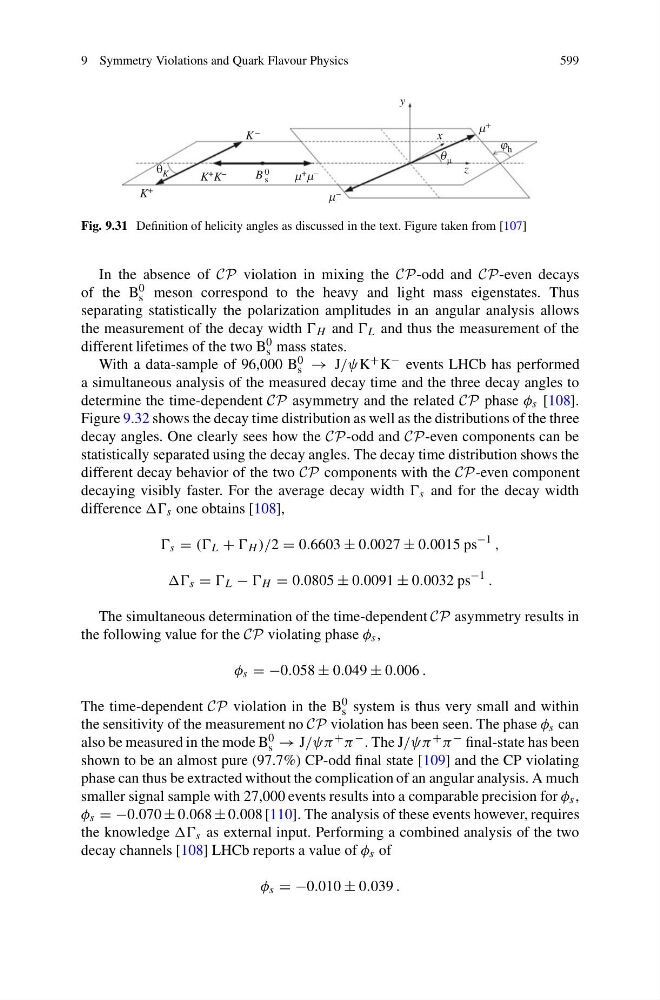
Fig. 9.31 Definition of helicity angles as discussed in the text. Figure taken from [107]
In the absence of CP violation in mixing the CP-odd and CP-even decays
of the B 0
s meson correspond to the heavy and light mass eigenstates. Thus
separating statistically the polarization amplitudes in an angular analysis allows
the measurement of the decay width H and L and thus the measurement of the
different lifetimes of the two B 0
s mass states.
With a data-sample of 96,000 B 0
s → J/ψK + K − events LHCb has performed
a simultaneous analysis of the measured decay time and the three decay angles to
determine the time-dependent CP asymmetry and the related CP phase φ s [108].
Figure 9.32 shows the decay time distribution as well as the distributions of the three
decay angles. One clearly sees how the CP-odd and CP-even components can be
statistically separated using the decay angles. The decay time distribution shows the
different decay behavior of the two CP components with the CP-even component
decaying visibly faster. For the average decay width s and for the decay width
difference s one obtains [108],
s = (( L + H )/2 = 0.6603 ± 0.0027 ± 0.0015 ps
−1 ,
s = L − H = 0.0805 ± 0.0091 ± 0.0032 ps
−1 .
The simultaneous determination of the time-dependent CP asymmetry results in
the following value for the CP violating phase φ s ,
φ s = −0.058 ± 0.049 ± 0.006 .
The time-dependent CP violation in the B 0
s system is thus very small and within
the sensitivity of the measurement no CP violation has been seen. The phase φ s can
also be measured in the mode B 0
s → J/ψπ + π − . The J/ψπ + π − final-state has been
shown to be an almost pure (97.7%) CP-odd final state [109] and the CP violating
phase can thus be extracted without the complication of an angular analysis. A much
smaller signal sample with 27,000 events results into a comparable precision for φ s ,
φ s = −0.070 ± 0.068 ± 0.008 [110]. The analysis of these events however, requires
the knowledge s as external input. Performing a combined analysis of the two
decay channels [108] LHCb reports a value of φ s of
φ s = −0.010 ± 0.039 .
599
K +
K + K –
+ –
–
+
B 0
s
K –
K
h
y
x
z
Fig. 9.31 Definition of helicity angles as discussed in the text. Figure taken from [107]
In the absence of CP violation in mixing the CP-odd and CP-even decays
of the B 0
s meson correspond to the heavy and light mass eigenstates. Thus
separating statistically the polarization amplitudes in an angular analysis allows
the measurement of the decay width H and L and thus the measurement of the
different lifetimes of the two B 0
s mass states.
With a data-sample of 96,000 B 0
s → J/ψK + K − events LHCb has performed
a simultaneous analysis of the measured decay time and the three decay angles to
determine the time-dependent CP asymmetry and the related CP phase φ s [108].
Figure 9.32 shows the decay time distribution as well as the distributions of the three
decay angles. One clearly sees how the CP-odd and CP-even components can be
statistically separated using the decay angles. The decay time distribution shows the
different decay behavior of the two CP components with the CP-even component
decaying visibly faster. For the average decay width s and for the decay width
difference s one obtains [108],
s = (( L + H )/2 = 0.6603 ± 0.0027 ± 0.0015 ps
−1 ,
s = L − H = 0.0805 ± 0.0091 ± 0.0032 ps
−1 .
The simultaneous determination of the time-dependent CP asymmetry results in
the following value for the CP violating phase φ s ,
φ s = −0.058 ± 0.049 ± 0.006 .
The time-dependent CP violation in the B 0
s system is thus very small and within
the sensitivity of the measurement no CP violation has been seen. The phase φ s can
also be measured in the mode B 0
s → J/ψπ + π − . The J/ψπ + π − final-state has been
shown to be an almost pure (97.7%) CP-odd final state [109] and the CP violating
phase can thus be extracted without the complication of an angular analysis. A much
smaller signal sample with 27,000 events results into a comparable precision for φ s ,
φ s = −0.070 ± 0.068 ± 0.008 [110]. The analysis of these events however, requires
the knowledge s as external input. Performing a combined analysis of the two
decay channels [108] LHCb reports a value of φ s of
φ s = −0.010 ± 0.039 .