

9 Symmetry Violations and Quark Flavour Physics
595
The values so far show no evidence for CP violation in mixing and are consistent
with the theory prediction of very small CP asymmetries [66].
9.6.5 CP Violation in the Interference of Mixing and Decay
The B-factories BABAR and Belle were built with the primary goal to discover CP
violation in the interference of B 0 decays to the CP eigenstate B 0 → J/ψK S with
and without mixing. Large CP violation had been predicted for this channel. Shortly
after the start of data-taking the two collaborations presented first measurements in
summer 2000. A clear evidence of the first CP violation outside the neutral K meson
was established in 2001 [59, 60].
9.6.5.1 B 0 Meson
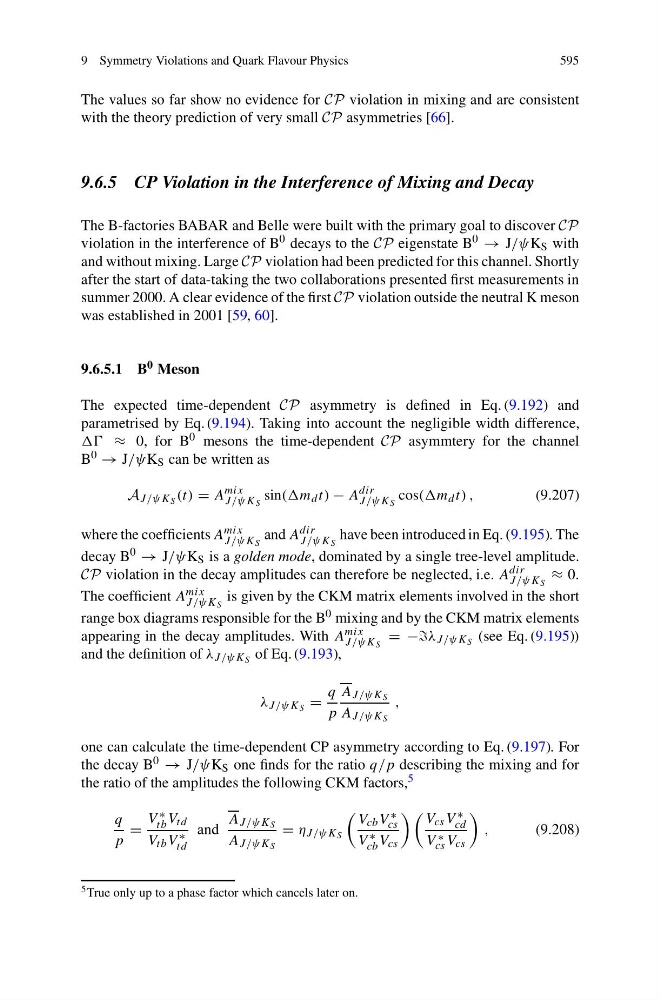
The expected time-dependent CP asymmetry is defined in Eq. (9.192) and
parametrised by Eq. (9.194). Taking into account the negligible width difference,
≈ 0, for B 0 mesons the time-dependent CP asymmtery for the channel
B 0 → J/ψK S can be written as
A J /ψK S (t) = A
mix
J /ψK S
sin((m d t) − A
dir
J /ψK S
cos((m d t) ,
(9.207)
where the coefficients A
mix
J /ψK S
and A
dir
J /ψK S
have been introduced in Eq. (9.195). The
decay B 0 → J/ψK S is a golden mode, dominated by a single tree-level amplitude.
CP violation in the decay amplitudes can therefore be neglected, i.e. A
dir
J /ψK S
≈ 0.
The coefficient A mix
J /ψK S
is given by the CKM matrix elements involved in the short
range box diagrams responsible for the B 0 mixing and by the CKM matrix elements
appearing in the decay amplitudes. With A mix
J /ψK S
= −−λ J /ψK S (see Eq. (9.195))
and the definition of λ J /ψK S of Eq. (9.193),
λ J /ψK S =
q
p
A J /ψK S
A J /ψK S
,
one can calculate the time-dependent CP asymmetry according to Eq. (9.197). For
the decay B 0 → J/ψK S one finds for the ratio q/p describing the mixing and for
the ratio of the amplitudes the following CKM factors, 5
q
p
=
V ∗
tb V td
V tb V ∗
td
and
A J /ψK S
A J /ψK S
= η J /ψK S
V cb V ∗
cs
V ∗
cb V cs
V cs V ∗
cd
V ∗
cs V cs
,
(9.208)
5 True only up to a phase factor which cancels later on.
595
The values so far show no evidence for CP violation in mixing and are consistent
with the theory prediction of very small CP asymmetries [66].
9.6.5 CP Violation in the Interference of Mixing and Decay
The B-factories BABAR and Belle were built with the primary goal to discover CP
violation in the interference of B 0 decays to the CP eigenstate B 0 → J/ψK S with
and without mixing. Large CP violation had been predicted for this channel. Shortly
after the start of data-taking the two collaborations presented first measurements in
summer 2000. A clear evidence of the first CP violation outside the neutral K meson
was established in 2001 [59, 60].
9.6.5.1 B 0 Meson
The expected time-dependent CP asymmetry is defined in Eq. (9.192) and
parametrised by Eq. (9.194). Taking into account the negligible width difference,
≈ 0, for B 0 mesons the time-dependent CP asymmtery for the channel
B 0 → J/ψK S can be written as
A J /ψK S (t) = A
mix
J /ψK S
sin((m d t) − A
dir
J /ψK S
cos((m d t) ,
(9.207)
where the coefficients A
mix
J /ψK S
and A
dir
J /ψK S
have been introduced in Eq. (9.195). The
decay B 0 → J/ψK S is a golden mode, dominated by a single tree-level amplitude.
CP violation in the decay amplitudes can therefore be neglected, i.e. A
dir
J /ψK S
≈ 0.
The coefficient A mix
J /ψK S
is given by the CKM matrix elements involved in the short
range box diagrams responsible for the B 0 mixing and by the CKM matrix elements
appearing in the decay amplitudes. With A mix
J /ψK S
= −−λ J /ψK S (see Eq. (9.195))
and the definition of λ J /ψK S of Eq. (9.193),
λ J /ψK S =
q
p
A J /ψK S
A J /ψK S
,
one can calculate the time-dependent CP asymmetry according to Eq. (9.197). For
the decay B 0 → J/ψK S one finds for the ratio q/p describing the mixing and for
the ratio of the amplitudes the following CKM factors, 5
q
p
=
V ∗
tb V td
V tb V ∗
td
and
A J /ψK S
A J /ψK S
= η J /ψK S
V cb V ∗
cs
V ∗
cb V cs
V cs V ∗
cd
V ∗
cs V cs
,
(9.208)
5 True only up to a phase factor which cancels later on.