

596
K. Kleinknecht and U. Uwer
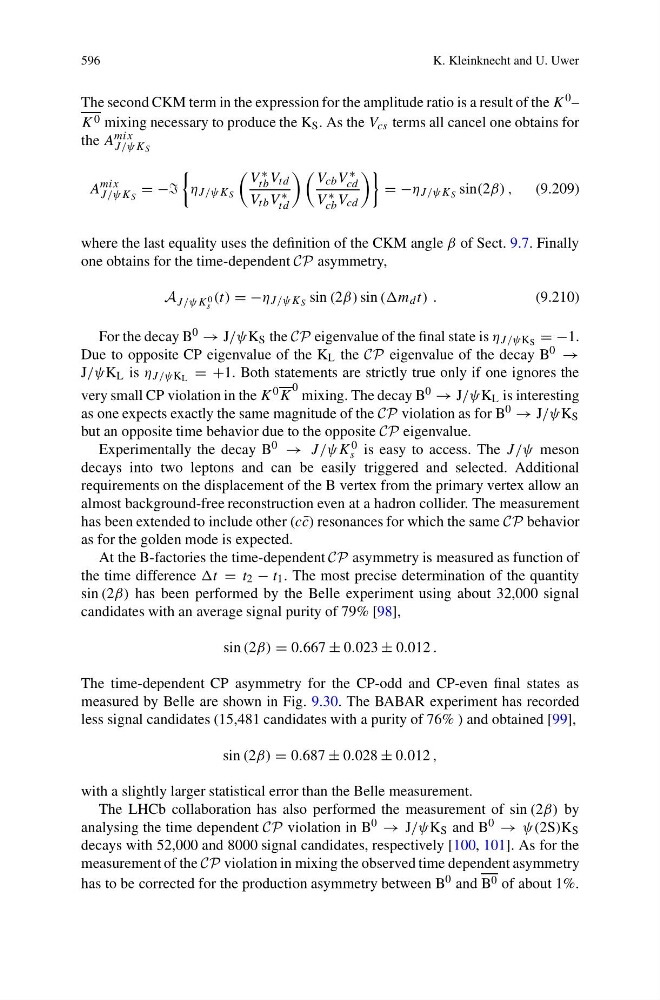
The second CKM term in the expression for the amplitude ratio is a result of the K 0 –
K 0 mixing necessary to produce the K S . As the V cs terms all cancel one obtains for
the A
mix
J /ψK S
A
mix
J /ψK S
= −−
η J /ψK S
V ∗
tb V td
V tb V ∗
td
V cb V ∗
cd
V ∗
cb V cd
= −η J /ψK S sin(2β) ,
(9.209)
where the last equality uses the definition of the CKM angle β of Sect. 9.7. Finally
one obtains for the time-dependent CP asymmetry,
A J /ψK 0
s
(t) = −η J /ψK S sin (2β) sin ( d t) .
(9.210)
For the decay B 0 → J/ψK S the CP eigenvalue of the final state is η J /ψK S = −1.
Due to opposite CP eigenvalue of the K L the CP eigenvalue of the decay B 0 →
J/ψK L is η J /ψK L = +1. Both statements are strictly true only if one ignores the
very small CP violation in the K 0 K
0 mixing. The decay B 0 → J/ψK L is interesting
as one expects exactly the same magnitude of the CP violation as for B 0 → J/ψK S
but an opposite time behavior due to the opposite CP eigenvalue.
Experimentally the decay B 0 → J/ψK 0
s is easy to access. The J/ψ meson
decays into two leptons and can be easily triggered and selected. Additional
requirements on the displacement of the B vertex from the primary vertex allow an
almost background-free reconstruction even at a hadron collider. The measurement
has been extended to include other (c ¯
c) resonances for which the same CP behavior
as for the golden mode is expected.
At the B-factories the time-dependent CP asymmetry is measured as function of
the time difference = t 2 − t 1 . The most precise determination of the quantity
sin (2β) has been performed by the Belle experiment using about 32,000 signal
candidates with an average signal purity of 79% [98],
sin (2β) = 0.667 ± 0.023 ± 0.012 .
The time-dependent CP asymmetry for the CP-odd and CP-even final states as
measured by Belle are shown in Fig. 9.30. The BABAR experiment has recorded
less signal candidates (15,481 candidates with a purity of 76% ) and obtained [99],
sin (2β) = 0.687 ± 0.028 ± 0.012 ,
with a slightly larger statistical error than the Belle measurement.
The LHCb collaboration has also performed the measurement of sin (2β) by
analysing the time dependent CP violation in B 0 → J/ψK S and B 0 → ψ(2S)K S
decays with 52,000 and 8000 signal candidates, respectively [100, 101]. As for the
measurement of the CP violation in mixing the observed time dependent asymmetry
has to be corrected for the production asymmetry between B 0 and B 0 of about 1%.
K. Kleinknecht and U. Uwer
The second CKM term in the expression for the amplitude ratio is a result of the K 0 –
K 0 mixing necessary to produce the K S . As the V cs terms all cancel one obtains for
the A
mix
J /ψK S
A
mix
J /ψK S
= −−
η J /ψK S
V ∗
tb V td
V tb V ∗
td
V cb V ∗
cd
V ∗
cb V cd
= −η J /ψK S sin(2β) ,
(9.209)
where the last equality uses the definition of the CKM angle β of Sect. 9.7. Finally
one obtains for the time-dependent CP asymmetry,
A J /ψK 0
s
(t) = −η J /ψK S sin (2β) sin ( d t) .
(9.210)
For the decay B 0 → J/ψK S the CP eigenvalue of the final state is η J /ψK S = −1.
Due to opposite CP eigenvalue of the K L the CP eigenvalue of the decay B 0 →
J/ψK L is η J /ψK L = +1. Both statements are strictly true only if one ignores the
very small CP violation in the K 0 K
0 mixing. The decay B 0 → J/ψK L is interesting
as one expects exactly the same magnitude of the CP violation as for B 0 → J/ψK S
but an opposite time behavior due to the opposite CP eigenvalue.
Experimentally the decay B 0 → J/ψK 0
s is easy to access. The J/ψ meson
decays into two leptons and can be easily triggered and selected. Additional
requirements on the displacement of the B vertex from the primary vertex allow an
almost background-free reconstruction even at a hadron collider. The measurement
has been extended to include other (c ¯
c) resonances for which the same CP behavior
as for the golden mode is expected.
At the B-factories the time-dependent CP asymmetry is measured as function of
the time difference = t 2 − t 1 . The most precise determination of the quantity
sin (2β) has been performed by the Belle experiment using about 32,000 signal
candidates with an average signal purity of 79% [98],
sin (2β) = 0.667 ± 0.023 ± 0.012 .
The time-dependent CP asymmetry for the CP-odd and CP-even final states as
measured by Belle are shown in Fig. 9.30. The BABAR experiment has recorded
less signal candidates (15,481 candidates with a purity of 76% ) and obtained [99],
sin (2β) = 0.687 ± 0.028 ± 0.012 ,
with a slightly larger statistical error than the Belle measurement.
The LHCb collaboration has also performed the measurement of sin (2β) by
analysing the time dependent CP violation in B 0 → J/ψK S and B 0 → ψ(2S)K S
decays with 52,000 and 8000 signal candidates, respectively [100, 101]. As for the
measurement of the CP violation in mixing the observed time dependent asymmetry
has to be corrected for the production asymmetry between B 0 and B 0 of about 1%.