

9 Symmetry Violations and Quark Flavour Physics
593
Measurements performed by BABAR, Belle, D0 and LHCb determine separately
the mixing asymmetries a d
SL and a s
SL for the two neutral B mesons by using partially
reconstructed semi-leptonic decays or with fully reconstructed hadronic decays.
Measuring the expected very tiny CP asymmetries requires a precise understanding
of various experimental and instrumental effects, e.g. asymmetries arising from
different detection efficiencies (A D ) or different material interaction (A I ) for the
two charge-conjugated final states. The so far most precise determination of both
mixing asymmetries has been performed by the LHCb experiment. At the LHC
the initial proton-proton collision is not a particle-antiparticle symmetric state. The
number of produced b and ¯
b hadrons of a given species is not necessarily the same
and the production asymmetry A P has also to be taken into account when the
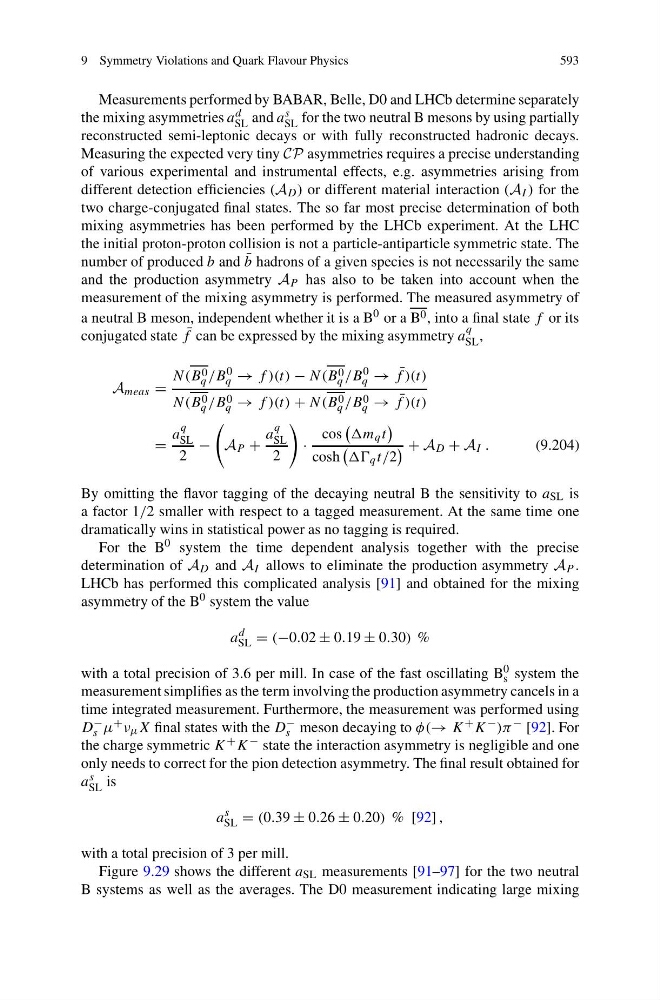
measurement of the mixing asymmetry is performed. The measured asymmetry of
a neutral B meson, independent whether it is a B 0 or a B 0 , into a final state f or its
conjugated state ¯
f can be expressed by the mixing asymmetry a
q
SL ,
A meas =
N(B 0
q /B 0
q → f )(t) − N(B 0
q /B 0
q → ¯
f )(t)
N(B 0
q /B 0
q → f )(t) + N(B 0
q /B 0
q → ¯
f )(t)
=
a
q
SL
2
−
A P +
a
q
SL
2
·
cos
q t
cosh
q t/2
+ A D + A I .
(9.204)
By omitting the flavor tagging of the decaying neutral B the sensitivity to a SL is
a factor 1/2 smaller with respect to a tagged measurement. At the same time one
dramatically wins in statistical power as no tagging is required.
For the B 0 system the time dependent analysis together with the precise
determination of A D and A I allows to eliminate the production asymmetry A P .
LHCb has performed this complicated analysis [91] and obtained for the mixing
asymmetry of the B 0 system the value
a
d
SL = (−0.02 ± 0.19 ± 0.30) %
with a total precision of 3.6 per mill. In case of the fast oscillating B 0
s system the
measurement simplifies as the term involving the production asymmetry cancels in a
time integrated measurement. Furthermore, the measurement was performed using
D −
s μ + ν μ X final states with the D −
s meson decaying to φ(→ K + K − )π − [92]. For
the charge symmetric K + K − state the interaction asymmetry is negligible and one
only needs to correct for the pion detection asymmetry. The final result obtained for
a s
SL is
a
s
SL = (0.39 ± 0.26 ± 0.20) % [92] ,
with a total precision of 3 per mill.
Figure 9.29 shows the different a SL measurements [91–97] for the two neutral
B systems as well as the averages. The D0 measurement indicating large mixing
593
Measurements performed by BABAR, Belle, D0 and LHCb determine separately
the mixing asymmetries a d
SL and a s
SL for the two neutral B mesons by using partially
reconstructed semi-leptonic decays or with fully reconstructed hadronic decays.
Measuring the expected very tiny CP asymmetries requires a precise understanding
of various experimental and instrumental effects, e.g. asymmetries arising from
different detection efficiencies (A D ) or different material interaction (A I ) for the
two charge-conjugated final states. The so far most precise determination of both
mixing asymmetries has been performed by the LHCb experiment. At the LHC
the initial proton-proton collision is not a particle-antiparticle symmetric state. The
number of produced b and ¯
b hadrons of a given species is not necessarily the same
and the production asymmetry A P has also to be taken into account when the
measurement of the mixing asymmetry is performed. The measured asymmetry of
a neutral B meson, independent whether it is a B 0 or a B 0 , into a final state f or its
conjugated state ¯
f can be expressed by the mixing asymmetry a
q
SL ,
A meas =
N(B 0
q /B 0
q → f )(t) − N(B 0
q /B 0
q → ¯
f )(t)
N(B 0
q /B 0
q → f )(t) + N(B 0
q /B 0
q → ¯
f )(t)
=
a
q
SL
2
−
A P +
a
q
SL
2
·
cos
q t
cosh
q t/2
+ A D + A I .
(9.204)
By omitting the flavor tagging of the decaying neutral B the sensitivity to a SL is
a factor 1/2 smaller with respect to a tagged measurement. At the same time one
dramatically wins in statistical power as no tagging is required.
For the B 0 system the time dependent analysis together with the precise
determination of A D and A I allows to eliminate the production asymmetry A P .
LHCb has performed this complicated analysis [91] and obtained for the mixing
asymmetry of the B 0 system the value
a
d
SL = (−0.02 ± 0.19 ± 0.30) %
with a total precision of 3.6 per mill. In case of the fast oscillating B 0
s system the
measurement simplifies as the term involving the production asymmetry cancels in a
time integrated measurement. Furthermore, the measurement was performed using
D −
s μ + ν μ X final states with the D −
s meson decaying to φ(→ K + K − )π − [92]. For
the charge symmetric K + K − state the interaction asymmetry is negligible and one
only needs to correct for the pion detection asymmetry. The final result obtained for
a s
SL is
a
s
SL = (0.39 ± 0.26 ± 0.20) % [92] ,
with a total precision of 3 per mill.
Figure 9.29 shows the different a SL measurements [91–97] for the two neutral
B systems as well as the averages. The D0 measurement indicating large mixing