

592
K. Kleinknecht and U. Uwer
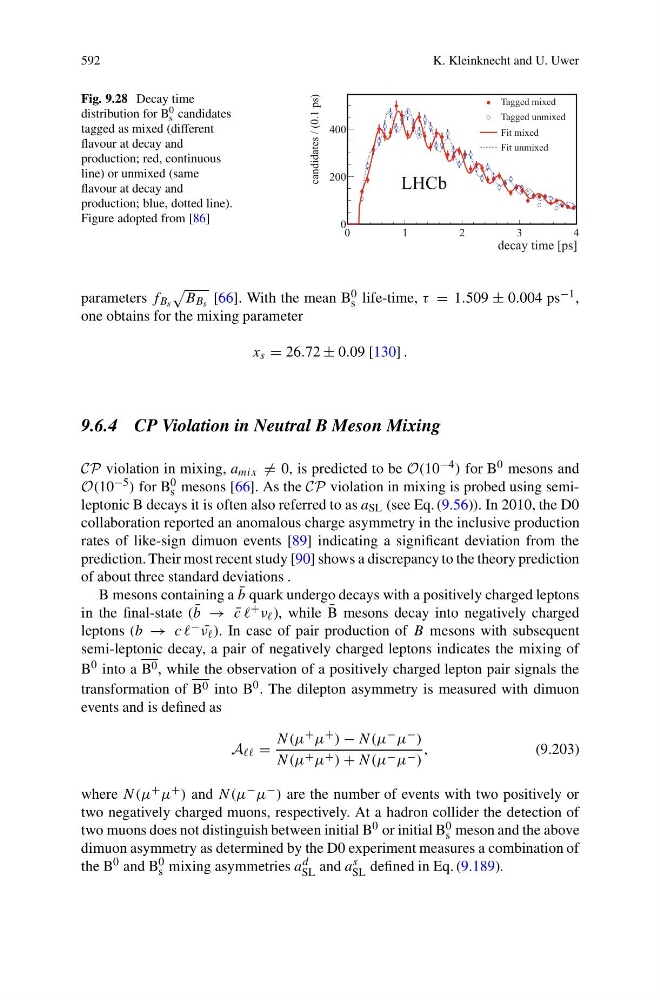
Fig. 9.28 Decay time
distribution for B 0
s candidates
tagged as mixed (different
flavour at decay and
production; red, continuous
line) or unmixed (same
flavour at decay and
production; blue, dotted line).
Figure adopted from [86]
decay time [ps]
0
1
2
3
4
candidates / (0.1 ps)
0
200
400
Tagged mixed
Tagged unmixed
Fit mixed
Fit unmixed
LHCb
parameters f B s
B B s [66]. With the mean B 0
s life-time, τ = 1.509 ± 0.004 ps −1 ,
one obtains for the mixing parameter
x s = 26.72 ± 0.09 [130] .
9.6.4 CP Violation in Neutral B Meson Mixing
CP violation in mixing, a mix = 0, is predicted to be O(10 −4 ) for B 0 mesons and
O(10 −5 ) for B 0
s mesons [66]. As the CP violation in mixing is probed using semileptonic B decays it is often also referred to as a SL (see Eq. (9.56)). In 2010, the D0
collaboration reported an anomalous charge asymmetry in the inclusive production
rates of like-sign dimuon events [89] indicating a significant deviation from the
prediction. Their most recent study [90] shows a discrepancy to the theory prediction
of about three standard deviations .
B mesons containing a ¯
b quark undergo decays with a positively charged leptons
in the final-state ( ¯
b → ¯
c c + ν ), while ¯
B mesons decay into negatively charged
leptons (b → c c − ¯
ν ). In case of pair production of B mesons with subsequent
semi-leptonic decay, a pair of negatively charged leptons indicates the mixing of
B 0 into a B 0 , while the observation of a positively charged lepton pair signals the
transformation of B 0 into B 0 . The dilepton asymmetry is measured with dimuon
events and is defined as
A =
N(μ + μ + ) − N(μ − μ − )
N(μ + μ + ) + N(μ − μ − )
,
(9.203)
where N(μ + μ + ) and N(μ − μ − ) are the number of events with two positively or
two negatively charged muons, respectively. At a hadron collider the detection of
two muons does not distinguish between initial B 0 or initial B 0
s meson and the above
dimuon asymmetry as determined by the D0 experiment measures a combination of
the B 0 and B 0
s mixing asymmetries a d
SL and a s
SL defined in Eq. (9.189).
K. Kleinknecht and U. Uwer
Fig. 9.28 Decay time
distribution for B 0
s candidates
tagged as mixed (different
flavour at decay and
production; red, continuous
line) or unmixed (same
flavour at decay and
production; blue, dotted line).
Figure adopted from [86]
decay time [ps]
0
1
2
3
4
candidates / (0.1 ps)
0
200
400
Tagged mixed
Tagged unmixed
Fit mixed
Fit unmixed
LHCb
parameters f B s
B B s [66]. With the mean B 0
s life-time, τ = 1.509 ± 0.004 ps −1 ,
one obtains for the mixing parameter
x s = 26.72 ± 0.09 [130] .
9.6.4 CP Violation in Neutral B Meson Mixing
CP violation in mixing, a mix = 0, is predicted to be O(10 −4 ) for B 0 mesons and
O(10 −5 ) for B 0
s mesons [66]. As the CP violation in mixing is probed using semileptonic B decays it is often also referred to as a SL (see Eq. (9.56)). In 2010, the D0
collaboration reported an anomalous charge asymmetry in the inclusive production
rates of like-sign dimuon events [89] indicating a significant deviation from the
prediction. Their most recent study [90] shows a discrepancy to the theory prediction
of about three standard deviations .
B mesons containing a ¯
b quark undergo decays with a positively charged leptons
in the final-state ( ¯
b → ¯
c c + ν ), while ¯
B mesons decay into negatively charged
leptons (b → c c − ¯
ν ). In case of pair production of B mesons with subsequent
semi-leptonic decay, a pair of negatively charged leptons indicates the mixing of
B 0 into a B 0 , while the observation of a positively charged lepton pair signals the
transformation of B 0 into B 0 . The dilepton asymmetry is measured with dimuon
events and is defined as
A =
N(μ + μ + ) − N(μ − μ − )
N(μ + μ + ) + N(μ − μ − )
,
(9.203)
where N(μ + μ + ) and N(μ − μ − ) are the number of events with two positively or
two negatively charged muons, respectively. At a hadron collider the detection of
two muons does not distinguish between initial B 0 or initial B 0
s meson and the above
dimuon asymmetry as determined by the D0 experiment measures a combination of
the B 0 and B 0
s mixing asymmetries a d
SL and a s
SL defined in Eq. (9.189).