

9 Symmetry Violations and Quark Flavour Physics
581
be noted that applying the definition of Sect. 9.3 for leads to a negative width
differences for the B 0
s mesons. It is therefore common practice [67] to redefine
to be positive,
= l − h .
(9.188)
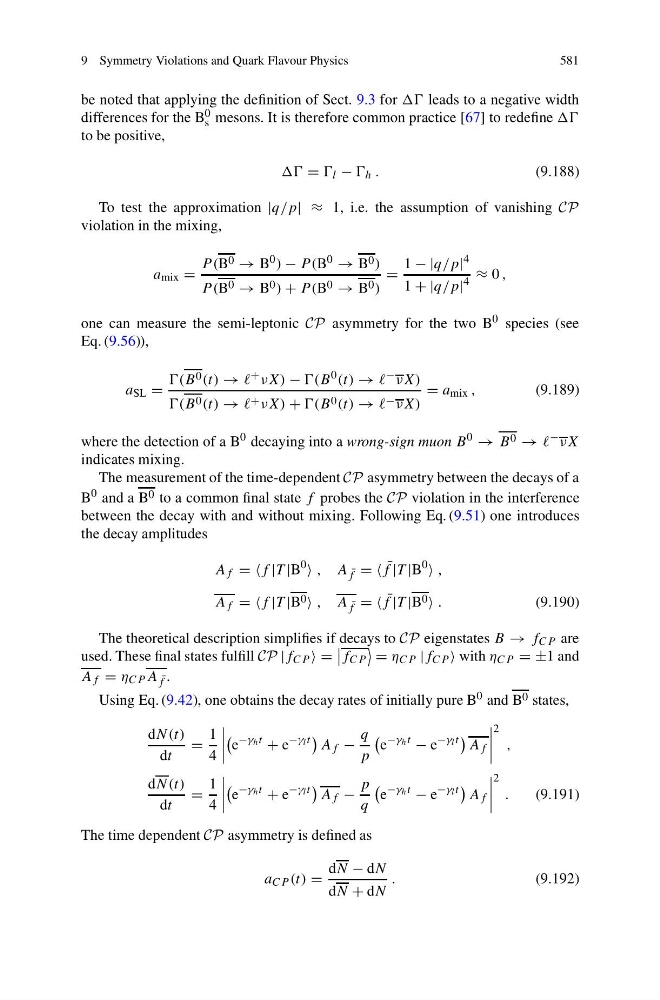
To test the approximation |q/p| ≈ 1, i.e. the assumption of vanishing CP
violation in the mixing,
a mix =
P (B 0 → B 0 ) − P (B 0 → B 0 )
P (B 0 → B 0 ) + P (B 0 → B 0 )
=
1 − |q/p| 4
1 + |q/p| 4 ≈ 0 ,
one can measure the semi-leptonic CP asymmetry for the two B 0 species (see
Eq. (9.56)),
a SL =
(B 0 (t) → + νX) − (B 0 (t) → − νX)
(B 0 (t) → + νX) + (B 0 (t) → − νX)
= a mix ,
(9.189)
where the detection of a B 0 decaying into a wrong-sign muon B 0 → B 0 → − νX
indicates mixing.
The measurement of the time-dependent CP asymmetry between the decays of a
B 0 and a B 0 to a common final state f probes the CP violation in the interference
between the decay with and without mixing. Following Eq. (9.51) one introduces
the decay amplitudes
A f = =f |T |B
0
, A ¯
f = = ¯
f |T |B
0
,
A f = =f |T |B 0 , A ¯
f = = ¯
f |T |B 0 .
(9.190)
The theoretical description simplifies if decays to CP eigenstates B → f CP are
used. These final states fulfill CP |f CP =
f CP
= η CP |f CP with η CP = ±1 and
A f = η CP A ¯
f .
Using Eq. (9.42), one obtains the decay rates of initially pure B 0 and B 0 states,
dN(t)
dt
=
1
4
e
−γ h t
+ e
−γ l t
A f −
q
p
e
−γ h t
− e
−γ l t
A f
2
,
dN(t)
dt
=
1
4
e
−γ h t
+ e
−γ l t
A f −
p
q
e
−γ h t
− e
−γ l t
A f
2
.
(9.191)
The time dependent CP asymmetry is defined as
a CP (t) =
dN − dN
dN + dN
.
(9.192)
581
be noted that applying the definition of Sect. 9.3 for leads to a negative width
differences for the B 0
s mesons. It is therefore common practice [67] to redefine
to be positive,
= l − h .
(9.188)
To test the approximation |q/p| ≈ 1, i.e. the assumption of vanishing CP
violation in the mixing,
a mix =
P (B 0 → B 0 ) − P (B 0 → B 0 )
P (B 0 → B 0 ) + P (B 0 → B 0 )
=
1 − |q/p| 4
1 + |q/p| 4 ≈ 0 ,
one can measure the semi-leptonic CP asymmetry for the two B 0 species (see
Eq. (9.56)),
a SL =
(B 0 (t) → + νX) − (B 0 (t) → − νX)
(B 0 (t) → + νX) + (B 0 (t) → − νX)
= a mix ,
(9.189)
where the detection of a B 0 decaying into a wrong-sign muon B 0 → B 0 → − νX
indicates mixing.
The measurement of the time-dependent CP asymmetry between the decays of a
B 0 and a B 0 to a common final state f probes the CP violation in the interference
between the decay with and without mixing. Following Eq. (9.51) one introduces
the decay amplitudes
A f = =f |T |B
0
, A ¯
f = = ¯
f |T |B
0
,
A f = =f |T |B 0 , A ¯
f = = ¯
f |T |B 0 .
(9.190)
The theoretical description simplifies if decays to CP eigenstates B → f CP are
used. These final states fulfill CP |f CP =
f CP
= η CP |f CP with η CP = ±1 and
A f = η CP A ¯
f .
Using Eq. (9.42), one obtains the decay rates of initially pure B 0 and B 0 states,
dN(t)
dt
=
1
4
e
−γ h t
+ e
−γ l t
A f −
q
p
e
−γ h t
− e
−γ l t
A f
2
,
dN(t)
dt
=
1
4
e
−γ h t
+ e
−γ l t
A f −
p
q
e
−γ h t
− e
−γ l t
A f
2
.
(9.191)
The time dependent CP asymmetry is defined as
a CP (t) =
dN − dN
dN + dN
.
(9.192)