

580
K. Kleinknecht and U. Uwer
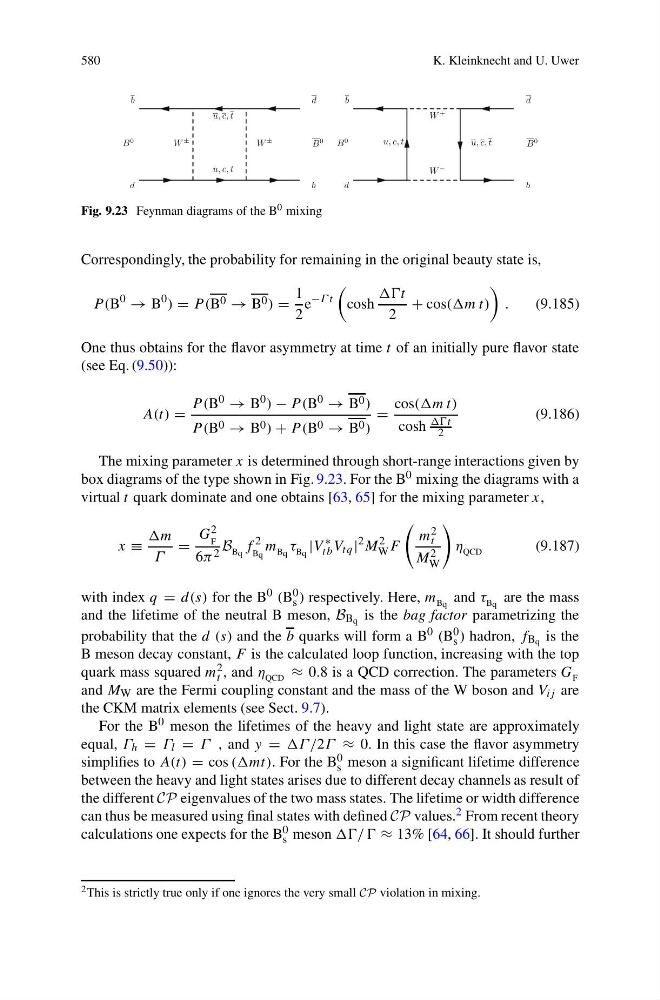
Fig. 9.23 Feynman diagrams of the B 0 mixing
Correspondingly, the probability for remaining in the original beauty state is,
P (B
0
→ B
0 ) = P (B 0 → B 0 ) =
1
2
e
−Γ t
cosh
2
+ cos((m t)
.
(9.185)
One thus obtains for the flavor asymmetry at time t of an initially pure flavor state
(see Eq. (9.50)):
A(t) =
P (B 0 → B 0 ) − P (B 0 → B 0 )
P (B 0 → B 0 ) + P (B 0 → B 0 )
=
cos((m t)
cosh
2
(9.186)
The mixing parameter x is determined through short-range interactions given by
box diagrams of the type shown in Fig. 9.23. For the B 0 mixing the diagrams with a
virtual t quark dominate and one obtains [63, 65] for the mixing parameter x,
x ≡
m
Γ
=
G 2
F
6π 2 B Bq f
2
Bq
m Bq τ Bq |V
∗
tb V tq |
2 M
2
W F
m 2
t
M 2
W
η QCD
(9.187)
with index q = d(s) for the B 0 (B 0
s ) respectively. Here, m Bq and τ Bq are the mass
and the lifetime of the neutral B meson, B B q is the bag factor parametrizing the
probability that the d (s) and the b quarks will form a B 0 (B 0
s ) hadron, f B q is the
B meson decay constant, F is the calculated loop function, increasing with the top
quark mass squared m 2
t , and η QCD ≈ 0.8 is a QCD correction. The parameters G F
and M W are the Fermi coupling constant and the mass of the W boson and V ij are
the CKM matrix elements (see Sect. 9.7).
For the B 0 meson the lifetimes of the heavy and light state are approximately
equal, Γ h = Γ l = Γ , and y = /2Γ ≈ 0. In this case the flavor asymmetry
simplifies to A(t) = cos ( For the B 0
s meson a significant lifetime difference
between the heavy and light states arises due to different decay channels as result of
the different CP eigenvalues of the two mass states. The lifetime or width difference
can thus be measured using final states with defined CP values. 2 From recent theory
calculations one expects for the B 0
s meson / ≈ 13% [64, 66]. It should further
2 This is strictly true only if one ignores the very small CP violation in mixing.
K. Kleinknecht and U. Uwer
Fig. 9.23 Feynman diagrams of the B 0 mixing
Correspondingly, the probability for remaining in the original beauty state is,
P (B
0
→ B
0 ) = P (B 0 → B 0 ) =
1
2
e
−Γ t
cosh
2
+ cos((m t)
.
(9.185)
One thus obtains for the flavor asymmetry at time t of an initially pure flavor state
(see Eq. (9.50)):
A(t) =
P (B 0 → B 0 ) − P (B 0 → B 0 )
P (B 0 → B 0 ) + P (B 0 → B 0 )
=
cos((m t)
cosh
2
(9.186)
The mixing parameter x is determined through short-range interactions given by
box diagrams of the type shown in Fig. 9.23. For the B 0 mixing the diagrams with a
virtual t quark dominate and one obtains [63, 65] for the mixing parameter x,
x ≡
m
Γ
=
G 2
F
6π 2 B Bq f
2
Bq
m Bq τ Bq |V
∗
tb V tq |
2 M
2
W F
m 2
t
M 2
W
η QCD
(9.187)
with index q = d(s) for the B 0 (B 0
s ) respectively. Here, m Bq and τ Bq are the mass
and the lifetime of the neutral B meson, B B q is the bag factor parametrizing the
probability that the d (s) and the b quarks will form a B 0 (B 0
s ) hadron, f B q is the
B meson decay constant, F is the calculated loop function, increasing with the top
quark mass squared m 2
t , and η QCD ≈ 0.8 is a QCD correction. The parameters G F
and M W are the Fermi coupling constant and the mass of the W boson and V ij are
the CKM matrix elements (see Sect. 9.7).
For the B 0 meson the lifetimes of the heavy and light state are approximately
equal, Γ h = Γ l = Γ , and y = /2Γ ≈ 0. In this case the flavor asymmetry
simplifies to A(t) = cos ( For the B 0
s meson a significant lifetime difference
between the heavy and light states arises due to different decay channels as result of
the different CP eigenvalues of the two mass states. The lifetime or width difference
can thus be measured using final states with defined CP values. 2 From recent theory
calculations one expects for the B 0
s meson / ≈ 13% [64, 66]. It should further
2 This is strictly true only if one ignores the very small CP violation in mixing.