

9 Symmetry Violations and Quark Flavour Physics
579
9.6.1 Phenomenology of Mixing in the Neutral B Meson
System
The parameters of mixing in the two neutral B mesons—the B 0 with quark content
( ¯
bd) and the B 0
s with quark content ( ¯
bs), in the following they are called both
generically B 0 —are very different from those observed in the neutral K meson
system. In Sect. 9.3 the complex decay parameters γ h and γ l are defined for the
heavy (h) and light (l) meson states (see Eq. (9.41)):
γ h = im h +
h
2
,
γ l = im l +
l
2
.
With these parameters the time evolution of the neutral B states can be written as
(see Eqs. (9.34) and (9.40))
|B h (t) = (p
B
0
− q
B 0
)e
−γ h t ,
|B l (t) = (p
B
0
+ q
B 0
)e
−γ l t .
(9.181)
The two initial states at t = 0, with a definite quantum number B , are
ψ B (0) = B
0 and ψ
B
(0) = B 0 .
(9.182)
Their decay law is not any longer exponential and results to a finite probability P
for a flavor change given by Eqs. (9.44) and (9.45). In the Standard Model, the CP
violation in mixing of neutral B mesons is expected to be very small, such that
|q/p| = 1 within O(10 −4 ) and O(10 −5 ) for the B 0 and the B 0
s system respectively
[63]. In this approximation the mixing probabilities for the two B 0 and B 0 are equal,
i.e.
P (B
0
→ B 0 ) = P (B 0 → B
0 ) ,
(9.183)
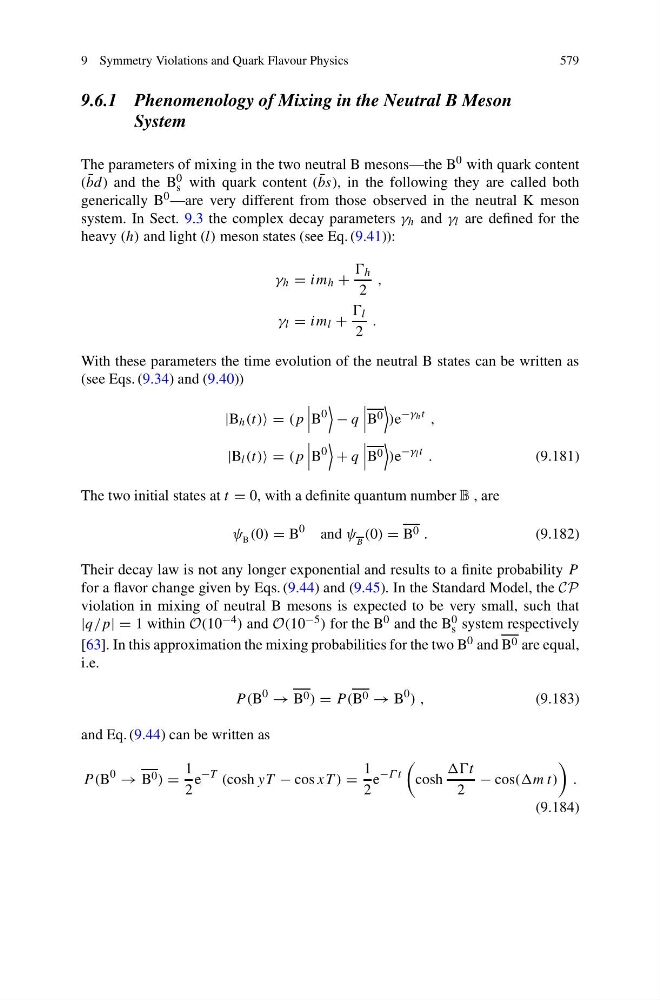
and Eq. (9.44) can be written as
P (B
0
→ B 0 ) =
1
2
e
−T (cosh yT − cos xT ) =
1
2
e
−Γ t
cosh
2
− cos((m t)
.
(9.184)
579
9.6.1 Phenomenology of Mixing in the Neutral B Meson
System
The parameters of mixing in the two neutral B mesons—the B 0 with quark content
( ¯
bd) and the B 0
s with quark content ( ¯
bs), in the following they are called both
generically B 0 —are very different from those observed in the neutral K meson
system. In Sect. 9.3 the complex decay parameters γ h and γ l are defined for the
heavy (h) and light (l) meson states (see Eq. (9.41)):
γ h = im h +
h
2
,
γ l = im l +
l
2
.
With these parameters the time evolution of the neutral B states can be written as
(see Eqs. (9.34) and (9.40))
|B h (t) = (p
B
0
− q
B 0
)e
−γ h t ,
|B l (t) = (p
B
0
+ q
B 0
)e
−γ l t .
(9.181)
The two initial states at t = 0, with a definite quantum number B , are
ψ B (0) = B
0 and ψ
B
(0) = B 0 .
(9.182)
Their decay law is not any longer exponential and results to a finite probability P
for a flavor change given by Eqs. (9.44) and (9.45). In the Standard Model, the CP
violation in mixing of neutral B mesons is expected to be very small, such that
|q/p| = 1 within O(10 −4 ) and O(10 −5 ) for the B 0 and the B 0
s system respectively
[63]. In this approximation the mixing probabilities for the two B 0 and B 0 are equal,
i.e.
P (B
0
→ B 0 ) = P (B 0 → B
0 ) ,
(9.183)
and Eq. (9.44) can be written as
P (B
0
→ B 0 ) =
1
2
e
−T (cosh yT − cos xT ) =
1
2
e
−Γ t
cosh
2
− cos((m t)
.
(9.184)