

578
K. Kleinknecht and U. Uwer
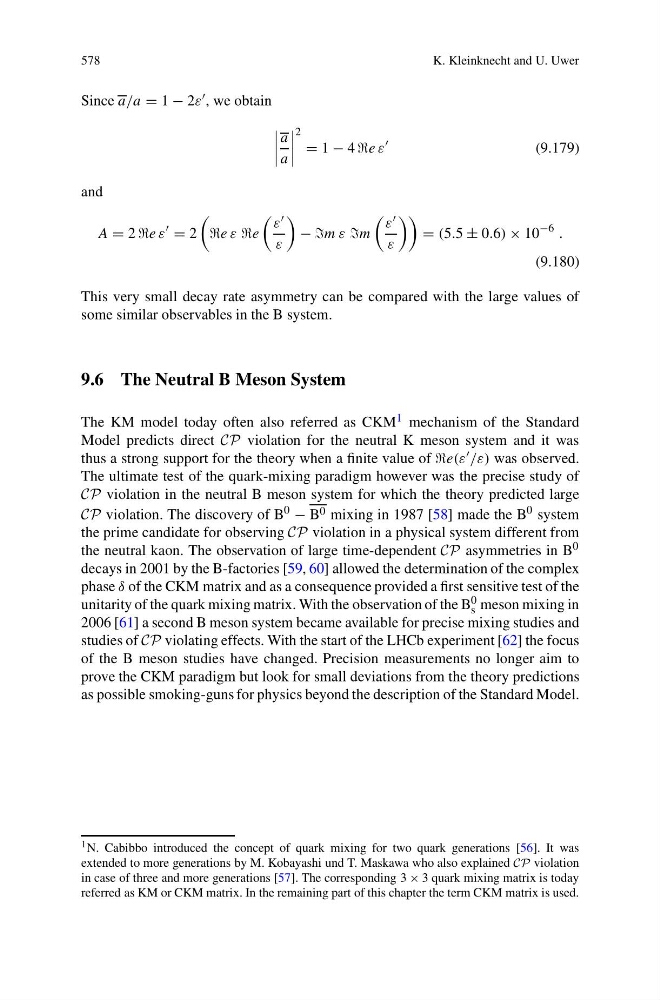
Since a/a = 1 − 2ε , we obtain
a
a
2
= 1 − 4 e ε
(9.179)
and
A = 2 e ε
= 2
e ε
ε
ε
− −m ε
ε
ε
= (5.5 ± 0.6) × 10
−6 .
(9.180)
This very small decay rate asymmetry can be compared with the large values of
some similar observables in the B system.
9.6 The Neutral B Meson System
The KM model today often also referred as CKM 1 mechanism of the Standard
Model predicts direct CP violation for the neutral K meson system and it was
thus a strong support for the theory when a finite value of e(ε /ε) was observed.
The ultimate test of the quark-mixing paradigm however was the precise study of
CP violation in the neutral B meson system for which the theory predicted large
CP violation. The discovery of B 0 − B 0 mixing in 1987 [58] made the B 0 system
the prime candidate for observing CP violation in a physical system different from
the neutral kaon. The observation of large time-dependent CP asymmetries in B 0
decays in 2001 by the B-factories [59, 60] allowed the determination of the complex
phase δ of the CKM matrix and as a consequence provided a first sensitive test of the
unitarity of the quark mixing matrix. With the observation of the B 0
s meson mixing in
2006 [61] a second B meson system became available for precise mixing studies and
studies of CP violating effects. With the start of the LHCb experiment [62] the focus
of the B meson studies have changed. Precision measurements no longer aim to
prove the CKM paradigm but look for small deviations from the theory predictions
as possible smoking-guns for physics beyond the description of the Standard Model.
1 N. Cabibbo introduced the concept of quark mixing for two quark generations [56]. It was
extended to more generations by M. Kobayashi und T. Maskawa who also explained CP violation
in case of three and more generations [57]. The corresponding 3 × 3 quark mixing matrix is today
referred as KM or CKM matrix. In the remaining part of this chapter the term CKM matrix is used.
K. Kleinknecht and U. Uwer
Since a/a = 1 − 2ε , we obtain
a
a
2
= 1 − 4 e ε
(9.179)
and
A = 2 e ε
= 2
e ε
ε
ε
− −m ε
ε
ε
= (5.5 ± 0.6) × 10
−6 .
(9.180)
This very small decay rate asymmetry can be compared with the large values of
some similar observables in the B system.
9.6 The Neutral B Meson System
The KM model today often also referred as CKM 1 mechanism of the Standard
Model predicts direct CP violation for the neutral K meson system and it was
thus a strong support for the theory when a finite value of e(ε /ε) was observed.
The ultimate test of the quark-mixing paradigm however was the precise study of
CP violation in the neutral B meson system for which the theory predicted large
CP violation. The discovery of B 0 − B 0 mixing in 1987 [58] made the B 0 system
the prime candidate for observing CP violation in a physical system different from
the neutral kaon. The observation of large time-dependent CP asymmetries in B 0
decays in 2001 by the B-factories [59, 60] allowed the determination of the complex
phase δ of the CKM matrix and as a consequence provided a first sensitive test of the
unitarity of the quark mixing matrix. With the observation of the B 0
s meson mixing in
2006 [61] a second B meson system became available for precise mixing studies and
studies of CP violating effects. With the start of the LHCb experiment [62] the focus
of the B meson studies have changed. Precision measurements no longer aim to
prove the CKM paradigm but look for small deviations from the theory predictions
as possible smoking-guns for physics beyond the description of the Standard Model.
1 N. Cabibbo introduced the concept of quark mixing for two quark generations [56]. It was
extended to more generations by M. Kobayashi und T. Maskawa who also explained CP violation
in case of three and more generations [57]. The corresponding 3 × 3 quark mixing matrix is today
referred as KM or CKM matrix. In the remaining part of this chapter the term CKM matrix is used.