

582
K. Kleinknecht and U. Uwer
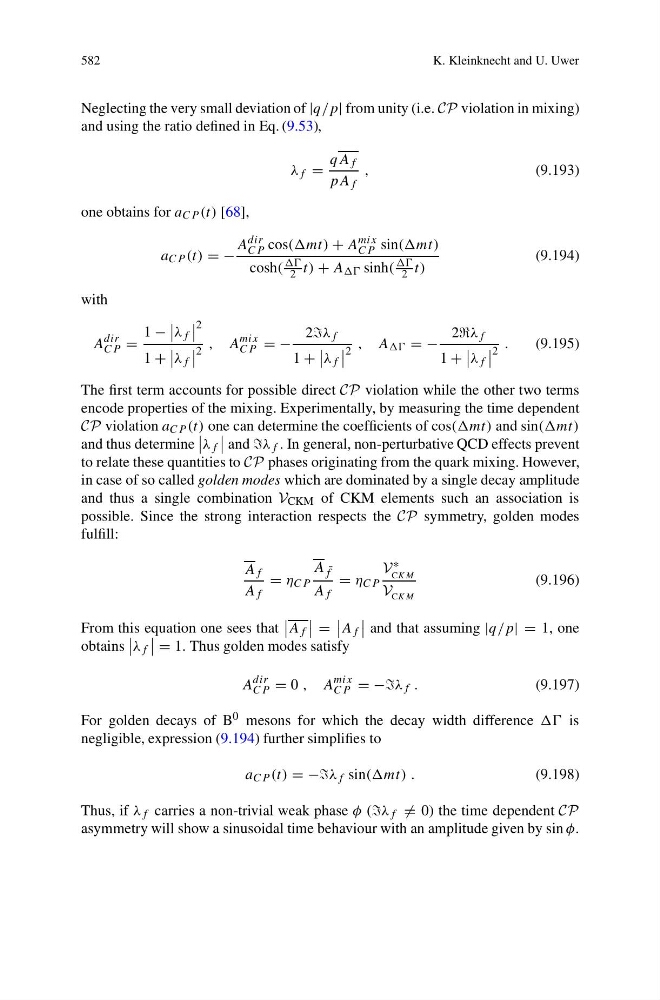
Neglecting the very small deviation of |q/p| from unity (i.e. CP violation in mixing)
and using the ratio defined in Eq. (9.53),
λ f =
qA f
pA f
,
(9.193)
one obtains for a CP (t) [68],
a CP (t) = −
A
dir
CP cos((mt) + A
mix
CP sin((mt)
cosh(
2 t) + A sinh(
2 t)
(9.194)
with
A
dir
CP =
1 −
λ f
2
1 +
λ f
2 , A
mix
CP = −
2 f
1 +
λ f
2 , A = −
2 f
1 +
λ f
2 .
(9.195)
The first term accounts for possible direct CP violation while the other two terms
encode properties of the mixing. Experimentally, by measuring the time dependent
CP violation a CP (t) one can determine the coefficients of cos((mt) and sin((mt)
and thus determine
λ f
and f . In general, non-perturbative QCD effects prevent
to relate these quantities to CP phases originating from the quark mixing. However,
in case of so called golden modes which are dominated by a single decay amplitude
and thus a single combination V CKM of CKM elements such an association is
possible. Since the strong interaction respects the CP symmetry, golden modes
fulfill:
A f
A f
= η CP
A ¯
f
A f
= η CP
V ∗
CKM
V CKM
(9.196)
From this equation one sees that
A f
=
A f
and that assuming |q/p| = 1, one
obtains
λ f
= 1. Thus golden modes satisfy
A
dir
CP = 0 , A
mix
CP = −−λ f .
(9.197)
For golden decays of B 0 mesons for which the decay width difference is
negligible, expression (9.194) further simplifies to
a CP (t) = −−λ f sin((mt) .
(9.198)
Thus, if λ f carries a non-trivial weak phase φ ( f = 0) the time dependent CP
asymmetry will show a sinusoidal time behaviour with an amplitude given by sin φ.
K. Kleinknecht and U. Uwer
Neglecting the very small deviation of |q/p| from unity (i.e. CP violation in mixing)
and using the ratio defined in Eq. (9.53),
λ f =
qA f
pA f
,
(9.193)
one obtains for a CP (t) [68],
a CP (t) = −
A
dir
CP cos((mt) + A
mix
CP sin((mt)
cosh(
2 t) + A sinh(
2 t)
(9.194)
with
A
dir
CP =
1 −
λ f
2
1 +
λ f
2 , A
mix
CP = −
2 f
1 +
λ f
2 , A = −
2 f
1 +
λ f
2 .
(9.195)
The first term accounts for possible direct CP violation while the other two terms
encode properties of the mixing. Experimentally, by measuring the time dependent
CP violation a CP (t) one can determine the coefficients of cos((mt) and sin((mt)
and thus determine
λ f
and f . In general, non-perturbative QCD effects prevent
to relate these quantities to CP phases originating from the quark mixing. However,
in case of so called golden modes which are dominated by a single decay amplitude
and thus a single combination V CKM of CKM elements such an association is
possible. Since the strong interaction respects the CP symmetry, golden modes
fulfill:
A f
A f
= η CP
A ¯
f
A f
= η CP
V ∗
CKM
V CKM
(9.196)
From this equation one sees that
A f
=
A f
and that assuming |q/p| = 1, one
obtains
λ f
= 1. Thus golden modes satisfy
A
dir
CP = 0 , A
mix
CP = −−λ f .
(9.197)
For golden decays of B 0 mesons for which the decay width difference is
negligible, expression (9.194) further simplifies to
a CP (t) = −−λ f sin((mt) .
(9.198)
Thus, if λ f carries a non-trivial weak phase φ ( f = 0) the time dependent CP
asymmetry will show a sinusoidal time behaviour with an amplitude given by sin φ.