

9 Symmetry Violations and Quark Flavour Physics
545
dispersion relation calculations or chiral perturbation theory, these results can be
used to extract arg(ε ). The results are (42.3 ± 1.5) ◦ [149] and (46.0 ± 3.6) ◦ [150].
The decomposition of the observable decay amplitude into ε and ε corresponds
to a separation of the CP-violating effects due to the mass and decay matrices
(represented by ε), which are seen also in the impurity of the K L and K S states,
from CP violation in the transition matrix element (represented by ε ).
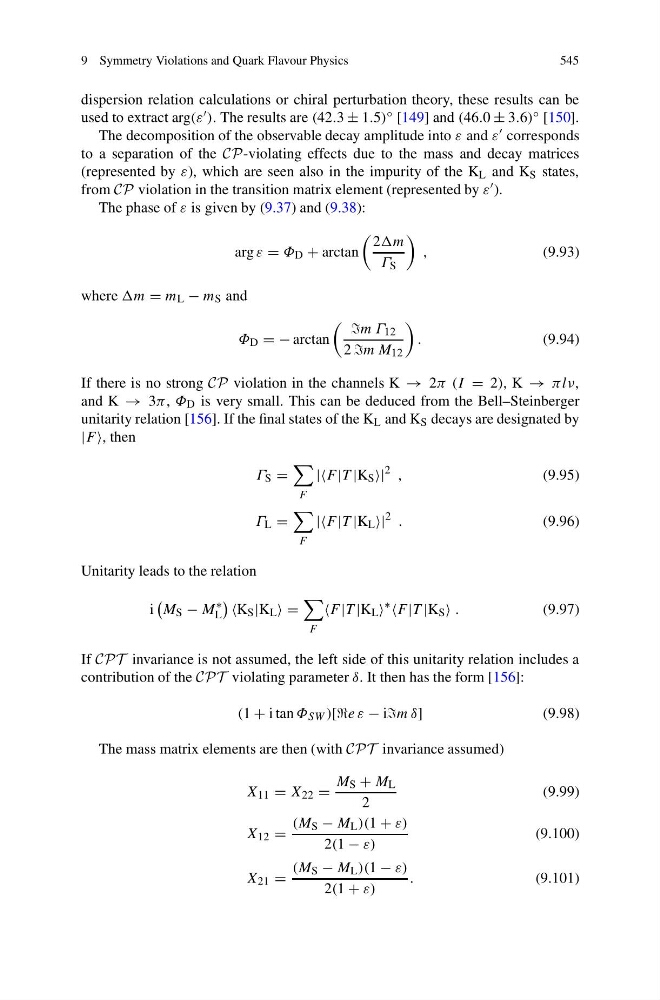
The phase of ε is given by (9.37) and (9.38):
arg ε = Φ D + arctan
2m
Γ S
,
(9.93)
where = m L − m S and
Φ D = − arctan
m Γ 12
2 m M 12
.
(9.94)
If there is no strong CP violation in the channels K → 2π (I = 2), K → πlν,
and K → 3π, Φ D is very small. This can be deduced from the Bell–Steinberger
unitarity relation [156]. If the final states of the K L and K S decays are designated by
|F , then
Γ S =
F
| |T |K S |
2 ,
(9.95)
Γ L =
F
| |T |K L |
2 .
(9.96)
Unitarity leads to the relation
i
M S − M
∗
L
S |K L =
F
|T |K L
∗
|T |K S .
(9.97)
If CPT invariance is not assumed, the left side of this unitarity relation includes a
contribution of the CPT violating parameter δ. It then has the form [156]:
(1 + i tan Φ SW )[[e ε − im δ]
(9.98)
The mass matrix elements are then (with CPT invariance assumed)
X 11 = X 22 =
M S + M L
2
(9.99)
X 12 =
(M S − M L )(1 + ε)
2(1 − ε)
(9.100)
X 21 =
(M S − M L )(1 − ε)
2(1 + ε)
.
(9.101)
545
dispersion relation calculations or chiral perturbation theory, these results can be
used to extract arg(ε ). The results are (42.3 ± 1.5) ◦ [149] and (46.0 ± 3.6) ◦ [150].
The decomposition of the observable decay amplitude into ε and ε corresponds
to a separation of the CP-violating effects due to the mass and decay matrices
(represented by ε), which are seen also in the impurity of the K L and K S states,
from CP violation in the transition matrix element (represented by ε ).
The phase of ε is given by (9.37) and (9.38):
arg ε = Φ D + arctan
2m
Γ S
,
(9.93)
where = m L − m S and
Φ D = − arctan
m Γ 12
2 m M 12
.
(9.94)
If there is no strong CP violation in the channels K → 2π (I = 2), K → πlν,
and K → 3π, Φ D is very small. This can be deduced from the Bell–Steinberger
unitarity relation [156]. If the final states of the K L and K S decays are designated by
|F , then
Γ S =
F
| |T |K S |
2 ,
(9.95)
Γ L =
F
| |T |K L |
2 .
(9.96)
Unitarity leads to the relation
i
M S − M
∗
L
S |K L =
F
|T |K L
∗
|T |K S .
(9.97)
If CPT invariance is not assumed, the left side of this unitarity relation includes a
contribution of the CPT violating parameter δ. It then has the form [156]:
(1 + i tan Φ SW )[[e ε − im δ]
(9.98)
The mass matrix elements are then (with CPT invariance assumed)
X 11 = X 22 =
M S + M L
2
(9.99)
X 12 =
(M S − M L )(1 + ε)
2(1 − ε)
(9.100)
X 21 =
(M S − M L )(1 − ε)
2(1 + ε)
.
(9.101)