

546
K. Kleinknecht and U. Uwer
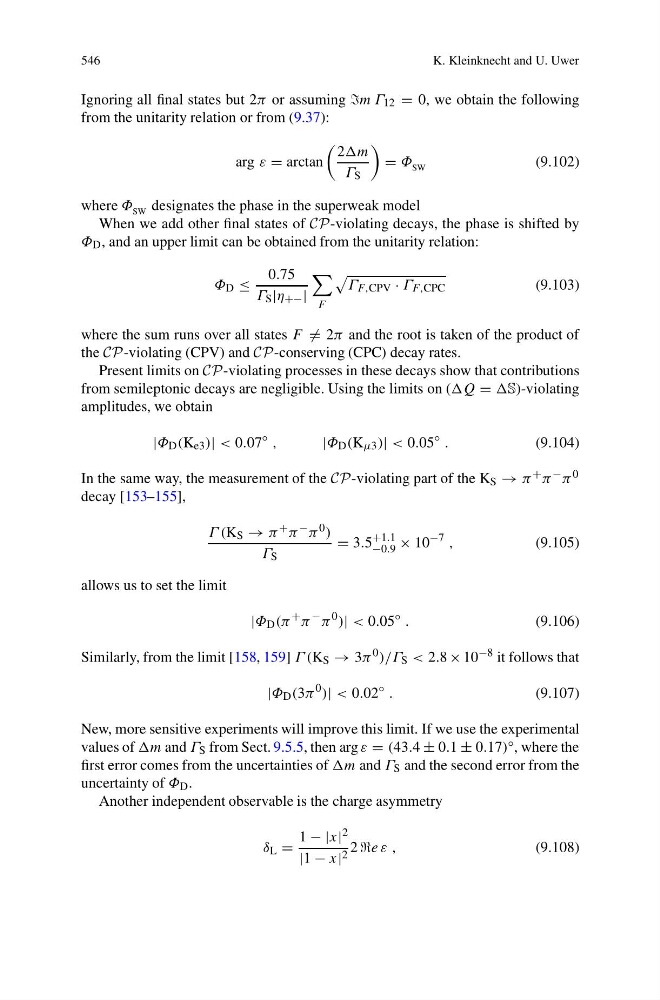
Ignoring all final states but 2π or assuming m Γ 12 = 0, we obtain the following
from the unitarity relation or from (9.37):
arg ε = arctan
2m
Γ S
= Φ SW
(9.102)
where Φ SW designates the phase in the superweak model
When we add other final states of CP-violating decays, the phase is shifted by
Φ D , and an upper limit can be obtained from the unitarity relation:
Φ D ≤
0.75
Γ S |η +− |
F
Γ F,CPV · Γ F,CPC
(9.103)
where the sum runs over all states F = 2π and the root is taken of the product of
the CP-violating (CPV) and CP-conserving (CPC) decay rates.
Present limits on CP-violating processes in these decays show that contributions
from semileptonic decays are negligible. Using the limits on ( =
amplitudes, we obtain
|Φ D (K e3 )| < 0.07
◦ ,
|Φ D (K μ3 )| < 0.05
◦ .
(9.104)
In the same way, the measurement of the CP-violating part of the K S → π + π − π 0
decay [153–155],
Γ (K S → π + π − π 0 )
Γ S
= 3.5
+1.1
−0.9 × 10
−7 ,
(9.105)
allows us to set the limit
|Φ D (π
+ π
− π
0 )| < 0.05
◦ .
(9.106)
Similarly, from the limit [158, 159] Γ (K S → 3π 0 )/Γ S < 2.8 × 10 −8 it follows that
|Φ D (3π
0 )| < 0.02
◦ .
(9.107)
New, more sensitive experiments will improve this limit. If we use the experimental
values of m and Γ S from Sect. 9.5.5, then arg ε = (43.4 ± 0.1 ± 0.17) ◦ , where the
first error comes from the uncertainties of m and Γ S and the second error from the
uncertainty of Φ D .
Another independent observable is the charge asymmetry
δ L =
1 − |x| 2
|1 − x| 2 2 e ε ,
(9.108)
K. Kleinknecht and U. Uwer
Ignoring all final states but 2π or assuming m Γ 12 = 0, we obtain the following
from the unitarity relation or from (9.37):
arg ε = arctan
2m
Γ S
= Φ SW
(9.102)
where Φ SW designates the phase in the superweak model
When we add other final states of CP-violating decays, the phase is shifted by
Φ D , and an upper limit can be obtained from the unitarity relation:
Φ D ≤
0.75
Γ S |η +− |
F
Γ F,CPV · Γ F,CPC
(9.103)
where the sum runs over all states F = 2π and the root is taken of the product of
the CP-violating (CPV) and CP-conserving (CPC) decay rates.
Present limits on CP-violating processes in these decays show that contributions
from semileptonic decays are negligible. Using the limits on ( =
amplitudes, we obtain
|Φ D (K e3 )| < 0.07
◦ ,
|Φ D (K μ3 )| < 0.05
◦ .
(9.104)
In the same way, the measurement of the CP-violating part of the K S → π + π − π 0
decay [153–155],
Γ (K S → π + π − π 0 )
Γ S
= 3.5
+1.1
−0.9 × 10
−7 ,
(9.105)
allows us to set the limit
|Φ D (π
+ π
− π
0 )| < 0.05
◦ .
(9.106)
Similarly, from the limit [158, 159] Γ (K S → 3π 0 )/Γ S < 2.8 × 10 −8 it follows that
|Φ D (3π
0 )| < 0.02
◦ .
(9.107)
New, more sensitive experiments will improve this limit. If we use the experimental
values of m and Γ S from Sect. 9.5.5, then arg ε = (43.4 ± 0.1 ± 0.17) ◦ , where the
first error comes from the uncertainties of m and Γ S and the second error from the
uncertainty of Φ D .
Another independent observable is the charge asymmetry
δ L =
1 − |x| 2
|1 − x| 2 2 e ε ,
(9.108)