

544
K. Kleinknecht and U. Uwer
we obtain
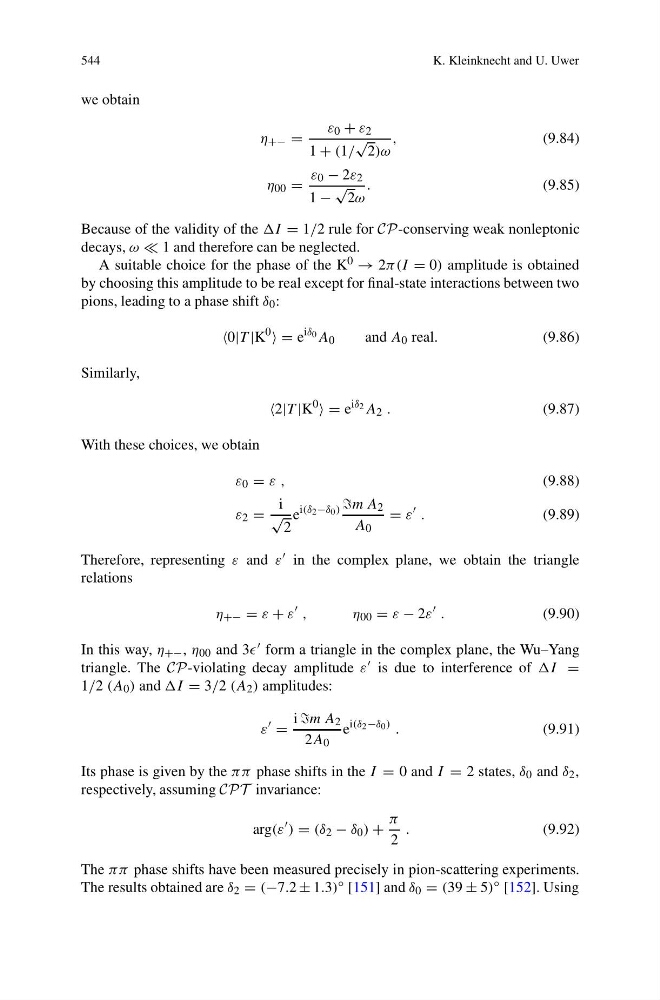
η +− =
ε 0 + ε 2
1 + (1/
√
2)ω
,
(9.84)
η 00 =
ε 0 − 2ε 2
1 −
√
2ω
.
(9.85)
Because of the validity of the = 1/2 rule for CP-conserving weak nonleptonic
decays, ω 1 and therefore can be neglected.
A suitable choice for the phase of the K 0 → 2π(I = 0) amplitude is obtained
by choosing this amplitude to be real except for final-state interactions between two
pions, leading to a phase shift δ 0 :
|K
0
= e
iδ 0 A 0
and A 0 real.
(9.86)
Similarly,
|K
0
= e
iδ 2 A 2 .
(9.87)
With these choices, we obtain
ε 0 = ε ,
(9.88)
ε 2 =
i
√
2
e
i(δ 2 −δ 0 ) m A 2
A 0
= ε
.
(9.89)
Therefore, representing ε and ε in the complex plane, we obtain the triangle
relations
η +− = ε + ε
,
η 00 = ε − 2ε
.
(9.90)
In this way, η +− , η 00 and 3 form a triangle in the complex plane, the Wu–Yang
triangle. The CP-violating decay amplitude ε is due to interference of =
1/2 (A 0 ) and = 3/2 (A 2 ) amplitudes:
ε
=
i m A 2
2A 0
e
i(δ 2 −δ 0 ) .
(9.91)
Its phase is given by the ππ phase shifts in the I = 0 and I = 2 states, δ 0 and δ 2 ,
respectively, assuming CPT invariance:
arg(ε
) = (δ 2 − δ 0 ) +
π
2
.
(9.92)
The ππ phase shifts have been measured precisely in pion-scattering experiments.
The results obtained are δ 2 = (−7.2 ± 1.3) ◦ [151] and δ 0 = (39 ± 5) ◦ [152]. Using
K. Kleinknecht and U. Uwer
we obtain
η +− =
ε 0 + ε 2
1 + (1/
√
2)ω
,
(9.84)
η 00 =
ε 0 − 2ε 2
1 −
√
2ω
.
(9.85)
Because of the validity of the = 1/2 rule for CP-conserving weak nonleptonic
decays, ω 1 and therefore can be neglected.
A suitable choice for the phase of the K 0 → 2π(I = 0) amplitude is obtained
by choosing this amplitude to be real except for final-state interactions between two
pions, leading to a phase shift δ 0 :
|K
0
= e
iδ 0 A 0
and A 0 real.
(9.86)
Similarly,
|K
0
= e
iδ 2 A 2 .
(9.87)
With these choices, we obtain
ε 0 = ε ,
(9.88)
ε 2 =
i
√
2
e
i(δ 2 −δ 0 ) m A 2
A 0
= ε
.
(9.89)
Therefore, representing ε and ε in the complex plane, we obtain the triangle
relations
η +− = ε + ε
,
η 00 = ε − 2ε
.
(9.90)
In this way, η +− , η 00 and 3 form a triangle in the complex plane, the Wu–Yang
triangle. The CP-violating decay amplitude ε is due to interference of =
1/2 (A 0 ) and = 3/2 (A 2 ) amplitudes:
ε
=
i m A 2
2A 0
e
i(δ 2 −δ 0 ) .
(9.91)
Its phase is given by the ππ phase shifts in the I = 0 and I = 2 states, δ 0 and δ 2 ,
respectively, assuming CPT invariance:
arg(ε
) = (δ 2 − δ 0 ) +
π
2
.
(9.92)
The ππ phase shifts have been measured precisely in pion-scattering experiments.
The results obtained are δ 2 = (−7.2 ± 1.3) ◦ [151] and δ 0 = (39 ± 5) ◦ [152]. Using