

9 Symmetry Violations and Quark Flavour Physics
541
the decay rates of K L to π + π − and to π 0 π 0 are equal. The predicted value of ε
within the KM model can be estimated if one infers the magnitude of the mixing
angles from other experiments and if the hadronic matrix elements for box graphs
and penguin graphs are calculated. Typical values of |ε /ε| are in the range +(0.05–
2.0)×10 −3 for three generations of quarks. A measurement of this quantity to this
level of precision therefore becomes the experimentum crucis for our understanding
of CP violation. If ε is orthogonal to ε, then a measurement of the phases of η +−
and of η 00 (see Eqs. (9.79) and (9.80), respectively) can help to detect a finite value
of m(ε /ε). If, however, the phase of ε is close to that of ε, and since |ε /ε| | 1
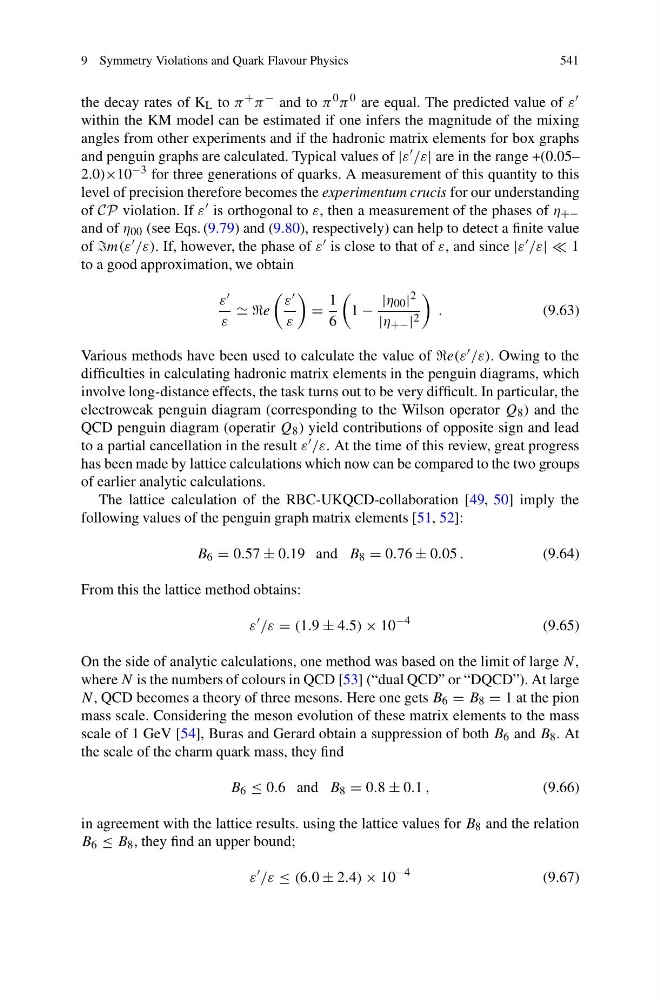
to a good approximation, we obtain
ε
ε
ε
ε
=
1
6
1 −
|η 00 | 2
|η +− | 2
.
(9.63)
Various methods have been used to calculate the value of e(ε /ε). Owing to the
difficulties in calculating hadronic matrix elements in the penguin diagrams, which
involve long-distance effects, the task turns out to be very difficult. In particular, the
electroweak penguin diagram (corresponding to the Wilson operator Q 8 ) and the
QCD penguin diagram (operatir Q 8 ) yield contributions of opposite sign and lead
to a partial cancellation in the result ε /ε. At the time of this review, great progress
has been made by lattice calculations which now can be compared to the two groups
of earlier analytic calculations.
The lattice calculation of the RBC-UKQCD-collaboration [49, 50] imply the
following values of the penguin graph matrix elements [51, 52]:
B 6 = 0.57 ± 0.19 and B 8 = 0.76 ± 0.05 .
(9.64)
From this the lattice method obtains:
ε
/ε = (1.9 ± 4.5) × 10
−4
(9.65)
On the side of analytic calculations, one method was based on the limit of large N,
where N is the numbers of colours in QCD [53] (“dual QCD” or “DQCD”). At large
N, QCD becomes a theory of three mesons. Here one gets B 6 = B 8 = 1 at the pion
mass scale. Considering the meson evolution of these matrix elements to the mass
scale of 1 GeV [54], Buras and Gerard obtain a suppression of both B 6 and B 8 . At
the scale of the charm quark mass, they find
B 6 ≤ 0.6 and B 8 = 0.8 ± 0.1 ,
(9.66)
in agreement with the lattice results. using the lattice values for B 8 and the relation
B 6 ≤ B 8 , they find an upper bound;
ε
/ε ≤ (6.0 ± 2.4) × 10
−4
(9.67)
541
the decay rates of K L to π + π − and to π 0 π 0 are equal. The predicted value of ε
within the KM model can be estimated if one infers the magnitude of the mixing
angles from other experiments and if the hadronic matrix elements for box graphs
and penguin graphs are calculated. Typical values of |ε /ε| are in the range +(0.05–
2.0)×10 −3 for three generations of quarks. A measurement of this quantity to this
level of precision therefore becomes the experimentum crucis for our understanding
of CP violation. If ε is orthogonal to ε, then a measurement of the phases of η +−
and of η 00 (see Eqs. (9.79) and (9.80), respectively) can help to detect a finite value
of m(ε /ε). If, however, the phase of ε is close to that of ε, and since |ε /ε| | 1
to a good approximation, we obtain
ε
ε
ε
ε
=
1
6
1 −
|η 00 | 2
|η +− | 2
.
(9.63)
Various methods have been used to calculate the value of e(ε /ε). Owing to the
difficulties in calculating hadronic matrix elements in the penguin diagrams, which
involve long-distance effects, the task turns out to be very difficult. In particular, the
electroweak penguin diagram (corresponding to the Wilson operator Q 8 ) and the
QCD penguin diagram (operatir Q 8 ) yield contributions of opposite sign and lead
to a partial cancellation in the result ε /ε. At the time of this review, great progress
has been made by lattice calculations which now can be compared to the two groups
of earlier analytic calculations.
The lattice calculation of the RBC-UKQCD-collaboration [49, 50] imply the
following values of the penguin graph matrix elements [51, 52]:
B 6 = 0.57 ± 0.19 and B 8 = 0.76 ± 0.05 .
(9.64)
From this the lattice method obtains:
ε
/ε = (1.9 ± 4.5) × 10
−4
(9.65)
On the side of analytic calculations, one method was based on the limit of large N,
where N is the numbers of colours in QCD [53] (“dual QCD” or “DQCD”). At large
N, QCD becomes a theory of three mesons. Here one gets B 6 = B 8 = 1 at the pion
mass scale. Considering the meson evolution of these matrix elements to the mass
scale of 1 GeV [54], Buras and Gerard obtain a suppression of both B 6 and B 8 . At
the scale of the charm quark mass, they find
B 6 ≤ 0.6 and B 8 = 0.8 ± 0.1 ,
(9.66)
in agreement with the lattice results. using the lattice values for B 8 and the relation
B 6 ≤ B 8 , they find an upper bound;
ε
/ε ≤ (6.0 ± 2.4) × 10
−4
(9.67)