

540
K. Kleinknecht and U. Uwer
Here G F is the Fermi constant, f K the kaon decay constant, B K the kaon bag factor
(0.80 ± 0.15), and F (M 2
t , m 2
c ) the loop function due to interference of the top and
charm graphs, given by
F (m 2
t , m 2
c ) = =e
V ∗
cs V cd
η 1 S 0
m 2
c
− η 3 S 0
m 2
c , m 2
t
− −e
V ∗
ts V td
η 2 S 0
m 2
t
,
(9.61)
where S 0 (m 2
t ) is a kinematical factor, and η 1 , η 2 , and η 3 are QCD correction factors.
For the B 0
d –B 0
d mixing, a similar box graph applies, with the s quark replaced
by a b quark. Here the amplitude is proportional to G 2
F
V tb V ∗
tb V td V ∗
td . Analogous
diagrams can be calculated for B 0
s (bs) mixing and for D 0 (cd) mixing.
All CP-violating amplitudes in the KM model are proportional to the following
product of the three mixing angles and the phase δ (Sect. 9.7),
J = |V us V ub V cb sin δ|
(9.62)
A necessary consequence of this model of CP violation is the non-equality of the
relative decay rates for K L → π + π − and K L → π 0 π 0 . This “direct CP violation”
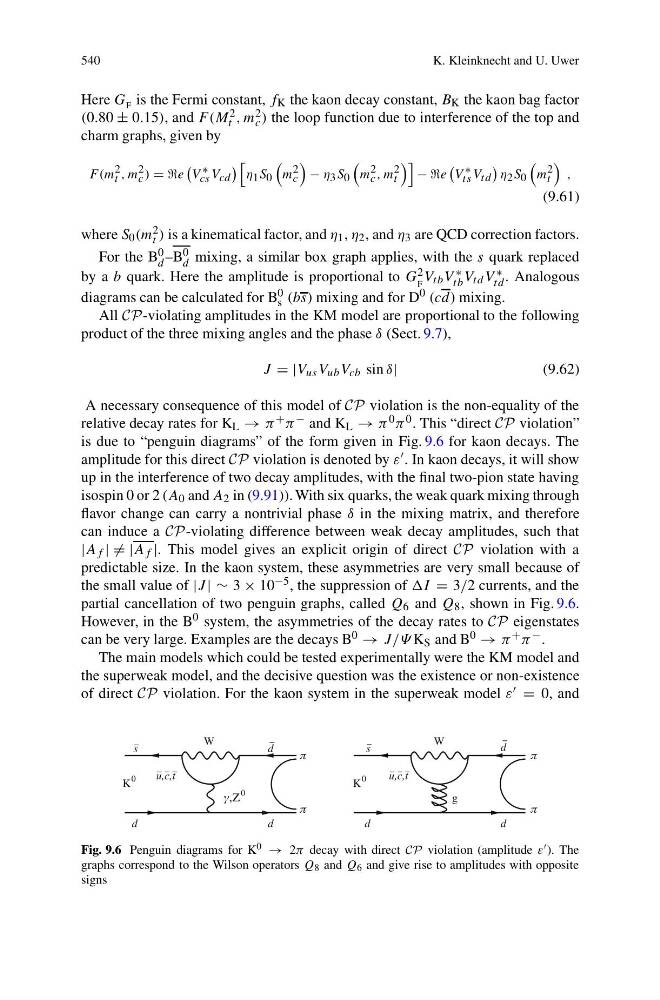
is due to “penguin diagrams” of the form given in Fig. 9.6 for kaon decays. The
amplitude for this direct CP violation is denoted by ε . In kaon decays, it will show
up in the interference of two decay amplitudes, with the final two-pion state having
isospin 0 or 2 (A 0 and A 2 in (9.91)). With six quarks, the weak quark mixing through
flavor change can carry a nontrivial phase δ in the mixing matrix, and therefore
can induce a CP-violating difference between weak decay amplitudes, such that
|A f | = |A f |. This model gives an explicit origin of direct CP violation with a
predictable size. In the kaon system, these asymmetries are very small because of
the small value of |J | ∼ 3 × 10 −5 , the suppression of = 3/2 currents, and the
partial cancellation of two penguin graphs, called Q 6 and Q 8 , shown in Fig. 9.6.
However, in the B 0 system, the asymmetries of the decay rates to CP eigenstates
can be very large. Examples are the decays B 0 → J/Ψ K S and B 0 → π + π − .
The main models which could be tested experimentally were the KM model and
the superweak model, and the decisive question was the existence or non-existence
of direct CP violation. For the kaon system in the superweak model ε = 0, and
Fig. 9.6 Penguin diagrams for K 0 → 2π decay with direct CP violation (amplitude ε ). The
graphs correspond to the Wilson operators Q 8 and Q 6 and give rise to amplitudes with opposite
signs
K. Kleinknecht and U. Uwer
Here G F is the Fermi constant, f K the kaon decay constant, B K the kaon bag factor
(0.80 ± 0.15), and F (M 2
t , m 2
c ) the loop function due to interference of the top and
charm graphs, given by
F (m 2
t , m 2
c ) = =e
V ∗
cs V cd
η 1 S 0
m 2
c
− η 3 S 0
m 2
c , m 2
t
− −e
V ∗
ts V td
η 2 S 0
m 2
t
,
(9.61)
where S 0 (m 2
t ) is a kinematical factor, and η 1 , η 2 , and η 3 are QCD correction factors.
For the B 0
d –B 0
d mixing, a similar box graph applies, with the s quark replaced
by a b quark. Here the amplitude is proportional to G 2
F
V tb V ∗
tb V td V ∗
td . Analogous
diagrams can be calculated for B 0
s (bs) mixing and for D 0 (cd) mixing.
All CP-violating amplitudes in the KM model are proportional to the following
product of the three mixing angles and the phase δ (Sect. 9.7),
J = |V us V ub V cb sin δ|
(9.62)
A necessary consequence of this model of CP violation is the non-equality of the
relative decay rates for K L → π + π − and K L → π 0 π 0 . This “direct CP violation”
is due to “penguin diagrams” of the form given in Fig. 9.6 for kaon decays. The
amplitude for this direct CP violation is denoted by ε . In kaon decays, it will show
up in the interference of two decay amplitudes, with the final two-pion state having
isospin 0 or 2 (A 0 and A 2 in (9.91)). With six quarks, the weak quark mixing through
flavor change can carry a nontrivial phase δ in the mixing matrix, and therefore
can induce a CP-violating difference between weak decay amplitudes, such that
|A f | = |A f |. This model gives an explicit origin of direct CP violation with a
predictable size. In the kaon system, these asymmetries are very small because of
the small value of |J | ∼ 3 × 10 −5 , the suppression of = 3/2 currents, and the
partial cancellation of two penguin graphs, called Q 6 and Q 8 , shown in Fig. 9.6.
However, in the B 0 system, the asymmetries of the decay rates to CP eigenstates
can be very large. Examples are the decays B 0 → J/Ψ K S and B 0 → π + π − .
The main models which could be tested experimentally were the KM model and
the superweak model, and the decisive question was the existence or non-existence
of direct CP violation. For the kaon system in the superweak model ε = 0, and
Fig. 9.6 Penguin diagrams for K 0 → 2π decay with direct CP violation (amplitude ε ). The
graphs correspond to the Wilson operators Q 8 and Q 6 and give rise to amplitudes with opposite
signs