

9 Symmetry Violations and Quark Flavour Physics
539
M KK ∼ G 2
F
m 2
p where the proton mass m p is used as a cutoff in the integration,
this yields g ∼ G F m 2
p ≈ 10 −8 .
This superweak interaction can be detected only in the K L –K S and B 0 –B 0
systems because these are the only known pairs of states with such a small
difference in energy that they are sensitive to forces weaker than the second-order
weak interaction. The clear prediction of this model is that there is no direct CP
violation in the decay.
For models other than the superweak one, violations of CP or T should manifest
themselves in other reactions of particles or nuclei. One observable is the electric
dipole moment (EDM) of the neutron. Most milliweak models predict this EDM
to be of order 10 −23 ecm to 10 −24 ecm, while the superweak model predicts
10 −29 ecm. The present experimental upper limit is 0.63 × 10 −25 ecm.
One of the milliweak models mentioned above under item 3 of the enumeration
which is rather clear in its predictions should be noted: this is the idea of Kobayashi
and Maskawa (KM) dating from 1973 [48]. At the time of the discovery of CP
violation, only three quarks were known, and there was no possibility of explaining
CP violation as a genuine phenomenon of weak interactions with left-handed
charged currents and an absence of flavor-changing neutral currents. This situation
remained unchanged with the introduction of a fourth quark because the 2×2 unitary
weak quark mixing matrix has only one free parameter, the Cabibbo angle, and no
nontrivial complex phase. However, as remarked by Kobayashi and Maskawa, the
picture changes if six quarks are present. In this case the 3×3 unitary mixing matrix
V ik naturally contains a phase δ, in addition to three mixing angles (Sect. 9.7). It is
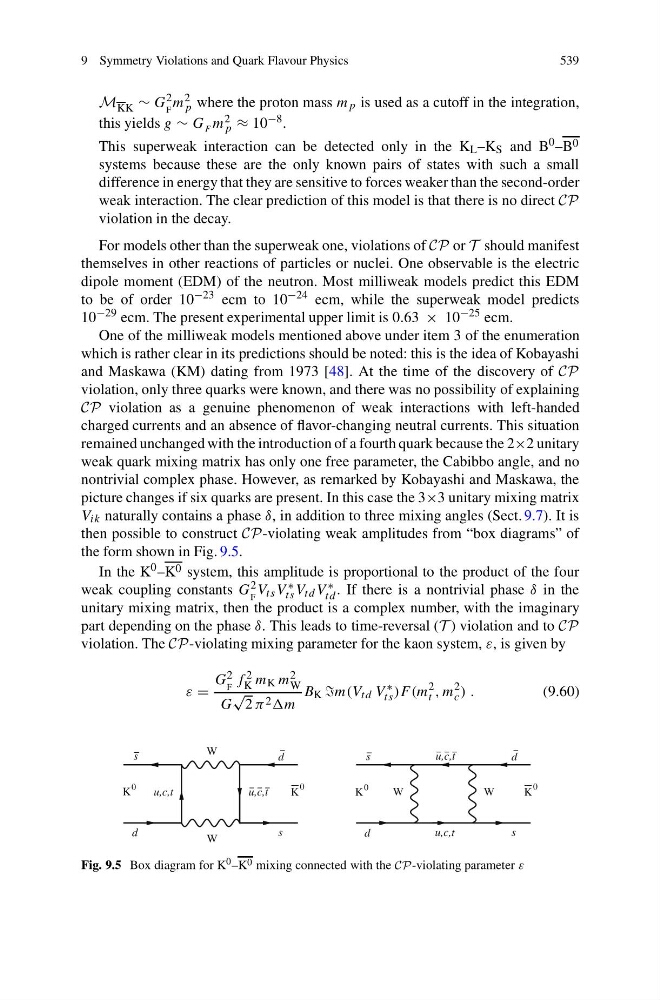
then possible to construct CP-violating weak amplitudes from “box diagrams” of
the form shown in Fig. 9.5.
In the K 0 –K 0 system, this amplitude is proportional to the product of the four
weak coupling constants G 2
F
V ts V ∗
ts V td V ∗
td . If there is a nontrivial phase δ in the
unitary mixing matrix, then the product is a complex number, with the imaginary
part depending on the phase δ. This leads to time-reversal (T ) violation and to CP
violation. The CP-violating mixing parameter for the kaon system, ε, is given by
ε =
G 2
F
f 2
K m K m 2
W
G
√
2 π 2
B K m(V td V
∗
ts )F (m
2
t , m
2
c ) .
(9.60)
Fig. 9.5 Box diagram for K 0 –K 0 mixing connected with the CP-violating parameter ε
539
M KK ∼ G 2
F
m 2
p where the proton mass m p is used as a cutoff in the integration,
this yields g ∼ G F m 2
p ≈ 10 −8 .
This superweak interaction can be detected only in the K L –K S and B 0 –B 0
systems because these are the only known pairs of states with such a small
difference in energy that they are sensitive to forces weaker than the second-order
weak interaction. The clear prediction of this model is that there is no direct CP
violation in the decay.
For models other than the superweak one, violations of CP or T should manifest
themselves in other reactions of particles or nuclei. One observable is the electric
dipole moment (EDM) of the neutron. Most milliweak models predict this EDM
to be of order 10 −23 ecm to 10 −24 ecm, while the superweak model predicts
10 −29 ecm. The present experimental upper limit is 0.63 × 10 −25 ecm.
One of the milliweak models mentioned above under item 3 of the enumeration
which is rather clear in its predictions should be noted: this is the idea of Kobayashi
and Maskawa (KM) dating from 1973 [48]. At the time of the discovery of CP
violation, only three quarks were known, and there was no possibility of explaining
CP violation as a genuine phenomenon of weak interactions with left-handed
charged currents and an absence of flavor-changing neutral currents. This situation
remained unchanged with the introduction of a fourth quark because the 2×2 unitary
weak quark mixing matrix has only one free parameter, the Cabibbo angle, and no
nontrivial complex phase. However, as remarked by Kobayashi and Maskawa, the
picture changes if six quarks are present. In this case the 3×3 unitary mixing matrix
V ik naturally contains a phase δ, in addition to three mixing angles (Sect. 9.7). It is
then possible to construct CP-violating weak amplitudes from “box diagrams” of
the form shown in Fig. 9.5.
In the K 0 –K 0 system, this amplitude is proportional to the product of the four
weak coupling constants G 2
F
V ts V ∗
ts V td V ∗
td . If there is a nontrivial phase δ in the
unitary mixing matrix, then the product is a complex number, with the imaginary
part depending on the phase δ. This leads to time-reversal (T ) violation and to CP
violation. The CP-violating mixing parameter for the kaon system, ε, is given by
ε =
G 2
F
f 2
K m K m 2
W
G
√
2 π 2
B K m(V td V
∗
ts )F (m
2
t , m
2
c ) .
(9.60)
Fig. 9.5 Box diagram for K 0 –K 0 mixing connected with the CP-violating parameter ε