

542
K. Kleinknecht and U. Uwer
However, an alternative analytic calculation [55] based on chiral perturbation theory
which emphasizes final state interactions and neglects the meson evolution, obtains
a much larger value
ε
/ε = (15 ± 7) × 10
−4 .
(9.68)
Further improvement of the lattice calculations will hopefully clear-up this important discrepancy of the standard model prediction for ε /ε.
9.5 The Neutral K Meson System
9.5.1 Mass Eigenstates and CP Eigenstates
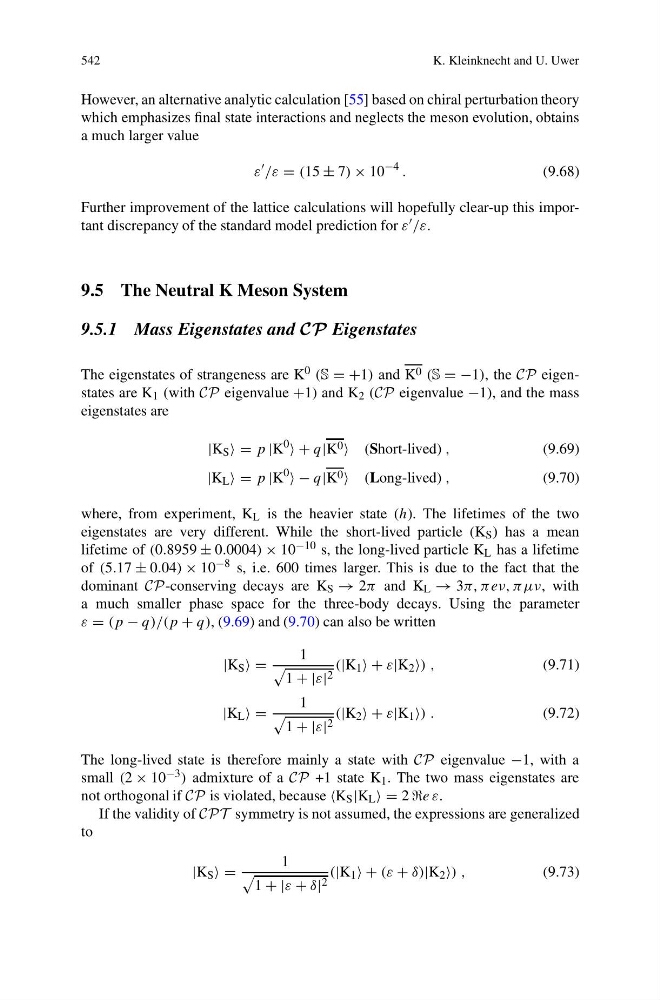
The eigenstates of strangeness are K 0 (S = +1) and K 0 (S = −1), the CP eigenstates are K 1 (with CP eigenvalue +1) and K 2 (CP eigenvalue −1), and the mass
eigenstates are
|K S = p |K
0
+ q|K 0 (Short-lived) ,
(9.69)
|K L = p |K
0
− q|K 0 (Long-lived) ,
(9.70)
where, from experiment, K L is the heavier state (h). The lifetimes of the two
eigenstates are very different. While the short-lived particle (K S ) has a mean
lifetime of (0.8959 ± 0.0004) × 10 −10 s, the long-lived particle K L has a lifetime
of (5.17 ± 0.04) × 10 −8 s, i.e. 600 times larger. This is due to the fact that the
dominant CP-conserving decays are K S → 2π and K L → 3π, πeν, πμν, with
a much smaller phase space for the three-body decays. Using the parameter
ε = (p − q)/(p + q), (9.69) and (9.70) can also be written
|K S =
1
1 + |ε| 2
(|K 1 + ε|K 2 ) ,
(9.71)
|K L =
1
1 + |ε| 2
(|K 2 + ε|K 1 ) .
(9.72)
The long-lived state is therefore mainly a state with CP eigenvalue −1, with a
small (2 × 10 −3 ) admixture of a CP +1 state K 1 . The two mass eigenstates are
not orthogonal if CP is violated, because S |K L = 2 e ε.
If the validity of CPT symmetry is not assumed, the expressions are generalized
to
|K S =
1
1 + |ε + δ| 2
(|K 1 + (ε + δ)|K 2 ) ,
(9.73)
K. Kleinknecht and U. Uwer
However, an alternative analytic calculation [55] based on chiral perturbation theory
which emphasizes final state interactions and neglects the meson evolution, obtains
a much larger value
ε
/ε = (15 ± 7) × 10
−4 .
(9.68)
Further improvement of the lattice calculations will hopefully clear-up this important discrepancy of the standard model prediction for ε /ε.
9.5 The Neutral K Meson System
9.5.1 Mass Eigenstates and CP Eigenstates
The eigenstates of strangeness are K 0 (S = +1) and K 0 (S = −1), the CP eigenstates are K 1 (with CP eigenvalue +1) and K 2 (CP eigenvalue −1), and the mass
eigenstates are
|K S = p |K
0
+ q|K 0 (Short-lived) ,
(9.69)
|K L = p |K
0
− q|K 0 (Long-lived) ,
(9.70)
where, from experiment, K L is the heavier state (h). The lifetimes of the two
eigenstates are very different. While the short-lived particle (K S ) has a mean
lifetime of (0.8959 ± 0.0004) × 10 −10 s, the long-lived particle K L has a lifetime
of (5.17 ± 0.04) × 10 −8 s, i.e. 600 times larger. This is due to the fact that the
dominant CP-conserving decays are K S → 2π and K L → 3π, πeν, πμν, with
a much smaller phase space for the three-body decays. Using the parameter
ε = (p − q)/(p + q), (9.69) and (9.70) can also be written
|K S =
1
1 + |ε| 2
(|K 1 + ε|K 2 ) ,
(9.71)
|K L =
1
1 + |ε| 2
(|K 2 + ε|K 1 ) .
(9.72)
The long-lived state is therefore mainly a state with CP eigenvalue −1, with a
small (2 × 10 −3 ) admixture of a CP +1 state K 1 . The two mass eigenstates are
not orthogonal if CP is violated, because S |K L = 2 e ε.
If the validity of CPT symmetry is not assumed, the expressions are generalized
to
|K S =
1
1 + |ε + δ| 2
(|K 1 + (ε + δ)|K 2 ) ,
(9.73)