

534
K. Kleinknecht and U. Uwer
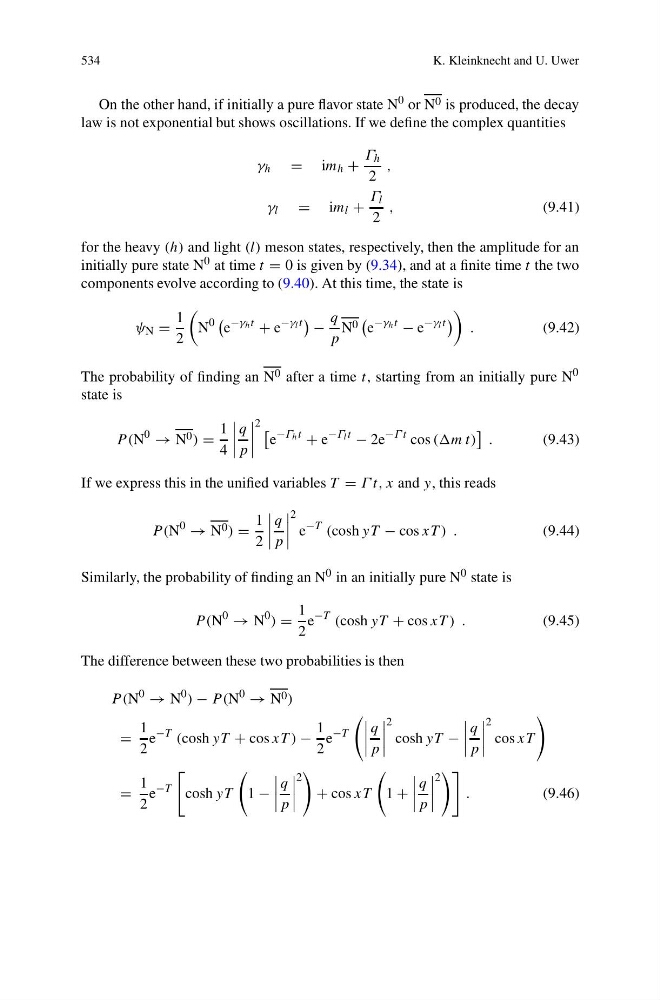
On the other hand, if initially a pure flavor state N 0 or N 0 is produced, the decay
law is not exponential but shows oscillations. If we define the complex quantities
γ h = im h +
Γ h
2
,
γ l = im l +
Γ l
2
,
(9.41)
for the heavy (h) and light (l) meson states, respectively, then the amplitude for an
initially pure state N 0 at time t = 0 is given by (9.34), and at a finite time t the two
components evolve according to (9.40). At this time, the state is
ψ N =
1
2
N
0
e
−γ h t
+ e
−γ l t
−
q
p
N 0
e
−γ h t
− e
−γ l t
.
(9.42)
The probability of finding an N 0 after a time t, starting from an initially pure N 0
state is
P (N
0
→ N 0 ) =
1
4
q
p
2
e
−Γ h t
+ e
−Γ l t
− 2e
−Γ t cos (m t)
.
(9.43)
If we express this in the unified variables T = Γ t, x and y, this reads
P (N
0
→ N 0 ) =
1
2
q
p
2
e
−T (cosh yT − cos xT ) .
(9.44)
Similarly, the probability of finding an N 0 in an initially pure N 0 state is
P (N
0
→ N
0 ) =
1
2
e
−T (cosh yT + cos xT ) .
(9.45)
The difference between these two probabilities is then
P (N
0
→ N
0 ) − P (N
0
→ N 0 )
=
1
2
e
−T (cosh yT + cos xT ) −
1
2
e
−T
q
p
2
cosh yT −
q
p
2
cos xT
=
1
2
e
−T
cosh yT
1 −
q
p
2
+ cos xT
1 +
q
p
2
.
(9.46)
K. Kleinknecht and U. Uwer
On the other hand, if initially a pure flavor state N 0 or N 0 is produced, the decay
law is not exponential but shows oscillations. If we define the complex quantities
γ h = im h +
Γ h
2
,
γ l = im l +
Γ l
2
,
(9.41)
for the heavy (h) and light (l) meson states, respectively, then the amplitude for an
initially pure state N 0 at time t = 0 is given by (9.34), and at a finite time t the two
components evolve according to (9.40). At this time, the state is
ψ N =
1
2
N
0
e
−γ h t
+ e
−γ l t
−
q
p
N 0
e
−γ h t
− e
−γ l t
.
(9.42)
The probability of finding an N 0 after a time t, starting from an initially pure N 0
state is
P (N
0
→ N 0 ) =
1
4
q
p
2
e
−Γ h t
+ e
−Γ l t
− 2e
−Γ t cos (m t)
.
(9.43)
If we express this in the unified variables T = Γ t, x and y, this reads
P (N
0
→ N 0 ) =
1
2
q
p
2
e
−T (cosh yT − cos xT ) .
(9.44)
Similarly, the probability of finding an N 0 in an initially pure N 0 state is
P (N
0
→ N
0 ) =
1
2
e
−T (cosh yT + cos xT ) .
(9.45)
The difference between these two probabilities is then
P (N
0
→ N
0 ) − P (N
0
→ N 0 )
=
1
2
e
−T (cosh yT + cos xT ) −
1
2
e
−T
q
p
2
cosh yT −
q
p
2
cos xT
=
1
2
e
−T
cosh yT
1 −
q
p
2
+ cos xT
1 +
q
p
2
.
(9.46)