

9 Symmetry Violations and Quark Flavour Physics
535
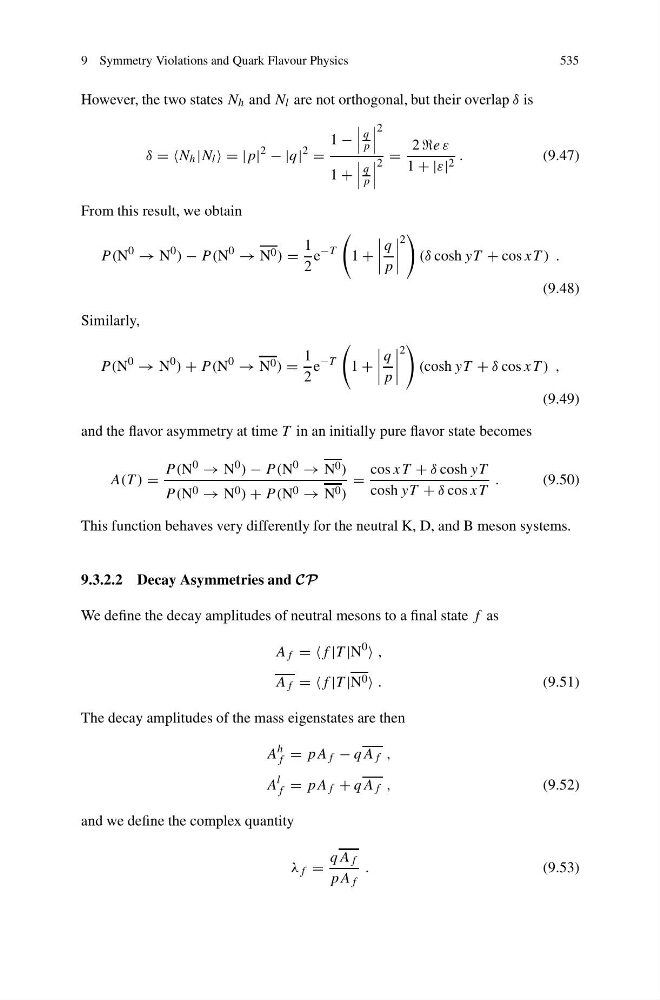
However, the two states N h and N l are not orthogonal, but their overlap δ is
δ = =N h |N l = |p|
2
− |q|
2
=
1 −
q
p
2
1 +
q
p
2
=
2 e ε
1 + |ε| 2 .
(9.47)
From this result, we obtain
P (N
0
→ N
0 ) − P (N
0
→ N 0 ) =
1
2
e
−T
1 +
q
p
2
(δ cosh yT + cos xT ) .
(9.48)
Similarly,
P (N
0
→ N
0 ) + P (N
0
→ N 0 ) =
1
2
e
−T
1 +
q
p
2
(cosh yT + δ cos xT ) ,
(9.49)
and the flavor asymmetry at time T in an initially pure flavor state becomes
A(T ) =
P (N 0 → N 0 ) − P (N 0 → N 0 )
P (N 0 → N 0 ) + P (N 0 → N 0 )
=
cos xT + δ cosh yT
cosh yT + δ cos xT
.
(9.50)
This function behaves very differently for the neutral K, D, and B meson systems.
9.3.2.2 Decay Asymmetries and CP
We define the decay amplitudes of neutral mesons to a final state f as
A f = =f |T |N
0
,
A f = =f |T |N 0 .
(9.51)
The decay amplitudes of the mass eigenstates are then
A
h
f = pA f − qA f ,
A
l
f = pA f + qA f ,
(9.52)
and we define the complex quantity
λ f =
qA f
pA f
.
(9.53)
535
However, the two states N h and N l are not orthogonal, but their overlap δ is
δ = =N h |N l = |p|
2
− |q|
2
=
1 −
q
p
2
1 +
q
p
2
=
2 e ε
1 + |ε| 2 .
(9.47)
From this result, we obtain
P (N
0
→ N
0 ) − P (N
0
→ N 0 ) =
1
2
e
−T
1 +
q
p
2
(δ cosh yT + cos xT ) .
(9.48)
Similarly,
P (N
0
→ N
0 ) + P (N
0
→ N 0 ) =
1
2
e
−T
1 +
q
p
2
(cosh yT + δ cos xT ) ,
(9.49)
and the flavor asymmetry at time T in an initially pure flavor state becomes
A(T ) =
P (N 0 → N 0 ) − P (N 0 → N 0 )
P (N 0 → N 0 ) + P (N 0 → N 0 )
=
cos xT + δ cosh yT
cosh yT + δ cos xT
.
(9.50)
This function behaves very differently for the neutral K, D, and B meson systems.
9.3.2.2 Decay Asymmetries and CP
We define the decay amplitudes of neutral mesons to a final state f as
A f = =f |T |N
0
,
A f = =f |T |N 0 .
(9.51)
The decay amplitudes of the mass eigenstates are then
A
h
f = pA f − qA f ,
A
l
f = pA f + qA f ,
(9.52)
and we define the complex quantity
λ f =
qA f
pA f
.
(9.53)