

9 Symmetry Violations and Quark Flavour Physics
533
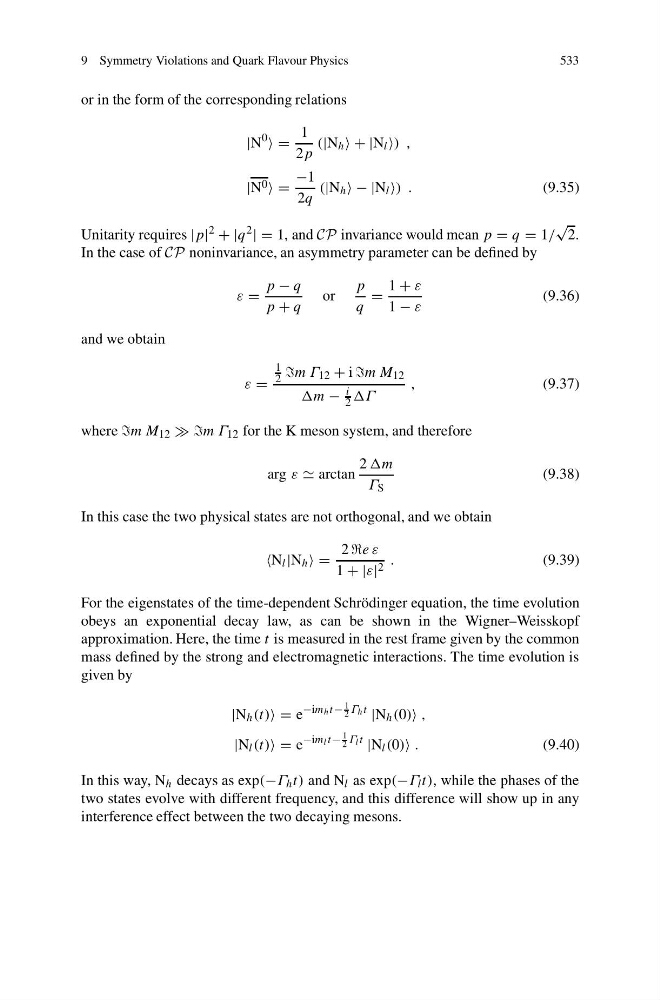
or in the form of the corresponding relations
|N
0
=
1
2p
(|N h + |N l ) ,
|N 0 =
−1
2q
(|N h − |N l ) .
(9.35)
Unitarity requires |p| 2 + |q 2 | = 1, and CP invariance would mean p = q = 1/
√
2.
In the case of CP noninvariance, an asymmetry parameter can be defined by
ε =
p − q
p + q
or
p
q
=
1 + ε
1 − ε
(9.36)
and we obtain
ε =
1
2 m Γ 12 + i m M 12
−
i
2
,
(9.37)
where m M 12 m Γ 12 for the K meson system, and therefore
arg ε arctan
2 m
Γ S
(9.38)
In this case the two physical states are not orthogonal, and we obtain
l |N h =
2 e ε
1 + |ε| 2 .
(9.39)
For the eigenstates of the time-dependent Schrödinger equation, the time evolution
obeys an exponential decay law, as can be shown in the Wigner–Weisskopf
approximation. Here, the time t is measured in the rest frame given by the common
mass defined by the strong and electromagnetic interactions. The time evolution is
given by
|N h (t) = e
−im h t −
1
2 Γ h t
|N h (0) ,
|N l (t) = e
−im l t −
1
2 Γ l t
|N l (0) .
(9.40)
In this way, N h decays as exp(−Γ h t) and N l as exp(−Γ l t), while the phases of the
two states evolve with different frequency, and this difference will show up in any
interference effect between the two decaying mesons.
533
or in the form of the corresponding relations
|N
0
=
1
2p
(|N h + |N l ) ,
|N 0 =
−1
2q
(|N h − |N l ) .
(9.35)
Unitarity requires |p| 2 + |q 2 | = 1, and CP invariance would mean p = q = 1/
√
2.
In the case of CP noninvariance, an asymmetry parameter can be defined by
ε =
p − q
p + q
or
p
q
=
1 + ε
1 − ε
(9.36)
and we obtain
ε =
1
2 m Γ 12 + i m M 12
−
i
2
,
(9.37)
where m M 12 m Γ 12 for the K meson system, and therefore
arg ε arctan
2 m
Γ S
(9.38)
In this case the two physical states are not orthogonal, and we obtain
l |N h =
2 e ε
1 + |ε| 2 .
(9.39)
For the eigenstates of the time-dependent Schrödinger equation, the time evolution
obeys an exponential decay law, as can be shown in the Wigner–Weisskopf
approximation. Here, the time t is measured in the rest frame given by the common
mass defined by the strong and electromagnetic interactions. The time evolution is
given by
|N h (t) = e
−im h t −
1
2 Γ h t
|N h (0) ,
|N l (t) = e
−im l t −
1
2 Γ l t
|N l (0) .
(9.40)
In this way, N h decays as exp(−Γ h t) and N l as exp(−Γ l t), while the phases of the
two states evolve with different frequency, and this difference will show up in any
interference effect between the two decaying mesons.