

532
K. Kleinknecht and U. Uwer
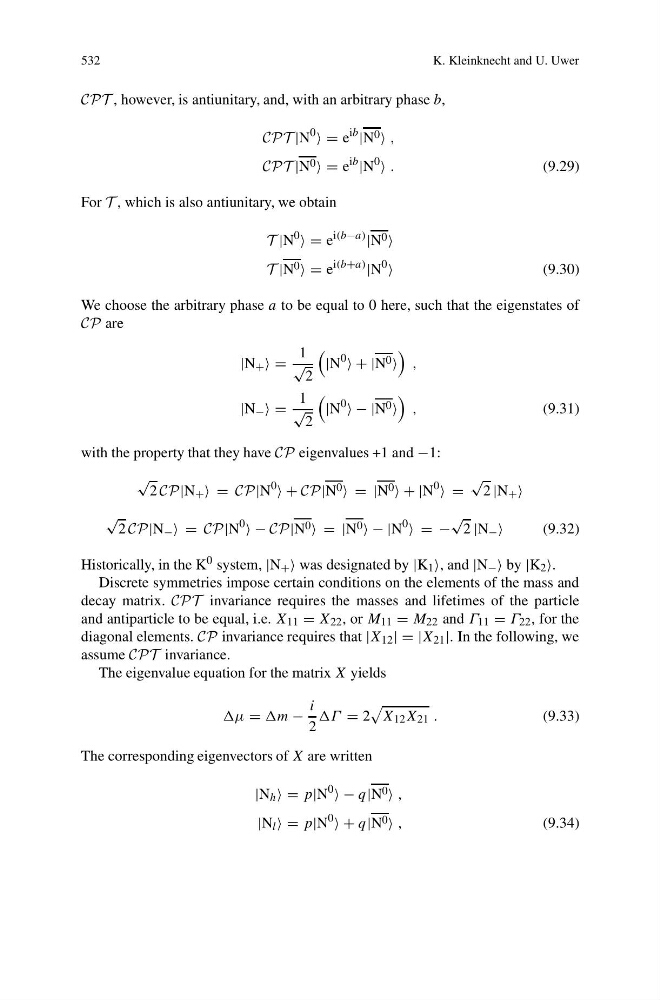
CPT , however, is antiunitary, and, with an arbitrary phase b,
CPT |N
0
= e
ib
|N 0 ,
CPT |N 0 = e
ib
|N
0
.
(9.29)
For T , which is also antiunitary, we obtain
T |N
0
= e
i(b−a)
|N 0
T |N 0 = e
i(b+a)
|N
0
(9.30)
We choose the arbitrary phase a to be equal to 0 here, such that the eigenstates of
CP are
|N + =
1
√
2
|N
0
+ |N 0
,
|N − =
1
√
2
|N
0
− |N 0
,
(9.31)
with the property that they have CP eigenvalues +1 and −1:
√
2 CP|N + = CP|N
0
+ CP|N 0 = |N 0 + |N
0
=
√
2 |N +
√
2 CP|N − = CP|N
0
− CP|N 0 = |N 0 − |N
0
= −
√
2 |N −
(9.32)
Historically, in the K 0 system, |N + was designated by |K 1 , and |N − by |K 2
Discrete symmetries impose certain conditions on the elements of the mass and
decay matrix. CPT invariance requires the masses and lifetimes of the particle
and antiparticle to be equal, i.e. X 11 = X 22 , or M 11 = M 22 and Γ 11 = Γ 22 , for the
diagonal elements. CP invariance requires that |X 12 | = |X 21 |. In the following, we
assume CPT invariance.
The eigenvalue equation for the matrix X yields
= −
i
2
= 2
X 12 X 21 .
(9.33)
The corresponding eigenvectors of X are written
|N h = p|N
0
− q|N 0 ,
|N l = p|N
0
+ q|N 0 ,
(9.34)
K. Kleinknecht and U. Uwer
CPT , however, is antiunitary, and, with an arbitrary phase b,
CPT |N
0
= e
ib
|N 0 ,
CPT |N 0 = e
ib
|N
0
.
(9.29)
For T , which is also antiunitary, we obtain
T |N
0
= e
i(b−a)
|N 0
T |N 0 = e
i(b+a)
|N
0
(9.30)
We choose the arbitrary phase a to be equal to 0 here, such that the eigenstates of
CP are
|N + =
1
√
2
|N
0
+ |N 0
,
|N − =
1
√
2
|N
0
− |N 0
,
(9.31)
with the property that they have CP eigenvalues +1 and −1:
√
2 CP|N + = CP|N
0
+ CP|N 0 = |N 0 + |N
0
=
√
2 |N +
√
2 CP|N − = CP|N
0
− CP|N 0 = |N 0 − |N
0
= −
√
2 |N −
(9.32)
Historically, in the K 0 system, |N + was designated by |K 1 , and |N − by |K 2
Discrete symmetries impose certain conditions on the elements of the mass and
decay matrix. CPT invariance requires the masses and lifetimes of the particle
and antiparticle to be equal, i.e. X 11 = X 22 , or M 11 = M 22 and Γ 11 = Γ 22 , for the
diagonal elements. CP invariance requires that |X 12 | = |X 21 |. In the following, we
assume CPT invariance.
The eigenvalue equation for the matrix X yields
= −
i
2
= 2
X 12 X 21 .
(9.33)
The corresponding eigenvectors of X are written
|N h = p|N
0
− q|N 0 ,
|N l = p|N
0
+ q|N 0 ,
(9.34)