

9 Symmetry Violations and Quark Flavour Physics
531
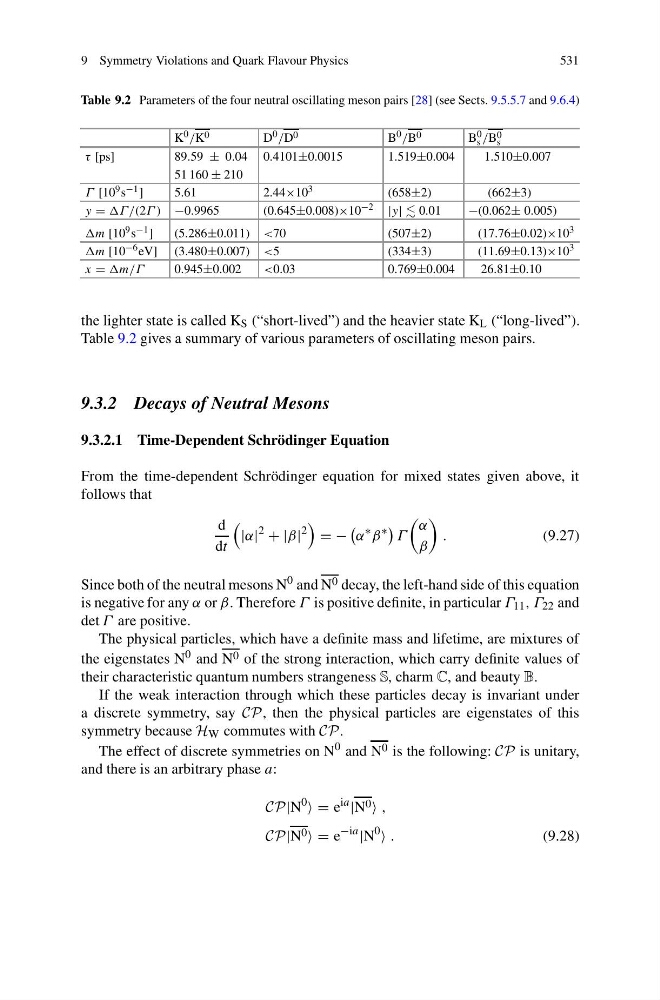
Table 9.2 Parameters of the four neutral oscillating meson pairs [28] (see Sects. 9.5.5.7 and 9.6.4)
K 0 /K 0
D 0 /D 0
B 0 /B 0
B 0
s /B 0
s
τ [ps]
89.59 ± 0.04 0.4101±0.0015
1.519±0.004
1.510±0.007
51 160 ± 210
Γ [10 9 s −1 ]
5.61
2.44×10 3
(658±2)
(662±3)
y = /(2Γ ) −0.9965
(0.645±0.008)×10 −2 |y| 0.01
−(0.062± 0.005)
m [10 9 s −1 ]
(5.286±0.011) <70
(507±2)
(17.76±0.02)×10 3
m [10 −6 eV] (3.480±0.007) <5
(334±3)
(11.69±0.13)×10 3
x =
0.945±0.002
<0.03
0.769±0.004
26.81±0.10
the lighter state is called K S (“short-lived”) and the heavier state K L (“long-lived”).
Table 9.2 gives a summary of various parameters of oscillating meson pairs.
9.3.2 Decays of Neutral Mesons
9.3.2.1 Time-Dependent Schrödinger Equation
From the time-dependent Schrödinger equation for mixed states given above, it
follows that
d
dt
|α|
2
+ |β|
2
= −
α
∗ β
∗
Γ
α
β
.
(9.27)
Since both of the neutral mesons N 0 and N 0 decay, the left-hand side of this equation
is negative for any α or β. Therefore Γ is positive definite, in particular Γ 11 , Γ 22 and
det Γ are positive.
The physical particles, which have a definite mass and lifetime, are mixtures of
the eigenstates N 0 and N 0 of the strong interaction, which carry definite values of
their characteristic quantum numbers strangeness S, charm C, and beauty B.
If the weak interaction through which these particles decay is invariant under
a discrete symmetry, say CP, then the physical particles are eigenstates of this
symmetry because H W commutes with CP.
The effect of discrete symmetries on N 0 and N 0 is the following: CP is unitary,
and there is an arbitrary phase a:
CP|N
0
= e
ia
|N 0 ,
CP|N 0 = e
−ia
|N
0
.
(9.28)
531
Table 9.2 Parameters of the four neutral oscillating meson pairs [28] (see Sects. 9.5.5.7 and 9.6.4)
K 0 /K 0
D 0 /D 0
B 0 /B 0
B 0
s /B 0
s
τ [ps]
89.59 ± 0.04 0.4101±0.0015
1.519±0.004
1.510±0.007
51 160 ± 210
Γ [10 9 s −1 ]
5.61
2.44×10 3
(658±2)
(662±3)
y = /(2Γ ) −0.9965
(0.645±0.008)×10 −2 |y| 0.01
−(0.062± 0.005)
m [10 9 s −1 ]
(5.286±0.011) <70
(507±2)
(17.76±0.02)×10 3
m [10 −6 eV] (3.480±0.007) <5
(334±3)
(11.69±0.13)×10 3
x =
0.945±0.002
<0.03
0.769±0.004
26.81±0.10
the lighter state is called K S (“short-lived”) and the heavier state K L (“long-lived”).
Table 9.2 gives a summary of various parameters of oscillating meson pairs.
9.3.2 Decays of Neutral Mesons
9.3.2.1 Time-Dependent Schrödinger Equation
From the time-dependent Schrödinger equation for mixed states given above, it
follows that
d
dt
|α|
2
+ |β|
2
= −
α
∗ β
∗
Γ
α
β
.
(9.27)
Since both of the neutral mesons N 0 and N 0 decay, the left-hand side of this equation
is negative for any α or β. Therefore Γ is positive definite, in particular Γ 11 , Γ 22 and
det Γ are positive.
The physical particles, which have a definite mass and lifetime, are mixtures of
the eigenstates N 0 and N 0 of the strong interaction, which carry definite values of
their characteristic quantum numbers strangeness S, charm C, and beauty B.
If the weak interaction through which these particles decay is invariant under
a discrete symmetry, say CP, then the physical particles are eigenstates of this
symmetry because H W commutes with CP.
The effect of discrete symmetries on N 0 and N 0 is the following: CP is unitary,
and there is an arbitrary phase a:
CP|N
0
= e
ia
|N 0 ,
CP|N 0 = e
−ia
|N
0
.
(9.28)