

528
K. Kleinknecht and U. Uwer
By defining the intrinsic parity of the proton as +1, a phase convention for the
fields can be chosen, such that the parity operator P has only eigenvalues of +1
or −1, and all particles have intrinsic parities ±1 as quantum numbers. These
conserved quantities, which correspond to discrete symmetries, are multiplicative
quantum numbers.
The third discrete symmetry, time reversal, is a special case. The corresponding
operator T is not unitary, but antiunitary. Here the bracket is not conserved
by the T transformation, but rather
|ϕ
= =ψ|ϕ
∗ .
(9.14)
Probability is still conserved, i.e.
||ψ
|ϕ
= ||ψ|ϕ ,
(9.15)
but the phases are not. The fact that T is antiunitary can be deduced from the
Schrödinger equation for a free particle, where the time derivative is odd under
T while the Laplace operator is even. This can be reconciled with T invariance
only if T makes the changes i → −i and ψ → ψ ∗ .
CPT , the product of all three discrete transformations, being a product of two
unitary and one antiunitary operator, is also antiunitary. According to the CPT
theorem of Lüders [7] and Pauli [8], and Jost [9], a field theory with Lorentz
invariance, locality, and the commutation relations given by the spin-statistics
theorem, is CPT -invariant. At present there is no realistic field theory which
violates CPT invariance.
As a consequence of this theorem, violation of one of the three discrete
symmetries implies a violation of a complementary one. If CP is violated, then
T is also violated.
The experimental consequences of CPT invariance are the equality of the
masses, lifetimes and magnetic dipole moments of a particle and its antiparticle.
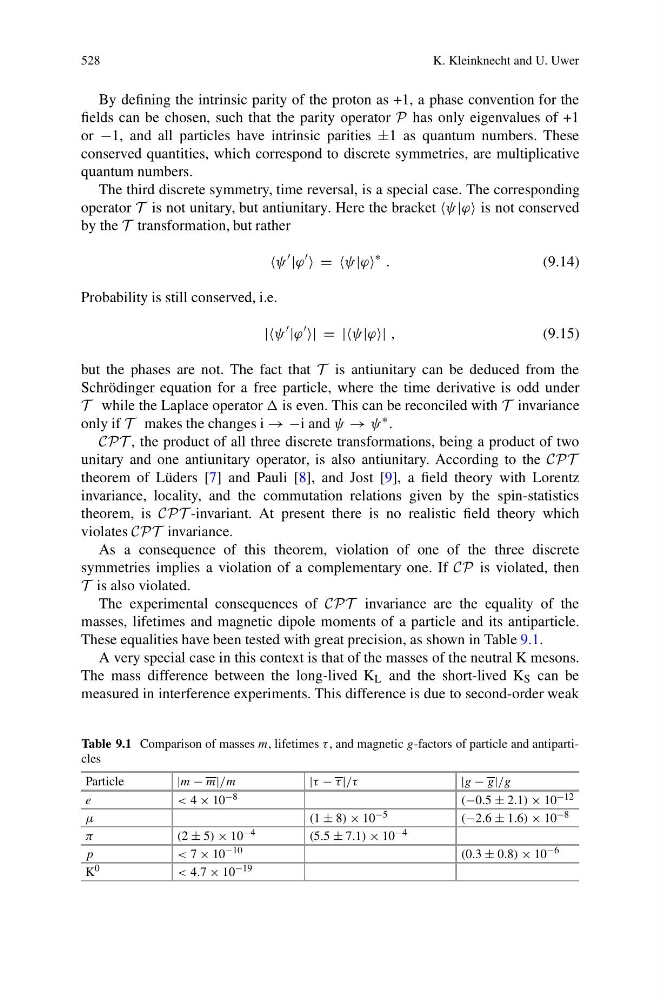
These equalities have been tested with great precision, as shown in Table 9.1.
A very special case in this context is that of the masses of the neutral K mesons.
The mass difference between the long-lived K L and the short-lived K S can be
measured in interference experiments. This difference is due to second-order weak
Table 9.1 Comparison of masses m, lifetimes τ , and magnetic g-factors of particle and antiparticles
Particle
|m − m|/m
|τ − τ |/τ
|g − g|/g
e
< 4 × 10 −8
(−0.5 ± 2.1) × 10 −12
μ
(1 ± 8) × 10 −5
(−2.6 ± 1.6) × 10 −8
π
(2 ± 5) × 10 −4
(5.5 ± 7.1) × 10 −4
p
< 7 × 10 −10
(0.3 ± 0.8) × 10 −6
K 0
< 4.7 × 10 −19
K. Kleinknecht and U. Uwer
By defining the intrinsic parity of the proton as +1, a phase convention for the
fields can be chosen, such that the parity operator P has only eigenvalues of +1
or −1, and all particles have intrinsic parities ±1 as quantum numbers. These
conserved quantities, which correspond to discrete symmetries, are multiplicative
quantum numbers.
The third discrete symmetry, time reversal, is a special case. The corresponding
operator T is not unitary, but antiunitary. Here the bracket is not conserved
by the T transformation, but rather
|ϕ
= =ψ|ϕ
∗ .
(9.14)
Probability is still conserved, i.e.
||ψ
|ϕ
= ||ψ|ϕ ,
(9.15)
but the phases are not. The fact that T is antiunitary can be deduced from the
Schrödinger equation for a free particle, where the time derivative is odd under
T while the Laplace operator is even. This can be reconciled with T invariance
only if T makes the changes i → −i and ψ → ψ ∗ .
CPT , the product of all three discrete transformations, being a product of two
unitary and one antiunitary operator, is also antiunitary. According to the CPT
theorem of Lüders [7] and Pauli [8], and Jost [9], a field theory with Lorentz
invariance, locality, and the commutation relations given by the spin-statistics
theorem, is CPT -invariant. At present there is no realistic field theory which
violates CPT invariance.
As a consequence of this theorem, violation of one of the three discrete
symmetries implies a violation of a complementary one. If CP is violated, then
T is also violated.
The experimental consequences of CPT invariance are the equality of the
masses, lifetimes and magnetic dipole moments of a particle and its antiparticle.
These equalities have been tested with great precision, as shown in Table 9.1.
A very special case in this context is that of the masses of the neutral K mesons.
The mass difference between the long-lived K L and the short-lived K S can be
measured in interference experiments. This difference is due to second-order weak
Table 9.1 Comparison of masses m, lifetimes τ , and magnetic g-factors of particle and antiparticles
Particle
|m − m|/m
|τ − τ |/τ
|g − g|/g
e
< 4 × 10 −8
(−0.5 ± 2.1) × 10 −12
μ
(1 ± 8) × 10 −5
(−2.6 ± 1.6) × 10 −8
π
(2 ± 5) × 10 −4
(5.5 ± 7.1) × 10 −4
p
< 7 × 10 −10
(0.3 ± 0.8) × 10 −6
K 0
< 4.7 × 10 −19