

9 Symmetry Violations and Quark Flavour Physics
527
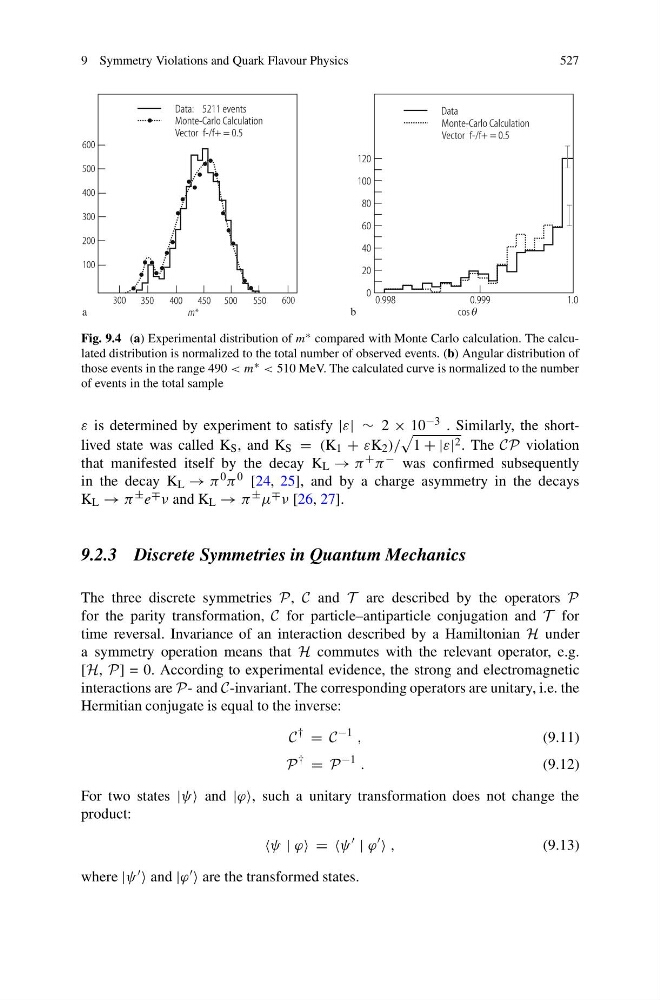
Fig. 9.4 (a) Experimental distribution of m ∗ compared with Monte Carlo calculation. The calculated distribution is normalized to the total number of observed events. (b) Angular distribution of
those events in the range 490 < m ∗ < 510 MeV. The calculated curve is normalized to the number
of events in the total sample
ε is determined by experiment to satisfy |ε| ∼ 2 × 10 −3 . Similarly, the shortlived state was called K S , and K S = (K 1 + εK 2 )/
1 + |ε| 2 . The CP violation
that manifested itself by the decay K L → π + π − was confirmed subsequently
in the decay K L → π 0 π 0 [24, 25], and by a charge asymmetry in the decays
K L → π ± e ∓ ν and K L → π ± μ ∓ ν [26, 27].
9.2.3 Discrete Symmetries in Quantum Mechanics
The three discrete symmetries P, C and T are described by the operators P
for the parity transformation, C for particle–antiparticle conjugation and T for
time reversal. Invariance of an interaction described by a Hamiltonian H under
a symmetry operation means that H commutes with the relevant operator, e.g.
[H, P] = 0. According to experimental evidence, the strong and electromagnetic
interactions are P- and C-invariant. The corresponding operators are unitary, i.e. the
Hermitian conjugate is equal to the inverse:
C
†
= C
−1 ,
(9.11)
P
†
= P
−1 .
(9.12)
For two states |ψ and |ϕ, such a unitary transformation does not change the
product:
| ϕ = =ψ
| ϕ
,
(9.13)
where |ψ and |ϕ are the transformed states.
527
Fig. 9.4 (a) Experimental distribution of m ∗ compared with Monte Carlo calculation. The calculated distribution is normalized to the total number of observed events. (b) Angular distribution of
those events in the range 490 < m ∗ < 510 MeV. The calculated curve is normalized to the number
of events in the total sample
ε is determined by experiment to satisfy |ε| ∼ 2 × 10 −3 . Similarly, the shortlived state was called K S , and K S = (K 1 + εK 2 )/
1 + |ε| 2 . The CP violation
that manifested itself by the decay K L → π + π − was confirmed subsequently
in the decay K L → π 0 π 0 [24, 25], and by a charge asymmetry in the decays
K L → π ± e ∓ ν and K L → π ± μ ∓ ν [26, 27].
9.2.3 Discrete Symmetries in Quantum Mechanics
The three discrete symmetries P, C and T are described by the operators P
for the parity transformation, C for particle–antiparticle conjugation and T for
time reversal. Invariance of an interaction described by a Hamiltonian H under
a symmetry operation means that H commutes with the relevant operator, e.g.
[H, P] = 0. According to experimental evidence, the strong and electromagnetic
interactions are P- and C-invariant. The corresponding operators are unitary, i.e. the
Hermitian conjugate is equal to the inverse:
C
†
= C
−1 ,
(9.11)
P
†
= P
−1 .
(9.12)
For two states |ψ and |ϕ, such a unitary transformation does not change the
product:
| ϕ = =ψ
| ϕ
,
(9.13)
where |ψ and |ϕ are the transformed states.