

526
K. Kleinknecht and U. Uwer
Magnet
Magnet
Water
Cerenkov
Water
Cerenkov
Plan view
1 ft
57 ft to
internal target
Scintillator
Scintillator
Spark chamber
Helium bag
22°
22°
Collimator
K 2
0
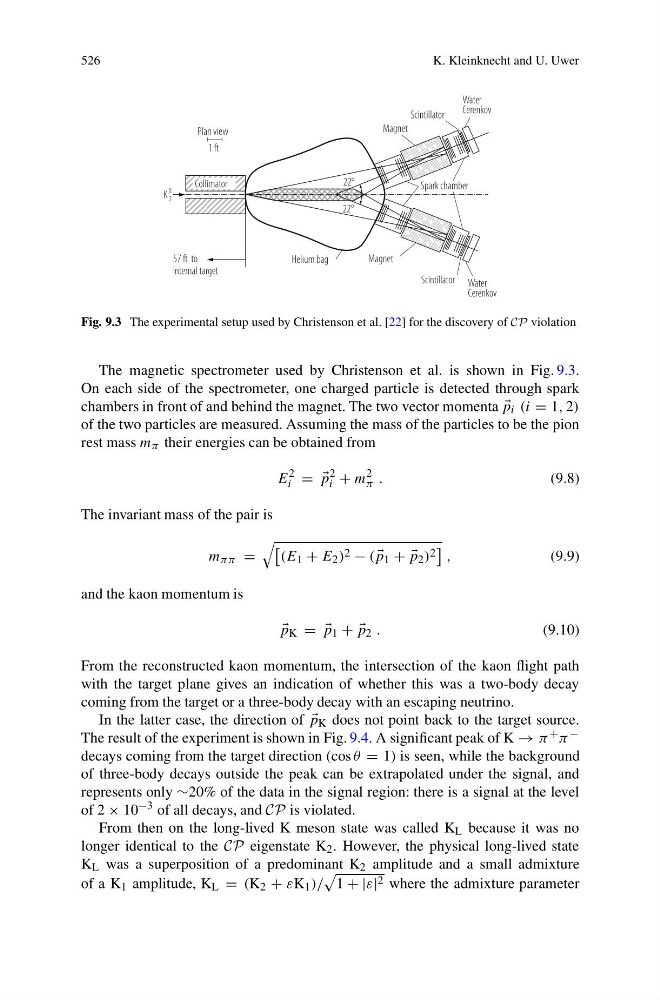
Fig. 9.3 The experimental setup used by Christenson et al. [22] for the discovery of CP violation
The magnetic spectrometer used by Christenson et al. is shown in Fig. 9.3.
On each side of the spectrometer, one charged particle is detected through spark
chambers in front of and behind the magnet. The two vector momenta
p i (i = 1, 2)
of the two particles are measured. Assuming the mass of the particles to be the pion
rest mass m π their energies can be obtained from
E
2
i = =
p
2
i + m
2
π .
(9.8)
The invariant mass of the pair is
m ππ =
(E 1 + E 2 ) 2 − (
p 1 + +
p 2 ) 2
,
(9.9)
and the kaon momentum is
p K = =
p 1 + +
p 2 .
(9.10)
From the reconstructed kaon momentum, the intersection of the kaon flight path
with the target plane gives an indication of whether this was a two-body decay
coming from the target or a three-body decay with an escaping neutrino.
In the latter case, the direction of
p K does not point back to the target source.
The result of the experiment is shown in Fig. 9.4. A significant peak of K → π + π −
decays coming from the target direction (cos θ = 1) is seen, while the background
of three-body decays outside the peak can be extrapolated under the signal, and
represents only ∼20% of the data in the signal region: there is a signal at the level
of 2 × 10 −3 of all decays, and CP is violated.
From then on the long-lived K meson state was called K L because it was no
longer identical to the CP eigenstate K 2 . However, the physical long-lived state
K L was a superposition of a predominant K 2 amplitude and a small admixture
of a K 1 amplitude, K L = (K 2 + εK 1 )/
1 + |ε| 2 where the admixture parameter
K. Kleinknecht and U. Uwer
Magnet
Magnet
Water
Cerenkov
Water
Cerenkov
Plan view
1 ft
57 ft to
internal target
Scintillator
Scintillator
Spark chamber
Helium bag
22°
22°
Collimator
K 2
0
Fig. 9.3 The experimental setup used by Christenson et al. [22] for the discovery of CP violation
The magnetic spectrometer used by Christenson et al. is shown in Fig. 9.3.
On each side of the spectrometer, one charged particle is detected through spark
chambers in front of and behind the magnet. The two vector momenta
p i (i = 1, 2)
of the two particles are measured. Assuming the mass of the particles to be the pion
rest mass m π their energies can be obtained from
E
2
i = =
p
2
i + m
2
π .
(9.8)
The invariant mass of the pair is
m ππ =
(E 1 + E 2 ) 2 − (
p 1 + +
p 2 ) 2
,
(9.9)
and the kaon momentum is
p K = =
p 1 + +
p 2 .
(9.10)
From the reconstructed kaon momentum, the intersection of the kaon flight path
with the target plane gives an indication of whether this was a two-body decay
coming from the target or a three-body decay with an escaping neutrino.
In the latter case, the direction of
p K does not point back to the target source.
The result of the experiment is shown in Fig. 9.4. A significant peak of K → π + π −
decays coming from the target direction (cos θ = 1) is seen, while the background
of three-body decays outside the peak can be extrapolated under the signal, and
represents only ∼20% of the data in the signal region: there is a signal at the level
of 2 × 10 −3 of all decays, and CP is violated.
From then on the long-lived K meson state was called K L because it was no
longer identical to the CP eigenstate K 2 . However, the physical long-lived state
K L was a superposition of a predominant K 2 amplitude and a small admixture
of a K 1 amplitude, K L = (K 2 + εK 1 )/
1 + |ε| 2 where the admixture parameter