

9 Symmetry Violations and Quark Flavour Physics
525
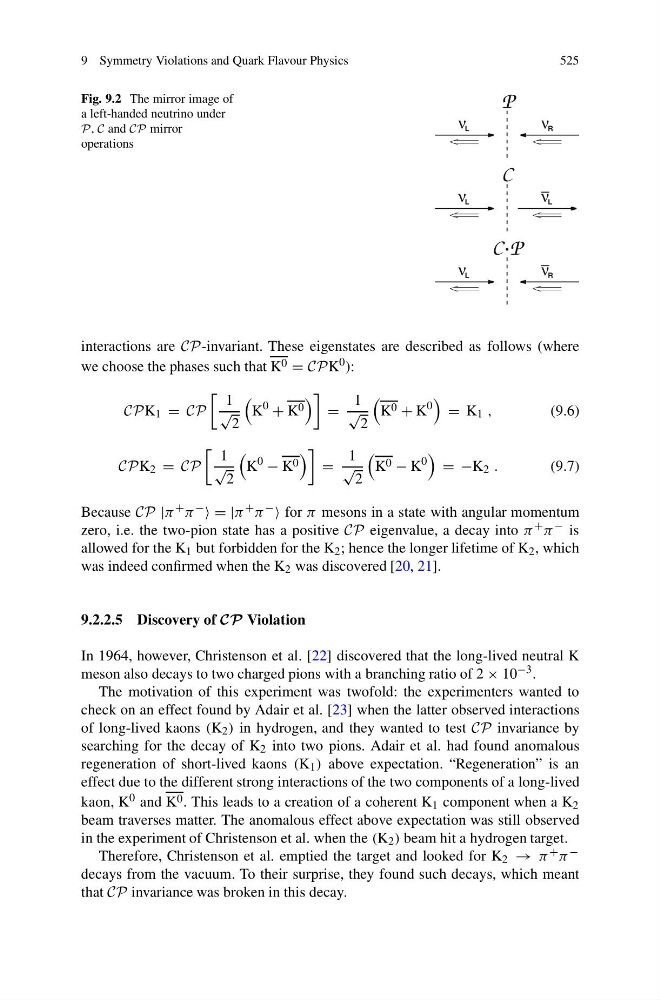
Fig. 9.2 The mirror image of
a left-handed neutrino under
P, C and CP mirror
operations
interactions are CP-invariant. These eigenstates are described as follows (where
we choose the phases such that K 0 = CPK 0 ):
CPK 1 = CP
1
√
2
K
0
+ K 0
=
1
√
2
K 0 + K
0
= K 1 ,
(9.6)
CPK 2 = CP
1
√
2
K
0
− K 0
=
1
√
2
K 0 − K
0
= −K 2 .
(9.7)
Because CP |π + π − = |π + π − for π mesons in a state with angular momentum
zero, i.e. the two-pion state has a positive CP eigenvalue, a decay into π + π − is
allowed for the K 1 but forbidden for the K 2 ; hence the longer lifetime of K 2 , which
was indeed confirmed when the K 2 was discovered [20, 21].
9.2.2.5 Discovery of CP Violation
In 1964, however, Christenson et al. [22] discovered that the long-lived neutral K
meson also decays to two charged pions with a branching ratio of 2 × 10 −3 .
The motivation of this experiment was twofold: the experimenters wanted to
check on an effect found by Adair et al. [23] when the latter observed interactions
of long-lived kaons (K 2 ) in hydrogen, and they wanted to test CP invariance by
searching for the decay of K 2 into two pions. Adair et al. had found anomalous
regeneration of short-lived kaons (K 1 ) above expectation. “Regeneration” is an
effect due to the different strong interactions of the two components of a long-lived
kaon, K 0 and K 0 . This leads to a creation of a coherent K 1 component when a K 2
beam traverses matter. The anomalous effect above expectation was still observed
in the experiment of Christenson et al. when the (K 2 ) beam hit a hydrogen target.
Therefore, Christenson et al. emptied the target and looked for K 2 → π + π −
decays from the vacuum. To their surprise, they found such decays, which meant
that CP invariance was broken in this decay.
525
Fig. 9.2 The mirror image of
a left-handed neutrino under
P, C and CP mirror
operations
interactions are CP-invariant. These eigenstates are described as follows (where
we choose the phases such that K 0 = CPK 0 ):
CPK 1 = CP
1
√
2
K
0
+ K 0
=
1
√
2
K 0 + K
0
= K 1 ,
(9.6)
CPK 2 = CP
1
√
2
K
0
− K 0
=
1
√
2
K 0 − K
0
= −K 2 .
(9.7)
Because CP |π + π − = |π + π − for π mesons in a state with angular momentum
zero, i.e. the two-pion state has a positive CP eigenvalue, a decay into π + π − is
allowed for the K 1 but forbidden for the K 2 ; hence the longer lifetime of K 2 , which
was indeed confirmed when the K 2 was discovered [20, 21].
9.2.2.5 Discovery of CP Violation
In 1964, however, Christenson et al. [22] discovered that the long-lived neutral K
meson also decays to two charged pions with a branching ratio of 2 × 10 −3 .
The motivation of this experiment was twofold: the experimenters wanted to
check on an effect found by Adair et al. [23] when the latter observed interactions
of long-lived kaons (K 2 ) in hydrogen, and they wanted to test CP invariance by
searching for the decay of K 2 into two pions. Adair et al. had found anomalous
regeneration of short-lived kaons (K 1 ) above expectation. “Regeneration” is an
effect due to the different strong interactions of the two components of a long-lived
kaon, K 0 and K 0 . This leads to a creation of a coherent K 1 component when a K 2
beam traverses matter. The anomalous effect above expectation was still observed
in the experiment of Christenson et al. when the (K 2 ) beam hit a hydrogen target.
Therefore, Christenson et al. emptied the target and looked for K 2 → π + π −
decays from the vacuum. To their surprise, they found such decays, which meant
that CP invariance was broken in this decay.