

9 Symmetry Violations and Quark Flavour Physics
529
interactions and, therefore, is very small, about m = (3.480 ± 0.007) × 10 −6
eV, which means that K < 10 −14 . From this, one can deduce very stringent
limits on the mass difference between the K 0 and K 0 , of order 10 −18 .
Thus, from experimental evidence, there is no doubt about the validity of CPT
invariance.
9.3 Mixing and Decay of Neutral Flavoured Mesons
9.3.1 Particle–Antiparticle Mixing
Neutral mesons (represented by N 0 in this chapter) with a characteristic quantum
number, such as the strangeness S for K 0 mesons, charm C for D 0 mesons and
beauty B for B 0
s and B
0
d mesons, have the particular property that they can mix with
their antiparticles, which carry an opposite-sign quantum number. Weak interactions
do not conserve any of these quantum numbers (S, C, B); consequently N 0 and
N 0 can mix by second-order weak transitions through intermediate states such as
2π, 3π, πμν, πeν (for K 0 ), or πK (for B 0 ). The states that obey an exponential
decay law are linear superpositions of N 0 and N 0 ,
α |N
0
+ β |N 0 =
α
β
.
(9.16)
The time-dependent Schrödinger equation then becomes a matrix equation
i
d
dt
α
β
= X
α
β
,
(9.17)
where X ik = M ik − iΓ ik /2, and M ik and Γ ik are Hermitian matrices, called mass
matrix and decay matrix, respectively. Both of the latter two matrices are Hermitian:
M = M † and Γ = Γ † . However, X is not Hermitian. The elements of the matrix X
are
X 11 = =N
0
|H|N
0
, X 22 = =N 0 |H|N 0 ,
X 12 = =N
0
|H|N 0 , X 21 = =N 0 |H|N
0
(9.18)
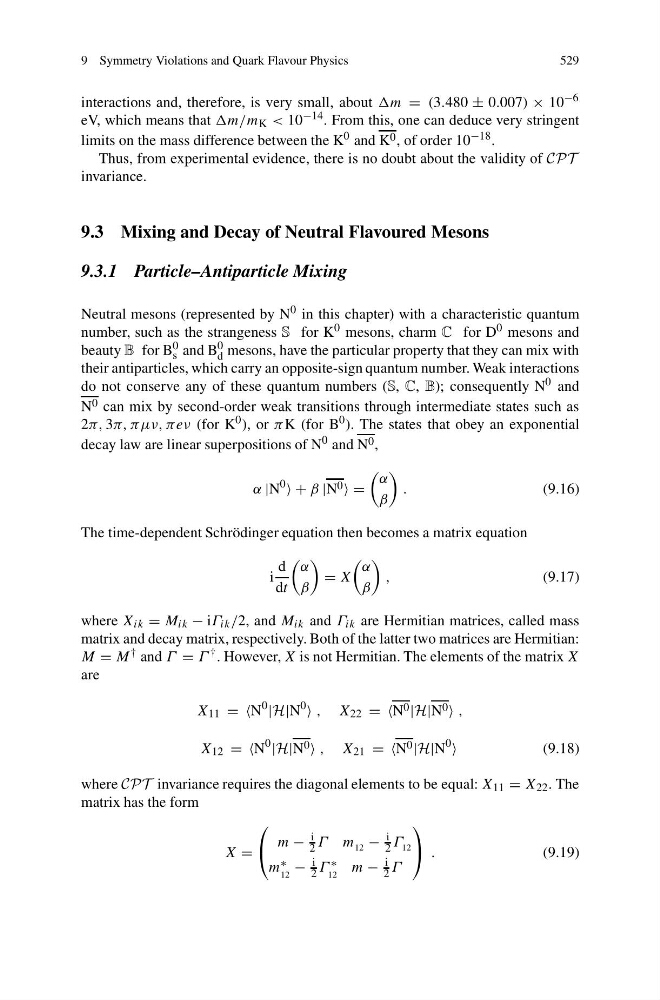
where CPT invariance requires the diagonal elements to be equal: X 11 = X 22 . The
matrix has the form
X =
⎛
⎝
m −
i
2 Γ m 12 −
i
2 Γ 12
m ∗
12
−
i
2 Γ ∗
12
m −
i
2 Γ
⎞
⎠ .
(9.19)
529
interactions and, therefore, is very small, about m = (3.480 ± 0.007) × 10 −6
eV, which means that K < 10 −14 . From this, one can deduce very stringent
limits on the mass difference between the K 0 and K 0 , of order 10 −18 .
Thus, from experimental evidence, there is no doubt about the validity of CPT
invariance.
9.3 Mixing and Decay of Neutral Flavoured Mesons
9.3.1 Particle–Antiparticle Mixing
Neutral mesons (represented by N 0 in this chapter) with a characteristic quantum
number, such as the strangeness S for K 0 mesons, charm C for D 0 mesons and
beauty B for B 0
s and B
0
d mesons, have the particular property that they can mix with
their antiparticles, which carry an opposite-sign quantum number. Weak interactions
do not conserve any of these quantum numbers (S, C, B); consequently N 0 and
N 0 can mix by second-order weak transitions through intermediate states such as
2π, 3π, πμν, πeν (for K 0 ), or πK (for B 0 ). The states that obey an exponential
decay law are linear superpositions of N 0 and N 0 ,
α |N
0
+ β |N 0 =
α
β
.
(9.16)
The time-dependent Schrödinger equation then becomes a matrix equation
i
d
dt
α
β
= X
α
β
,
(9.17)
where X ik = M ik − iΓ ik /2, and M ik and Γ ik are Hermitian matrices, called mass
matrix and decay matrix, respectively. Both of the latter two matrices are Hermitian:
M = M † and Γ = Γ † . However, X is not Hermitian. The elements of the matrix X
are
X 11 = =N
0
|H|N
0
, X 22 = =N 0 |H|N 0 ,
X 12 = =N
0
|H|N 0 , X 21 = =N 0 |H|N
0
(9.18)
where CPT invariance requires the diagonal elements to be equal: X 11 = X 22 . The
matrix has the form
X =
⎛
⎝
m −
i
2 Γ m 12 −
i
2 Γ 12
m ∗
12
−
i
2 Γ ∗
12
m −
i
2 Γ
⎞
⎠ .
(9.19)