

8 Beyond the Standard Model
481
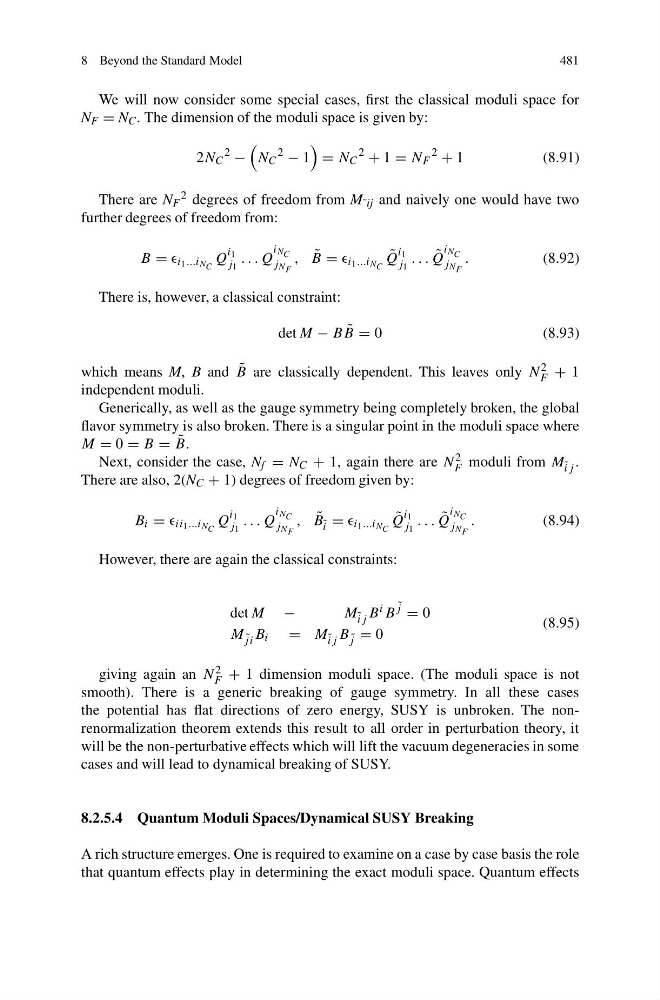
We will now consider some special cases, first the classical moduli space for
N F = N C . The dimension of the moduli space is given by:
2N C
2
−
N C
2
− 1
= N C
2
+ 1 = N F
2
+ 1
(8.91)
There are N F
2 degrees of freedom from M ˜ij and naively one would have two
further degrees of freedom from:
B = i 1 ...i N C Q
i 1
j 1
. . . Q
i N C
j N F
, ˜
B = i 1 ...i N C
˜
Q
i 1
j 1
. . . ˜
Q
i N C
j N F
.
(8.92)
There is, however, a classical constraint:
det M − B ˜
B = 0
(8.93)
which means M, B and ˜
B are classically dependent. This leaves only N 2
F + 1
independent moduli.
Generically, as well as the gauge symmetry being completely broken, the global
flavor symmetry is also broken. There is a singular point in the moduli space where
M = 0 = B = ˜
B.
Next, consider the case, N f = N C + 1, again there are N 2
F moduli from M ˜
ij .
There are also, 2(N C + 1) degrees of freedom given by:
B i = ii 1 ...i N C Q
i 1
j 1
. . . Q
i N C
j N F
, ˜
B ˜
i = i 1 ...i N C
˜
Q
i 1
j 1
. . . ˜
Q
i N C
j N F
.
(8.94)
However, there are again the classical constraints:
det M −
M ˜
ij B i B
˜
j = 0
M ˜
ji B i = M ˜
ij B ˜
j = 0
(8.95)
giving again an N 2
F + 1 dimension moduli space. (The moduli space is not
smooth). There is a generic breaking of gauge symmetry. In all these cases
the potential has flat directions of zero energy, SUSY is unbroken. The nonrenormalization theorem extends this result to all order in perturbation theory, it
will be the non-perturbative effects which will lift the vacuum degeneracies in some
cases and will lead to dynamical breaking of SUSY.
8.2.5.4 Quantum Moduli Spaces/Dynamical SUSY Breaking
A rich structure emerges. One is required to examine on a case by case basis the role
that quantum effects play in determining the exact moduli space. Quantum effects
481
We will now consider some special cases, first the classical moduli space for
N F = N C . The dimension of the moduli space is given by:
2N C
2
−
N C
2
− 1
= N C
2
+ 1 = N F
2
+ 1
(8.91)
There are N F
2 degrees of freedom from M ˜ij and naively one would have two
further degrees of freedom from:
B = i 1 ...i N C Q
i 1
j 1
. . . Q
i N C
j N F
, ˜
B = i 1 ...i N C
˜
Q
i 1
j 1
. . . ˜
Q
i N C
j N F
.
(8.92)
There is, however, a classical constraint:
det M − B ˜
B = 0
(8.93)
which means M, B and ˜
B are classically dependent. This leaves only N 2
F + 1
independent moduli.
Generically, as well as the gauge symmetry being completely broken, the global
flavor symmetry is also broken. There is a singular point in the moduli space where
M = 0 = B = ˜
B.
Next, consider the case, N f = N C + 1, again there are N 2
F moduli from M ˜
ij .
There are also, 2(N C + 1) degrees of freedom given by:
B i = ii 1 ...i N C Q
i 1
j 1
. . . Q
i N C
j N F
, ˜
B ˜
i = i 1 ...i N C
˜
Q
i 1
j 1
. . . ˜
Q
i N C
j N F
.
(8.94)
However, there are again the classical constraints:
det M −
M ˜
ij B i B
˜
j = 0
M ˜
ji B i = M ˜
ij B ˜
j = 0
(8.95)
giving again an N 2
F + 1 dimension moduli space. (The moduli space is not
smooth). There is a generic breaking of gauge symmetry. In all these cases
the potential has flat directions of zero energy, SUSY is unbroken. The nonrenormalization theorem extends this result to all order in perturbation theory, it
will be the non-perturbative effects which will lift the vacuum degeneracies in some
cases and will lead to dynamical breaking of SUSY.
8.2.5.4 Quantum Moduli Spaces/Dynamical SUSY Breaking
A rich structure emerges. One is required to examine on a case by case basis the role
that quantum effects play in determining the exact moduli space. Quantum effects