

482
E. Rabinovici
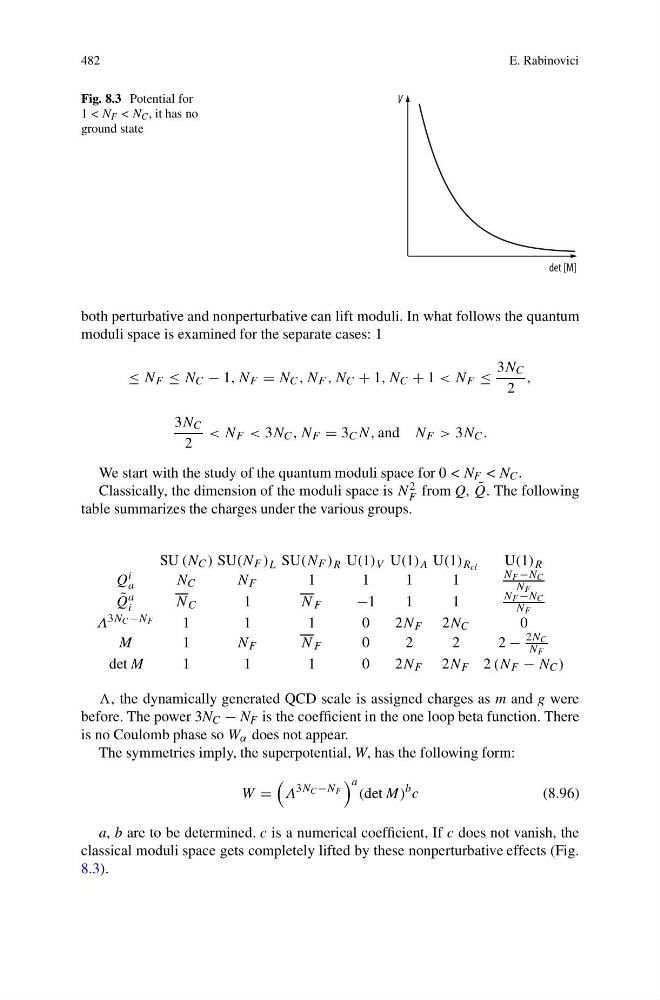
Fig. 8.3 Potential for
1 < N F < N C , it has no
ground state
V
det [M]
both perturbative and nonperturbative can lift moduli. In what follows the quantum
moduli space is examined for the separate cases: 1
≤ N F ≤ N C − 1, N F = N C , N F , N C + 1, N C + 1 < N F ≤
3N C
2
,
3N C
2
< N F < 3N C , N F = 3 C N, and N F > 3N C .
We start with the study of the quantum moduli space for 0 < N F < N C .
Classically, the dimension of the moduli space is N 2
F from Q, ˜
Q. The following
table summarizes the charges under the various groups.
SU (N C ) SU(N F ) L SU(N F ) R U(1) V U(1) A U(1) R cl
U(1) R
Q i
a
N C
N F
1
1
1
1
N F −N C
N F
˜
Q
a
i
N C
1
N F
−1
1
1
N F −N C
N F
Λ 3N C −N F
1
1
1
0
2 N F 2N C
0
M
1
N F
N F
0
2
2
2−
2N C
N F
det M
1
1
1
0
2 N F 2N F 2 (N F − N C )
, the dynamically generated QCD scale is assigned charges as m and g were
before. The power 3N C − N F is the coefficient in the one loop beta function. There
is no Coulomb phase so W α does not appear.
The symmetries imply, the superpotential, W, has the following form:
W =
Λ
3N C −N F
a
(det M)
b c
(8.96)
a, b are to be determined. c is a numerical coefficient, If c does not vanish, the
classical moduli space gets completely lifted by these nonperturbative effects (Fig.
8.3).
E. Rabinovici
Fig. 8.3 Potential for
1 < N F < N C , it has no
ground state
V
det [M]
both perturbative and nonperturbative can lift moduli. In what follows the quantum
moduli space is examined for the separate cases: 1
≤ N F ≤ N C − 1, N F = N C , N F , N C + 1, N C + 1 < N F ≤
3N C
2
,
3N C
2
< N F < 3N C , N F = 3 C N, and N F > 3N C .
We start with the study of the quantum moduli space for 0 < N F < N C .
Classically, the dimension of the moduli space is N 2
F from Q, ˜
Q. The following
table summarizes the charges under the various groups.
SU (N C ) SU(N F ) L SU(N F ) R U(1) V U(1) A U(1) R cl
U(1) R
Q i
a
N C
N F
1
1
1
1
N F −N C
N F
˜
Q
a
i
N C
1
N F
−1
1
1
N F −N C
N F
Λ 3N C −N F
1
1
1
0
2 N F 2N C
0
M
1
N F
N F
0
2
2
2−
2N C
N F
det M
1
1
1
0
2 N F 2N F 2 (N F − N C )
, the dynamically generated QCD scale is assigned charges as m and g were
before. The power 3N C − N F is the coefficient in the one loop beta function. There
is no Coulomb phase so W α does not appear.
The symmetries imply, the superpotential, W, has the following form:
W =
Λ
3N C −N F
a
(det M)
b c
(8.96)
a, b are to be determined. c is a numerical coefficient, If c does not vanish, the
classical moduli space gets completely lifted by these nonperturbative effects (Fig.
8.3).