

480
E. Rabinovici
This is for generic values of a i . By setting some subset of a i to zero one may break
to a subgroup of SU(N C ) that is larger than SU(N C − N F ). Also, if N F = N C − 1
then the gauge group is complete broken. This is called the Higgs phase.
The number of massless vector Bosons becomes
N C
2
−
(N C − N F )
2
− 1
= 2N C N F − N F
2 ,
(8.85)
the number of massless scalar fields becomes,
2N C N F −
2N C N F − N
2
F
= N
2
F .
(8.86)
The matrix
M ˜
ij ≡ ˜
Q ˜
i Q j
(8.87)
forms a gauge invariant basis. The Kahler potential is then,
K = 2Tr
MM
.
(8.88)
When singularities appear, i.e. detM = 0, it signals the presence of massless
particles as well as of enhanced symmetries.
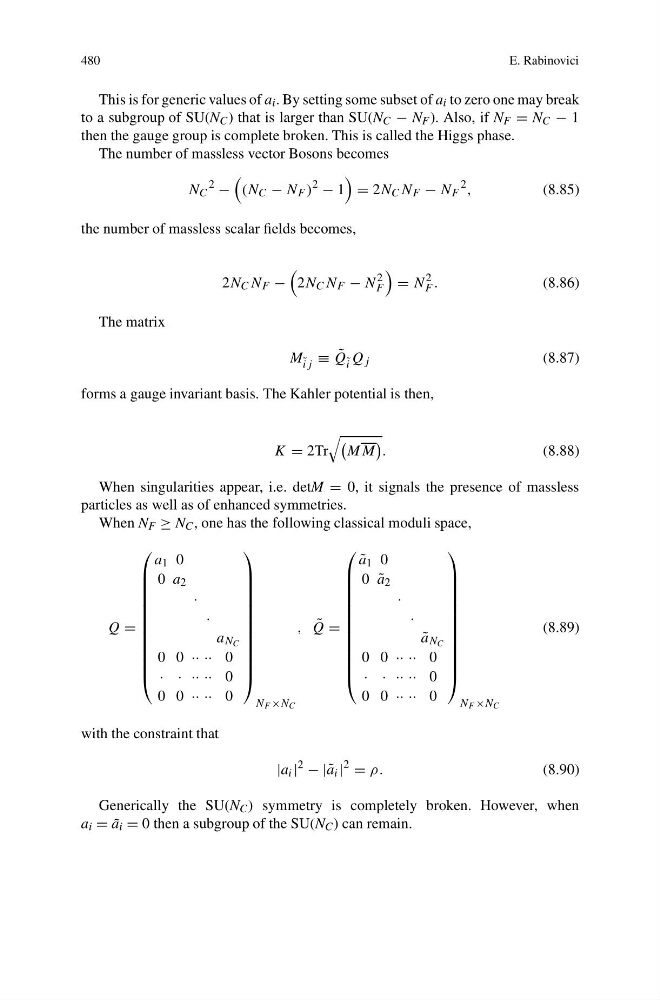
When N F ≥ N C , one has the following classical moduli space,
Q =
⎛
⎜
⎜
⎜
⎜
⎜
⎜
⎜
⎜
⎜
⎜
⎜
⎝
a 1 0
0 a 2
·
·
a N C
0 0 ·· ·· 0
· · ·· ·· 0
0 0 ·· ·· 0
⎞
⎟
⎟
⎟
⎟
⎟
⎟
⎟
⎟
⎟
⎟
⎟
⎠
N F ×N C
, ˜
Q =
⎛
⎜
⎜
⎜
⎜
⎜
⎜
⎜
⎜
⎜
⎜
⎜
⎝
˜
a 1 0
0 ˜
a 2
·
·
˜
a N C
0 0 ·· ·· 0
· · ·· ·· 0
0 0 ·· ·· 0
⎞
⎟
⎟
⎟
⎟
⎟
⎟
⎟
⎟
⎟
⎟
⎟
⎠
N F ×N C
(8.89)
with the constraint that
|a i |
2
− | ˜
a i |
2
= ρ.
(8.90)
Generically the SU(N C ) symmetry is completely broken. However, when
a i = ã i = 0 then a subgroup of the SU(N C ) can remain.
E. Rabinovici
This is for generic values of a i . By setting some subset of a i to zero one may break
to a subgroup of SU(N C ) that is larger than SU(N C − N F ). Also, if N F = N C − 1
then the gauge group is complete broken. This is called the Higgs phase.
The number of massless vector Bosons becomes
N C
2
−
(N C − N F )
2
− 1
= 2N C N F − N F
2 ,
(8.85)
the number of massless scalar fields becomes,
2N C N F −
2N C N F − N
2
F
= N
2
F .
(8.86)
The matrix
M ˜
ij ≡ ˜
Q ˜
i Q j
(8.87)
forms a gauge invariant basis. The Kahler potential is then,
K = 2Tr
MM
.
(8.88)
When singularities appear, i.e. detM = 0, it signals the presence of massless
particles as well as of enhanced symmetries.
When N F ≥ N C , one has the following classical moduli space,
Q =
⎛
⎜
⎜
⎜
⎜
⎜
⎜
⎜
⎜
⎜
⎜
⎜
⎝
a 1 0
0 a 2
·
·
a N C
0 0 ·· ·· 0
· · ·· ·· 0
0 0 ·· ·· 0
⎞
⎟
⎟
⎟
⎟
⎟
⎟
⎟
⎟
⎟
⎟
⎟
⎠
N F ×N C
, ˜
Q =
⎛
⎜
⎜
⎜
⎜
⎜
⎜
⎜
⎜
⎜
⎜
⎜
⎝
˜
a 1 0
0 ˜
a 2
·
·
˜
a N C
0 0 ·· ·· 0
· · ·· ·· 0
0 0 ·· ·· 0
⎞
⎟
⎟
⎟
⎟
⎟
⎟
⎟
⎟
⎟
⎟
⎟
⎠
N F ×N C
(8.89)
with the constraint that
|a i |
2
− | ˜
a i |
2
= ρ.
(8.90)
Generically the SU(N C ) symmetry is completely broken. However, when
a i = ã i = 0 then a subgroup of the SU(N C ) can remain.