

8 Beyond the Standard Model
473
The first term is the F-term and the second is the D-term. Both these terms need
to vanish for supersymmetry to remain unbroken.
Some remarks about this potential are in order:
Generically, the F-terms should vanish since there are indeed n equations for
n unknowns. If < ϕ i > = 0, that is if the U(1) is not spontaneously broken then
supersymmetry is broken if and only if K F. I. = 0. When K = 0 and the F-terms have
a vanishing solution then so will the D-term and there will be no supersymmetry
breaking.
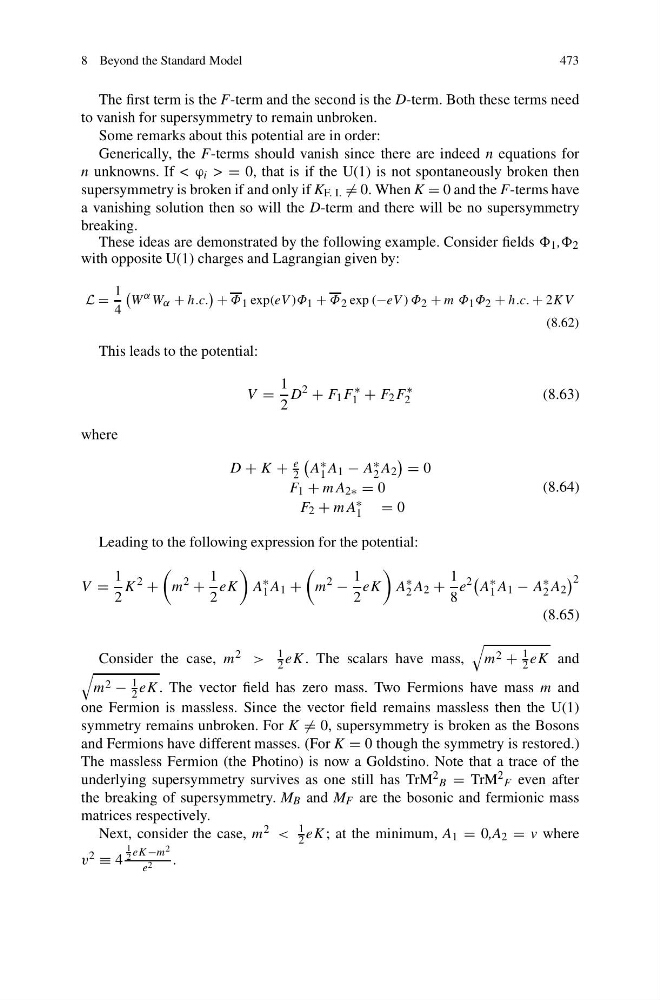
These ideas are demonstrated by the following example. Consider fields 1 , 2
with opposite U(1) charges and Lagrangian given by:
L =
1
4
W α W α + h.c.
+ Φ 1 exp(eV )Φ 1 + Φ 2 exp (−eV ) Φ 2 + m Φ 1 Φ 2 + h.c. + 2KV
(8.62)
This leads to the potential:
V =
1
2
D
2
+ F 1 F
∗
1 + F 2 F
∗
2
(8.63)
where
D + K +
e
2
A ∗
1 A 1 − A ∗
2 A 2
= 0
F 1 + mA 2∗ = 0
F 2 + mA ∗
1
= 0
(8.64)
Leading to the following expression for the potential:
V =
1
2
K
2
+
m
2
+
1
2
eK
A
∗
1 A 1 +
m
2
−
1
2
eK
A
∗
2 A 2 +
1
8
e
2
A
∗
1 A 1 − A
∗
2 A 2
2
(8.65)
Consider the case, m 2 >
1
2 eK. The scalars have mass,
m 2 +
1
2 eK and
m 2 −
1
2 eK. The vector field has zero mass. Two Fermions have mass m and
one Fermion is massless. Since the vector field remains massless then the U(1)
symmetry remains unbroken. For K = 0, supersymmetry is broken as the Bosons
and Fermions have different masses. (For K = 0 though the symmetry is restored.)
The massless Fermion (the Photino) is now a Goldstino. Note that a trace of the
underlying supersymmetry survives as one still has TrM 2 B = TrM 2 F even after
the breaking of supersymmetry. M B and M F are the bosonic and fermionic mass
matrices respectively.
Next, consider the case, m 2 <
1
2 eK; at the minimum, A 1 = 0,A 2 = v where
v 2 ≡ 4
1
2 eK−m 2
e 2
.
473
The first term is the F-term and the second is the D-term. Both these terms need
to vanish for supersymmetry to remain unbroken.
Some remarks about this potential are in order:
Generically, the F-terms should vanish since there are indeed n equations for
n unknowns. If < ϕ i > = 0, that is if the U(1) is not spontaneously broken then
supersymmetry is broken if and only if K F. I. = 0. When K = 0 and the F-terms have
a vanishing solution then so will the D-term and there will be no supersymmetry
breaking.
These ideas are demonstrated by the following example. Consider fields 1 , 2
with opposite U(1) charges and Lagrangian given by:
L =
1
4
W α W α + h.c.
+ Φ 1 exp(eV )Φ 1 + Φ 2 exp (−eV ) Φ 2 + m Φ 1 Φ 2 + h.c. + 2KV
(8.62)
This leads to the potential:
V =
1
2
D
2
+ F 1 F
∗
1 + F 2 F
∗
2
(8.63)
where
D + K +
e
2
A ∗
1 A 1 − A ∗
2 A 2
= 0
F 1 + mA 2∗ = 0
F 2 + mA ∗
1
= 0
(8.64)
Leading to the following expression for the potential:
V =
1
2
K
2
+
m
2
+
1
2
eK
A
∗
1 A 1 +
m
2
−
1
2
eK
A
∗
2 A 2 +
1
8
e
2
A
∗
1 A 1 − A
∗
2 A 2
2
(8.65)
Consider the case, m 2 >
1
2 eK. The scalars have mass,
m 2 +
1
2 eK and
m 2 −
1
2 eK. The vector field has zero mass. Two Fermions have mass m and
one Fermion is massless. Since the vector field remains massless then the U(1)
symmetry remains unbroken. For K = 0, supersymmetry is broken as the Bosons
and Fermions have different masses. (For K = 0 though the symmetry is restored.)
The massless Fermion (the Photino) is now a Goldstino. Note that a trace of the
underlying supersymmetry survives as one still has TrM 2 B = TrM 2 F even after
the breaking of supersymmetry. M B and M F are the bosonic and fermionic mass
matrices respectively.
Next, consider the case, m 2 <
1
2 eK; at the minimum, A 1 = 0,A 2 = v where
v 2 ≡ 4
1
2 eK−m 2
e 2
.