

472
E. Rabinovici
prove that supersymmetry cannot be broken spontaneouly at all. Supersymmetry
resisted breaking attmepts for both theories of scalars and gauge theories. One could
be surprised that the breaking was first achieved in the gauge systems. This was done
by Fayet and Illiopoulos. The presence in the collaboration of a student who paid
little respect to the general counter arguements made the discovery possible. Fayet
went on to discover the breaking mechanism also in supersymmetric scalar theories
as did O’Raighfeartaigh.
We will describe four examples of mechanisms of breaking Super Symmetry.
The first will be for theories not containing gauge particles. The second for systems
containing gauge particles, the third is of a dynamical breaking of Super Symmetry
and the fourth occurs if our universe happens to be in a long lived metastable vacuum
of positive kinetic energy.
8.2.4.2 SUSY Breaking in Theories with Scalars and Spin One Half
Particles by F Terms
The Fayet-O’Raifeartaigh potential contains three fields this is the minimal number
needed in order to break supersymmetry. It is:
L Potential = λΦ 0 + mΦ 1 Φ 2 + gΦ 0 Φ 1 Φ 1 + h.c.
(8.59)
Minimizing the potential leads to the following equations:
0
=
λ + gΦ 1 Φ 1
0
=
mΦ 2 + 2gΦ 0 Φ 1
0
=
mΦ 1
(8.60)
These cannot be consistently solved so there cannot be a zero energy ground state
and supersymmetry must be spontaneously broken. To find the ground state one
must write out the full Lagrangian including the kinetic terms in component fields
and then minimize. Doing so one discovers that in the ground state A 1 = A 2 = 0
and A 0 is arbitrary. The arbitrariness of A 0 is a flat direction in the potential, the
field along the flat direction is called a moduli. Computing the masses by examining
the quadratic terms for component fields gives the following spectrum: the six real
scalars have masses: 0,0,m 2 m 2 ,m 2 ± 2gλ; and the Fermions have masses: 0,2 m.
The zero mass Fermion is the Goldstino. We turn next to breaking of supersymmetry
theories that are gauge invariant.
8.2.4.3 SUSY Breaking in Supersymmetric Gauge Theories
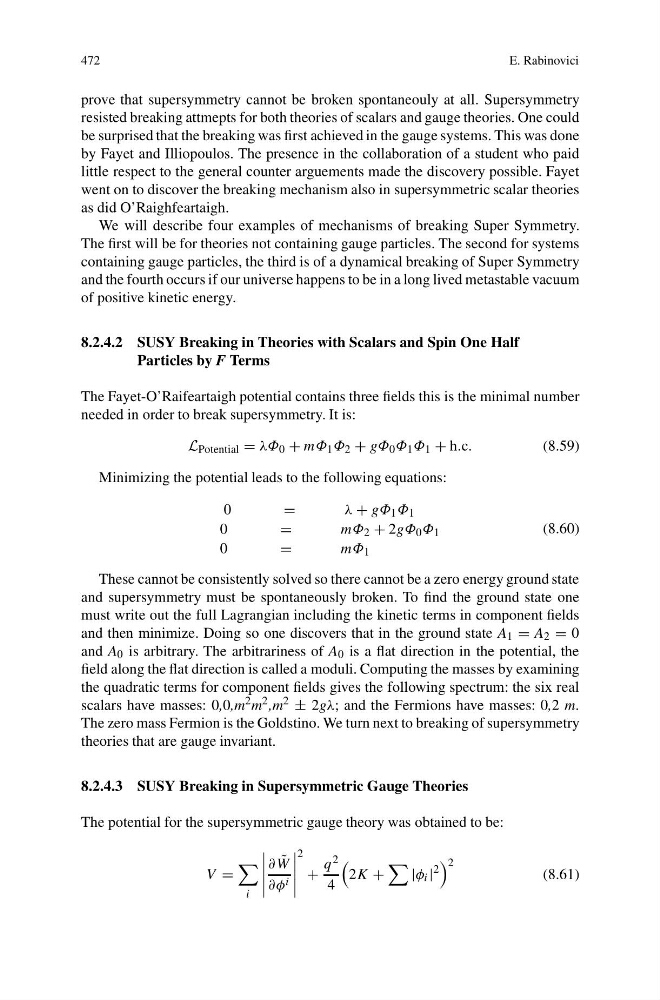
The potential for the supersymmetric gauge theory was obtained to be:
V =
i
∂ ˜
W
∂φ i
2
+
q 2
4
2K +
|φ i |
2
2
(8.61)
E. Rabinovici
prove that supersymmetry cannot be broken spontaneouly at all. Supersymmetry
resisted breaking attmepts for both theories of scalars and gauge theories. One could
be surprised that the breaking was first achieved in the gauge systems. This was done
by Fayet and Illiopoulos. The presence in the collaboration of a student who paid
little respect to the general counter arguements made the discovery possible. Fayet
went on to discover the breaking mechanism also in supersymmetric scalar theories
as did O’Raighfeartaigh.
We will describe four examples of mechanisms of breaking Super Symmetry.
The first will be for theories not containing gauge particles. The second for systems
containing gauge particles, the third is of a dynamical breaking of Super Symmetry
and the fourth occurs if our universe happens to be in a long lived metastable vacuum
of positive kinetic energy.
8.2.4.2 SUSY Breaking in Theories with Scalars and Spin One Half
Particles by F Terms
The Fayet-O’Raifeartaigh potential contains three fields this is the minimal number
needed in order to break supersymmetry. It is:
L Potential = λΦ 0 + mΦ 1 Φ 2 + gΦ 0 Φ 1 Φ 1 + h.c.
(8.59)
Minimizing the potential leads to the following equations:
0
=
λ + gΦ 1 Φ 1
0
=
mΦ 2 + 2gΦ 0 Φ 1
0
=
mΦ 1
(8.60)
These cannot be consistently solved so there cannot be a zero energy ground state
and supersymmetry must be spontaneously broken. To find the ground state one
must write out the full Lagrangian including the kinetic terms in component fields
and then minimize. Doing so one discovers that in the ground state A 1 = A 2 = 0
and A 0 is arbitrary. The arbitrariness of A 0 is a flat direction in the potential, the
field along the flat direction is called a moduli. Computing the masses by examining
the quadratic terms for component fields gives the following spectrum: the six real
scalars have masses: 0,0,m 2 m 2 ,m 2 ± 2gλ; and the Fermions have masses: 0,2 m.
The zero mass Fermion is the Goldstino. We turn next to breaking of supersymmetry
theories that are gauge invariant.
8.2.4.3 SUSY Breaking in Supersymmetric Gauge Theories
The potential for the supersymmetric gauge theory was obtained to be:
V =
i
∂ ˜
W
∂φ i
2
+
q 2
4
2K +
|φ i |
2
2
(8.61)